Welcome back! In our last session, you built a powerful toolkit for discovering open-source AI projects that match your full-stack skills. You learned to navigate the ecosystem using curated lists and advanced GitHub searches, culminating in a shortlist of 3-5 promising repositories.
Now that you have your targets, it's time for the due diligence phase. Choosing where to invest your valuable time is a critical decision. A project might look exciting on the surface, but if it's inactive or has an unwelcoming community, your contribution efforts can lead to frustration. Today, you will learn to be a repository detective. We will focus on how to evaluate a repository's health and contributor-friendliness by analyzing its activity metrics, issue tracker, and pull request history. By the end of this lesson, you'll have a systematic framework to analyze your shortlisted projects and confidently select the one that offers the best chance for a successful contribution.
1. The Anatomy of a Healthy Repository
Think of evaluating a repository like a check-up. We need to look at two main things: the project's "vital signs" (is it alive and active?) and its "community culture" (is it a place you want to spend your time?).
- Vital Signs (Activity Metrics): These are the quantitative indicators that a project is being actively developed and maintained. This includes commit frequency, release cadence, and the flow of issues and pull requests.
- Community Culture (Contributor-Friendliness): These are the qualitative signals that a project is welcoming, supportive, and well-organized. This is revealed in its documentation, communication tone, and the clarity of its contribution process.
The dashboards below show how maintainers often visualize these metrics to keep a pulse on their projects. You'll learn to spot these patterns yourself by exploring a repository's public data.

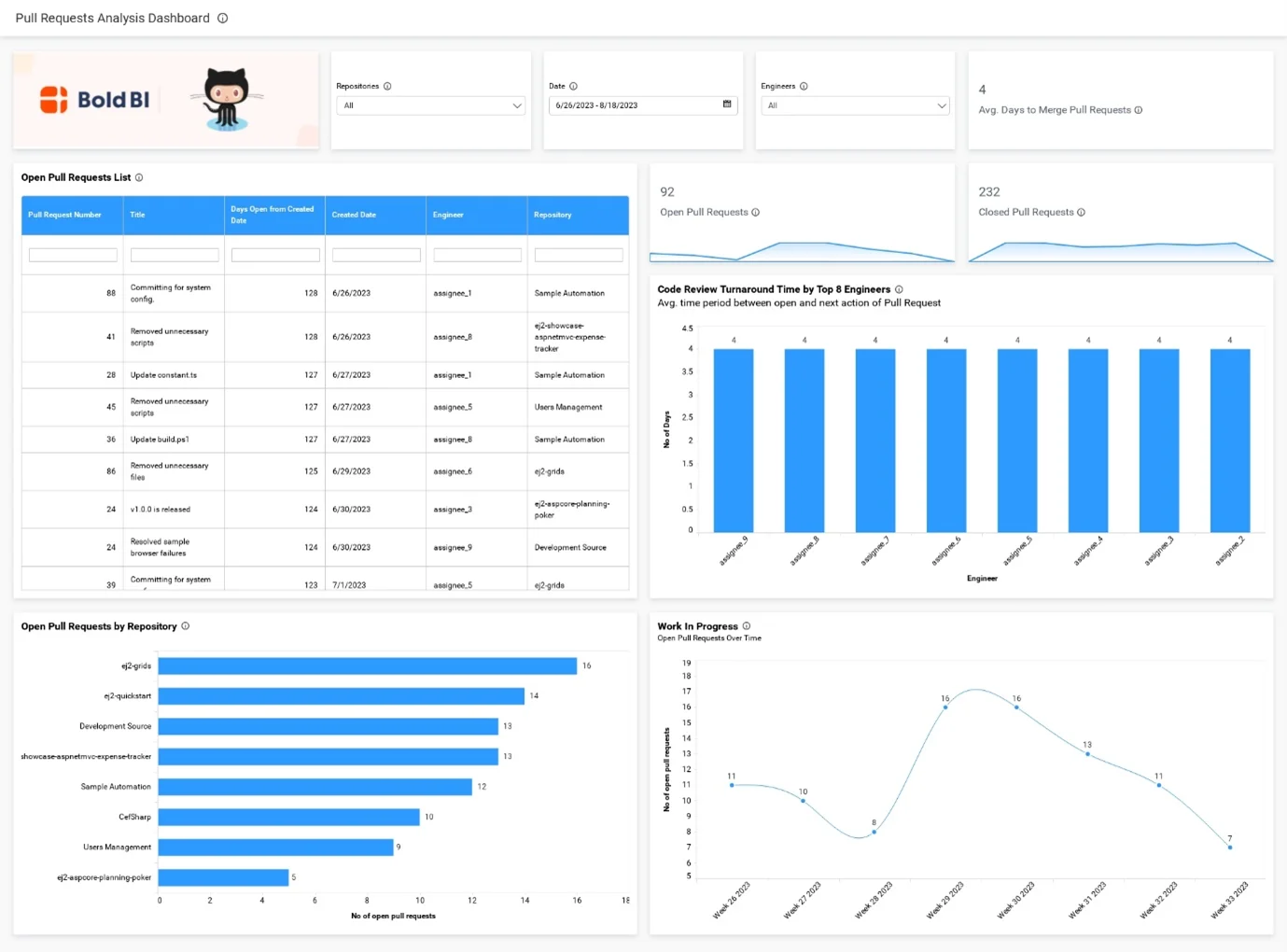
2. Reading the Vital Signs: A Contributor's Checklist
Before you commit to a project, you need to verify it's a living, breathing entity. An abandoned project is a dead end for contributions. The rOpenSci organization has an excellent guide on this, written for potential contributors like you.
rOpenSci | Evaluating GitHub Activity for Contributors
This article from rOpenSci provides a practical, step-by-step framework for assessing a repository's activity level. It helps you manage your expectations about how quickly your contribution might be reviewed.
Please read the following sections to build your evaluation checklist: Start with the simplest check: Is it archived? An archived repo is read-only. Review the guidance on reading contribution files. The existence and quality of CONTRIBUTING.md is a strong signal. Learn to assess code activity. This covers checking the latest commit date, branch activity, and release history. Understand how to evaluate user support activity. This is about checking how responsive maintainers are to new issues and PRs. Finally, check the project's technical health by looking at CI status. A sea of red, failing checks is a warning sign. As you read, think of this as a checklist you can run through for each repository on your shortlist.
The freeCodeCamp video below provides a great visual walkthrough of where to find this information on the GitHub UI.
Complete Guide to Open Source - How to Contribute
This video offers a guided tour of a GitHub repository page, pointing out the key areas for a potential contributor.
Watch the segment from the last commit. The presenter demonstrates how to check the recency of commits and browse the entire commit history to gauge the project's development rhythm. This is a direct application of the "look at latest code activity" point from the article.
3. Gauging the Culture: Is the Project Truly "Open"?
An active project isn't necessarily a friendly one. The community's culture determines whether your contribution experience will be collaborative and educational or difficult and discouraging. This is where you need to read between the lines of code.
Documentation and Onboarding
Good documentation is a sign of respect for a new contributor's time. It shows the maintainers have invested in making their project accessible.
How to get more GitHub Repo STARS (Open Source)
In this video, Eddie Jaoude explains what makes a repository attractive to contributors. While the video is aimed at maintainers, it provides you with a perfect set of criteria to judge a project by.
Pay close attention to these three points: Clarity: Watch the segments on the description and screenshot. Does the README quickly and clearly tell you what the project does? Onboarding: The section on the quick-start guide and documentation is critical. Can you easily figure out how to set up the project locally? A difficult setup is a major barrier. Guidance: Finally, watch the part about community standards and issues. This highlights the importance of CONTRIBUTING.md, CODE_OF_CONDUCT.md, and well-defined good first issue labels. A project that uses these well is actively trying to help you succeed.
Communication: The Ultimate Litmus Test
How maintainers and contributors talk to each other is the most important signal of a project's health. You're looking for a professional, constructive, and appreciative tone. The best way to assess this is to observe past conversations.
The freeCodeCamp video has two more clips that are incredibly insightful here.
Complete Guide to Open Source - How to Contribute
This video provides a masterclass in how to analyze the social dynamics of a project through its issues and pull requests.
First, watch the section on the Issues tab. Learn how to filter by labels like good first issue and observe the discussions happening within the tickets. Next, watch what I consider to be the single most important tip for evaluating a project: check closed issues and pull requests. This tells you how the project treats contributions, especially those it doesn't accept. A polite explanation is a green flag; a silent close is a red flag.
4. A Data-Driven Model for Evaluation: repo-health
Fittingly, there's an open-source, full-stack AI project dedicated to exactly what we're discussing: analyzing repository health. The project, repo-health, is a perfect case study for you. It not only demonstrates the principles of evaluation but also serves as an example of the exact type of project you're looking for, using a modern stack (Next.js, tRPC, Vercel AI SDK).
Let's study its README to see how it operationalizes repository analysis.
This repository's README file is a blueprint for data-driven repository analysis. We'll use it as a mental model for your own evaluation process.
As you review these sections, note how the author quantifies contributor-friendliness. First, look at the Tech Stack and Project Structure. This should feel familiar given your background and shows how a complex full-stack AI app is organized. Next, study the PR Analytics table under the PR Analytics section. Pay attention to metrics like "Merge Time" and "Author Breakdown." When you look at a project, ask yourself: do PRs from the community get merged, and how long do they wait? Finally, dive into the Issue Analytics section, specifically the tables and algorithm. The concept of a "Crackability Score" is brilliant. It formalizes what you should be looking for: issues that are well-labeled (good first issue), concise, recent, and have community interest (reactions).
5. Your Task: Conduct the Health Check
Now it's time to apply this framework. Take the shortlist of 3-5 projects you created in the last lesson and perform a health check on each one. For each repository, create a small report in your notes answering the following questions. Be a detective and gather the evidence.
Repository Health Check Template:
- Repository URL: [Link]
- Vital Signs:
- Last Commit: (e.g., "3 hours ago", "5 months ago")
- Release Cadence: (e.g., "Regular, every 2-3 weeks", "Sporadic, last one was a year ago")
- Issue Status: Are there a manageable number of open issues? Are they being actively discussed?
- PR Status: What is the ratio of open to merged PRs? Look at a few community PRs—did they get reviewed and merged in a reasonable time (days/weeks vs. months/never)?
- Contributor Friendliness:
- Core Documents: Does it have a clear
README, a helpfulCONTRIBUTING.md, and aCODE_OF_CONDUCT.md? - Communication Tone: Read 2-3 closed, community-submitted PRs. Was the feedback constructive and the closure polite?
- "Good First Issues": Are
good first issuelabels used? If so, are the issues well-described with clear instructions, or are they vague?
- Core Documents: Does it have a clear
- The Verdict: Based on your analysis, give a one-sentence summary and a score from 1 (avoid) to 5 (ideal candidate).
- Example: "Highly active project with a friendly community, but the 'good first issues' are complex. Score: 4/5"
Your goal is to use this analysis to select the single best repository from your shortlist. This will be the project you focus on for the remainder of our course.
Conclusion
You now have a comprehensive framework for vetting open-source projects, moving beyond surface-level impressions to a deep analysis of a repository's activity and culture. You've learned to read a project's vital signs from its commit and release history, and to gauge its community health by scrutinizing its documentation and communication patterns. This analytical process is your best defense against investing time in a project that won't value your contribution.
Key Takeaways:
- A great project for a new contributor is both active (healthy vital signs) and welcoming (positive community culture).
- Analyze quantitative metrics like commit frequency, release cadence, and PR merge times to assess activity.
- Evaluate qualitative signals like documentation quality, communication tone in issues, and the handling of closed PRs to assess contributor-friendliness.
- Use a structured approach, like the "Crackability Score" concept, to find issues that are genuinely approachable.
In our next lesson, we will zoom in on the project you've selected. You will learn how to select a 'good first issue' and deconstruct its requirements to create a detailed implementation plan, setting the stage for you to start writing code.