Hello. Last time, you saw how a mortgage rate, deposit rule or lending limit can change a buyer’s maximum bid even when their income stays the same. This lesson changes income instead. Keeping mortgage conditions and housing supply fixed lets us ask a narrower question: why might higher household income increase demand for homes, and when might it fail to raise a particular buyer’s bid?
Allow roughly 35–40 minutes for the reading, short video and worked example. The aim is to explain a possible demand effect, not to predict the next house-price figure.
Income affects what buyers can and will pay
Housing demand means more than wanting a home. To bid for one, a household needs both the willingness and the financial capacity to buy at a particular price. Higher income can increase that capacity: after meeting other expenses, a household may be able to support a larger mortgage payment, save a deposit more readily or consider homes it previously ruled out. It may also choose to spend some of its additional income on more space or a different type of home.
The Institute for Fiscal Studies places income alongside other drivers of housing demand. Read its account before we isolate income in the example below.
Housing: Trends in Prices, Costs and Tenure - IFS
Read the Institute for Fiscal Studies’ account of the factors affecting housing demand. It distinguishes income from mortgage credit and other influences that can change at the same time in a real market.
Find Box 2.1, “What determines house prices?”, around printed p. 5. Start with its opening sentence, beginning “The price of housing should reflect the balance of demand and supply”. Read the demand discussion, stopping after the sentence about easier access to mortgage credit. Focus on why the authors mention current and expected real income, and keep their other demand drivers distinct from income.
Real income concerns purchasing power, rather than the number of pounds on a payslip. If pay rises but everyday costs rise just as fast, the household may have little additional room to spend on housing. Expected income matters too: a household uncertain about its future earnings may hesitate to take on a larger long-term payment, even if its current income has risen.
For this lesson’s comparison, imagine income rises while mortgage rates, lending rules, the availability of homes and other relevant conditions remain unchanged. Holding those conditions fixed does not claim that they stay fixed in practice. It lets us identify what the income change could do without accidentally crediting income for the effect of a simultaneous rate cut.
A change in income is a shift in demand
Think of a demand curve as showing how many homes buyers would seek at each possible price, with income and other conditions held constant. If the price of a comparable home falls while income stays fixed, buyers respond to a different price on the same demand curve. If income rises while we compare buyers at the same home price, demand itself may change.
This short Khan Academy video uses other products to show that distinction. The relevant principle applies to owner-occupied housing: for many households, higher income increases the quantity of housing they are willing and able to seek at a given price.
Normal and inferior goods | Supply, demand, and market equilibrium | Microeconomics | Khan Academy
Watch Khan Academy’s “Normal and inferior goods” for a visual account of how income can shift a demand curve, rather than cause movement along it.
Watch the initial curves for the meaning of price and quantity on the axes. Then watch the income shift: notice that the comparison holds price fixed while the quantity demanded changes. Stop before the discussion of inferior goods.
The diagram below depicts that comparison. At a price of 6 on its vertical axis, for example, the quantity demanded is 3 on and 5 on . These are illustrative units, not measurements of UK homes.
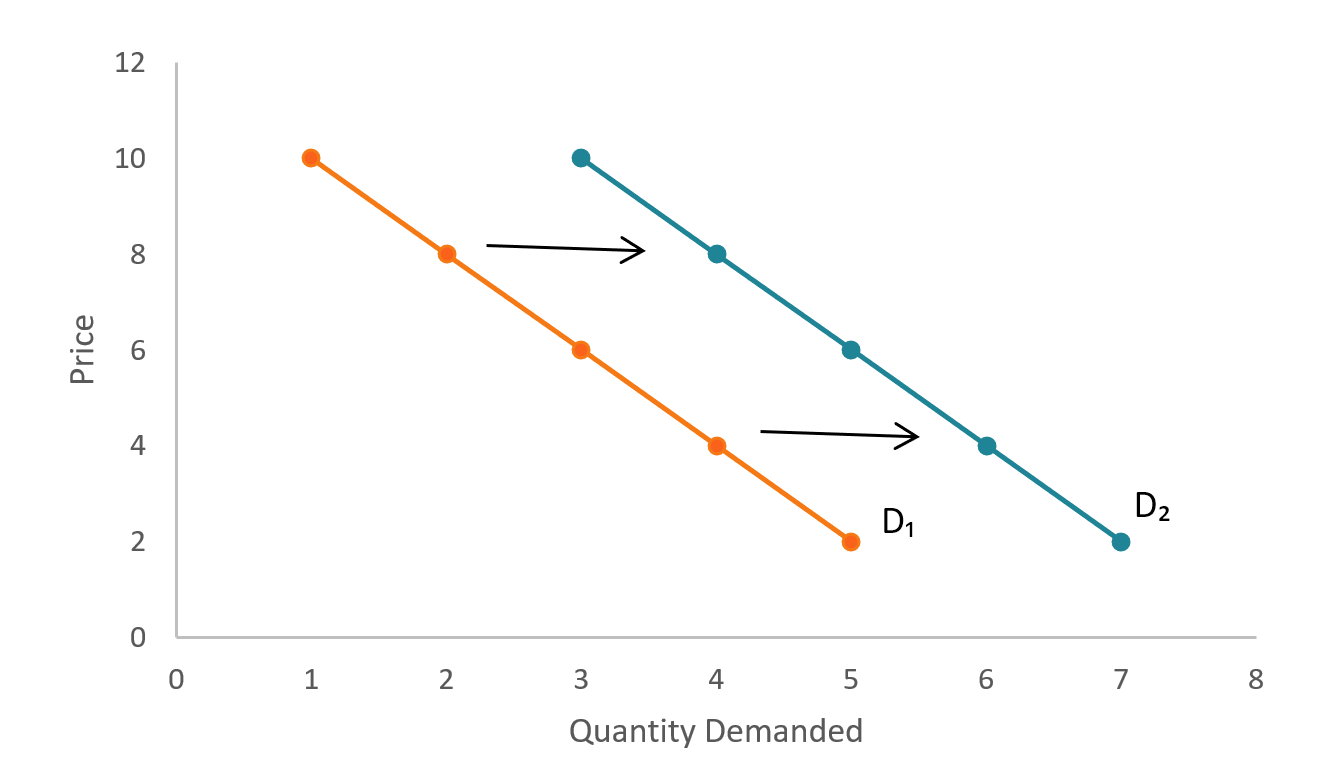
For housing, a rightward shift might mean that some renters can now afford to buy, or that existing owners seek a larger home. It does not mean every household buys an additional property. Nor does “greater quantity demanded at a given price” mean that the same number of additional homes will actually be sold: sales require available homes and willing sellers. The diagram describes buyers’ side of the market.
Carry the previous buyer through an income rise
Return to the previous lesson’s illustrative buyer. They had £50,000 annual income, £30,000 available for a deposit, a £1,050 monthly mortgage-payment ceiling and a maximum bid of about £229,000. The mortgage assumptions were a 4% rate over 25 years, a loan limit of four times annual income and a maximum 90% loan-to-value ratio.
Now suppose annual income rises to £60,000. Keep the £30,000 deposit, interest rate, term, lending multiple and LTV rule unchanged. Suppose also that, after other spending is considered, the higher income allows a £1,200 monthly mortgage-payment ceiling. That last figure is an assumption about this household’s budget and affordability assessment, not a rule that every 20% pay rise raises an approved payment by a particular amount.
At the unchanged rate and term, each £100,000 borrowed still costs about £528 a month. The new payment ceiling supports a loan of approximately:
The unchanged four-times-income rule now permits up to £240,000 of borrowing. The payment ceiling remains tighter. With the £30,000 deposit, the illustrative maximum bid rises from about £229,000 to £257,000. A £227,000 loan on a £257,000 purchase is about 88% of the price, within the unchanged 90% LTV limit.
Consider a home priced at £240,000 throughout. Buying it with the £30,000 deposit requires a £210,000 mortgage. Before the income rise, that exceeded both the buyer’s roughly £199,000 payment-based loan ceiling and the £200,000 income-based limit. Under the new assumed payment budget, £210,000 fits beneath both limits. At the same house price and mortgage terms, this buyer has become able to bid. If enough households experience a similar change, demand at that price can increase.
There is an important qualification. An income rise does not automatically increase a buyer’s maximum bid. If the £1,050 payment ceiling in this example did not rise, it would still restrict the loan to about £199,000, despite the higher income-based loan limit. A shortage of deposit cash could likewise remain the binding constraint. The effect depends on which limit actually restricts the buyer.
From one buyer to a market headline
A market-wide rise in household income can bring more buyers into contention or increase some buyers’ bids. Holding the homes available for sale fixed, stronger demand would tend to put upward pressure on prices. That is a conditional explanation, not a claim that a particular income rise must produce a particular percentage change in house prices. Income gains may be unevenly distributed, and households differ in deposits, existing housing costs and confidence about future earnings.
The historical chart below is a useful check on a different possible mistake: income growth and house-price growth are not the same series.
The lines show that incomes rose while house prices rose substantially faster. That does not contradict the idea that higher income can increase housing demand. It shows why income alone cannot explain the size of the observed price movement. Mortgage conditions, other sources of demand and the supply of homes may also matter. Because several influences changed during those years, the chart cannot tell us how far prices would have moved if only income had changed.
Keep three distinctions in mind when reading an income-based explanation of a price headline:
- Nominal versus real income: higher pay in pounds may not mean much greater purchasing power after inflation.
- One buyer versus the market: a changed bid ceiling illustrates a mechanism; it does not reveal how many other buyers face the same change.
- Demand versus sale price: stronger demand can put pressure on prices, but a completed sale also depends on the homes offered and the terms sellers accept.
Closing perspective
Holding mortgage conditions and housing supply constant, a rise in household income can increase housing demand because some buyers can afford to bid for homes they previously could not, while others may seek different or more expensive housing. On a demand diagram, that is a change in the quantity sought at a given price, not a price change along an unchanged demand curve. The effect is strongest where additional income relaxes a constraint that was actually binding; it is weaker or absent for a buyer still blocked by a payment or deposit limit.
The next lesson examines the other side of that conditional statement: why the price response to stronger demand depends on the homes available for sale now and the ability to add housing over time.