Welcome back. The previous lesson separated a house price’s change in pounds from its change after inflation. This lesson turns to a different kind of purchasing power: how much a buyer can bid with a given deposit, income and mortgage offer. A house can become harder to buy even if its advertised price does not change.
The worked example below holds the buyer’s income and available cash constant while changing one borrowing condition at a time. Its figures are illustrative, not an estimate of what any particular lender would offer. Allow about 40 minutes to follow the readings, video and calculations.
Three constraints on one bid
A buyer usually combines a cash deposit with a mortgage. If is the purchase price, is the deposit used and is the loan, then:
It is tempting to calculate a loan from income alone and add the deposit. A lender may also restrict the loan because of the proposed monthly payment or the share of the property’s value being borrowed. The tightest applicable constraint determines the maximum bid under a given set of assumptions.
The Financial Conduct Authority describes the checks behind this distinction. Its discussion paper is about mortgage rules rather than a promise that every lender applies one identical formula.
DP25/2: Mortgage Rule Review: the future of the mortgage market
Read the Financial Conduct Authority's account of affordability and lender standards to see why a simple income multiple is not the whole lending decision.
In "What our affordable lending rules currently require", read paragraphs 2.7–2.8, from the affordability rules. Focus on verified income, expenditure and when a lender must consider potential rate rises. Then, under "Lender standards", read paragraph 2.10 from lender standards. Distinguish loan-to-income from loan-to-value as you read.
Loan-to-income, or LTI, compares the mortgage with annual income. A hypothetical limit of four times a £50,000 annual income would cap the loan at £200,000; it would not cap the house price at £200,000. Loan-to-value, or LTV, compares the mortgage with the property price. A £180,000 loan on a £200,000 purchase has a 90% LTV because the other £20,000 is the deposit.
Watch the first part of this short explanation for the deposit–LTV relationship. Mortgage rates can differ across LTV bands, although LTV is not the only factor affecting the rate offered.
Martin Lewis: First-time buyers – the single biggest factor that’ll affect your mortgage rate
Watch “Martin Lewis: First-time buyers – the single biggest factor that’ll affect your mortgage rate” for its concrete definition of LTV and explanation of rate bands.
In the LTV example, follow how a £10,000 deposit on a £100,000 purchase produces a £90,000 loan and 90% LTV. In rate bands, note that a larger deposit can sometimes qualify a borrower for a different mortgage rate. Treat the bands discussed as examples, not permanent offers.
Establishing the starting bid
Suppose a buyer has £35,000 in savings but sets aside £5,000 for purchase costs and a cash reserve. That leaves £30,000 available as a deposit. Assume annual income of £50,000 and, after considering other spending, a maximum mortgage payment of £1,050 a month. For this illustration, a lender also offers:
- a 25-year repayment mortgage at a fixed illustrative rate of 4%;
- a maximum loan of four times annual income; and
- a maximum LTV of 90%, meaning the deposit must cover at least 10% of the price.
A repayment mortgage’s monthly payment covers interest and gradually pays down the loan. With a constant annual rate of 4% across the assumed 25-year calculation, each £100,000 borrowed costs about £528 a month in principal and interest. The £1,050 payment ceiling therefore supports a loan of about £199,000.
The other limits must still be checked. Four times £50,000 permits a loan of £200,000. The 90% LTV rule, with £30,000 available for the deposit, permits a purchase price of at most £300,000 if the other limits allow the necessary loan. Here they do not. The approximate starting result is:
| Constraint | Maximum implied by that constraint |
|---|---|
| £1,050 monthly payment at 4% over 25 years | £199,000 loan |
| Four times £50,000 annual income | £200,000 loan |
| £30,000 deposit meeting a 10% minimum | £300,000 purchase price |
The payment limit binds: it is slightly tighter than the income limit. Adding the £30,000 deposit to the approximately £199,000 loan gives a maximum bid of about £229,000. At that price, the loan is around 87% of the property’s value, so it also passes the 90% LTV limit. Rounding explains small differences of a few pounds in these figures.
This is a ceiling under the stated assumptions, not a recommendation to bid that amount. Nor does the calculation include every cost of owning a home.
Change one borrowing condition at a time
Now keep the £30,000 deposit, £50,000 income, £1,050 payment ceiling and 25-year term unchanged. Altering one condition at a time makes its effect visible.
1. The mortgage rate rises from 4% to 6%. At 6%, each £100,000 borrowed costs about £644 a month on the same 25-year repayment calculation. The £1,050 ceiling now supports only about £163,000 of borrowing. The maximum bid falls from approximately £229,000 to £193,000 after adding the unchanged deposit. The income and 90% LTV limits are no longer close to binding. Nothing about the seller’s asking price had to change for this buyer’s maximum bid to fall by roughly £36,000.
2. The required deposit rises from 10% to 20%. Return the rate to 4% and leave the other starting conditions unchanged. A £30,000 deposit can cover 20% of a price of at most £150,000. At that price the buyer needs a £120,000 loan, well below what the payment and income limits permit. The deposit requirement now binds. To bid the original £229,000 under a 20% rule would require about £45,800 as a deposit—roughly £15,800 more than the cash earmarked for one.
3. The illustrative LTI limit tightens from four times to three times income. Restore the 10% deposit rule and 4% rate. Three times £50,000 caps the loan at £150,000. With the £30,000 deposit, the maximum bid is £180,000. Its monthly payment is about £792, so finding room for a larger payment would not, on its own, remove this loan-size limit.
These are separate scenarios, not three reductions to apply successively. They also show why relaxing a limit need not raise a buyer’s bid. In the starting case, raising the income multiple from four to four and a half would not help much: the £1,050 payment ceiling would still restrict borrowing to about £199,000.
What the example explains—and what it does not
Mortgage conditions can interact. A larger deposit reduces the loan needed for a given price and lowers LTV; crossing an LTV band may also change the interest rate available. A lower rate can permit a larger loan under a fixed monthly-payment ceiling. But lenders assess more than these three numbers, and some mortgages are subject to an affordability check that considers possible future rate rises. The worked example deliberately keeps those other decisions fixed so that each change can be traced.
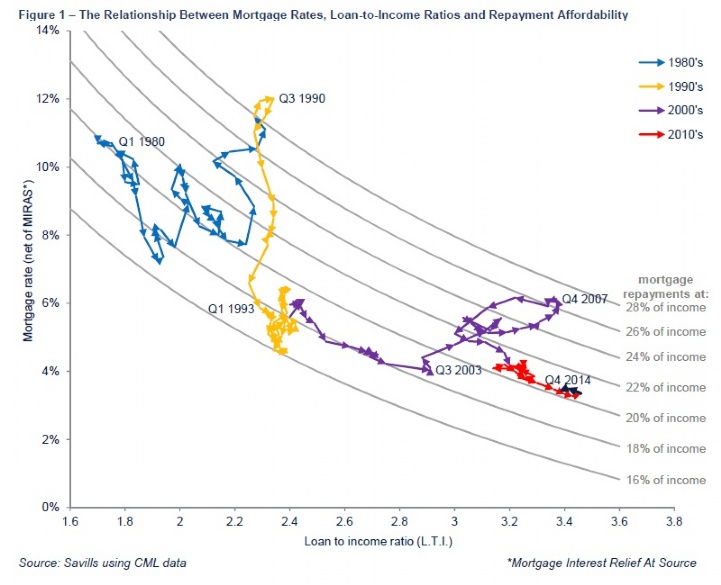
The historical chart below offers another view of the interaction. Its horizontal axis is loan-to-income, its vertical axis is the mortgage rate, and the curved lines indicate mortgage repayments as a share of income. It illustrates why the rate and the amount borrowed relative to income both matter for payments. Its plotted points describe different historical periods, however; they do not isolate the effect of one rule change or specify what a buyer could borrow today.
Finally, a change in a buyer’s maximum bid is not itself a forecast of house prices. It describes a potential change in demand from buyers facing those borrowing conditions. The price at which homes actually sell also depends on other buyers, sellers and the homes available. Likewise, the example is about mortgage purchasing power, not the inflation-adjusted house-price change calculated in the previous lesson.
Closing perspective
A workable maximum bid must pass several tests at once. In the starting example, the monthly-payment ceiling permitted about £199,000 of borrowing and a £229,000 bid with the deposit. A higher rate tightened the payment constraint; a higher deposit requirement constrained the price directly; and a lower income multiple capped the loan. Which limit binds matters more than any one headline mortgage figure.
The next lesson holds mortgage conditions and housing supply constant to examine how a change in household income can alter housing demand.