Hello! Welcome to the first lesson of our fourth module, "Corporate Formation and Capitalization."
In our last module, we concluded by learning how to advise a founder on the best business structure for their needs—weighing the pros and cons of entities like LLCs and corporations. Now, we move from choosing a structure to creating one.
Today's lesson focuses on the practical steps of bringing a corporation to life. The learning outcome is to describe the process of incorporating a business, including the role of articles of incorporation and bylaws. We'll explore why incorporation is so significant from a legal standpoint and then walk through the key documents and procedural milestones that transform a business idea into a formal legal entity.
1. The Legal Foundation: Creating a "Person"
Before diving into the paperwork, it's crucial to understand the fundamental legal principle at play. Incorporation is the process of creating a corporation, which the law recognizes as a separate legal person, distinct from its owners (the shareholders). This is the source of the limited liability you learned about in the previous module.
To grasp this core theory, please read a short excerpt from the academic paper, "The Legal Structure of the Firm."
The Legal Structure of the Firm
This reading explains the profound legal concept of 'juridical personality'—how the law treats corporations as if they were real people, capable of owning property, entering contracts, and being sued.
Please read section 1.3, 'The Firm is not a Legal Person and Large Firms Operate in the Legal System via Corporations,' and the first paragraph of section 1.4, 'The Not So Relevant Theories of Corporate Personality.' Focus on how the law treats a corporation as a 'person' and how creating one has become a straightforward 'formality.'
The key takeaway is that a corporation is a powerful legal tool. While historically it might have been a special privilege granted by the state, today it's a readily accessible structure. The process turns an abstract idea into a legal entity with its own rights and obligations.
This infographic provides a great visual summary of the core concepts we'll be discussing.
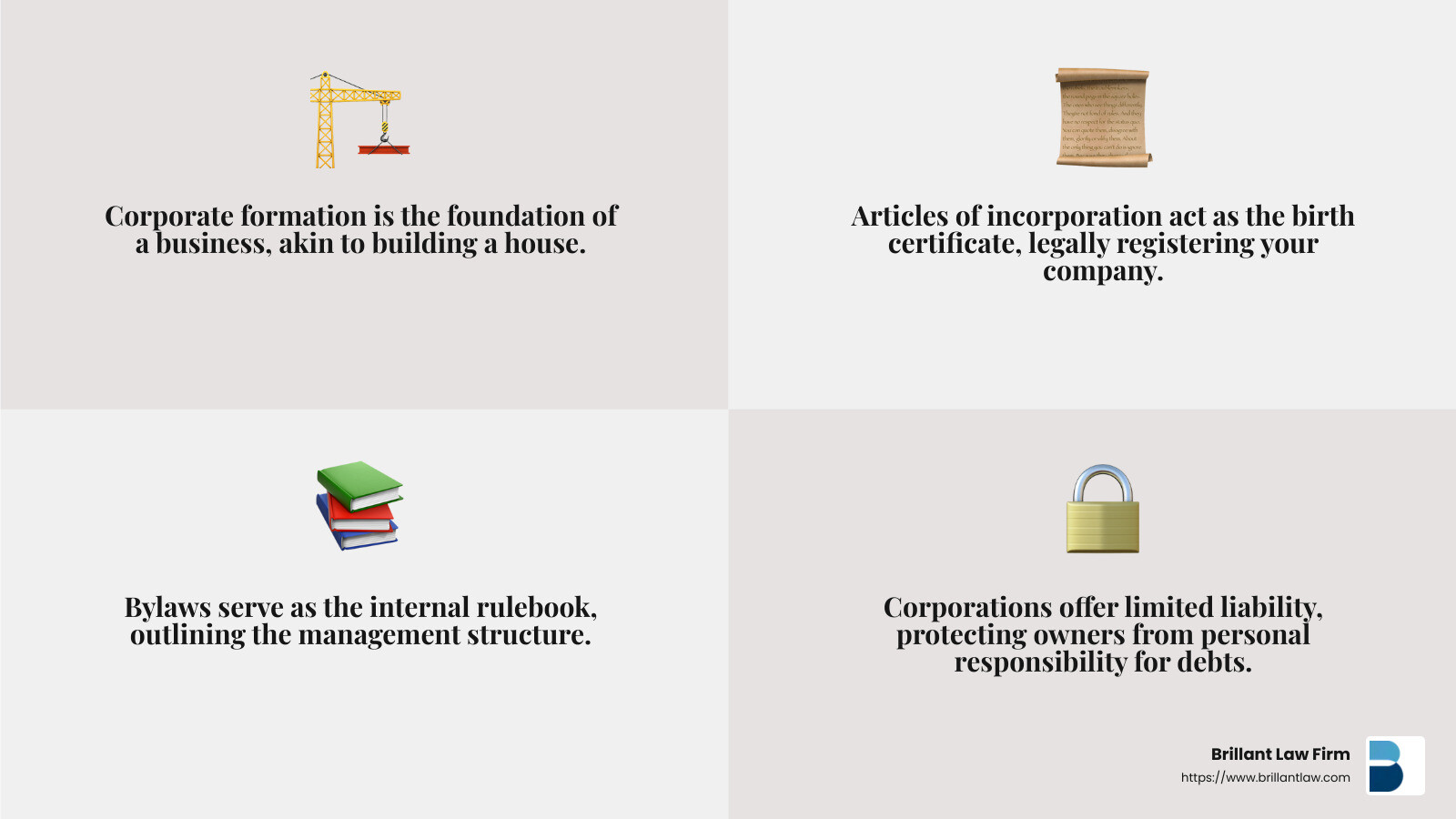
2. The "How-To": Steps of Incorporation
While the specific rules vary by state, the incorporation process generally follows a clear, logical sequence. Think of it in three main phases:
- Filing: Formally registering the corporation's existence with the state.
- Organizing: Appointing initial managers and adopting the internal rules.
- Finalizing: Ratifying the initial setup and electing the formal leadership.
Let's watch a video that outlines these practical steps.
How to Incorporate a Business - 6 Easy Steps!
The video 'How to Incorporate a Business - 6 Easy Steps!' by LYFE Accounting offers a clear, step-by-step guide to the incorporation process. We'll focus on the core legal actions.
Please watch from 03:53 to 06:01. Pay attention to: Filing the Articles of Incorporation: What information is included, and who is a registered agent? Holding the First Meeting: What key decisions are made?
Based on the video and standard corporate practice, let's break down that process in more detail.
Step 1: File the Articles of Incorporation
This is the official creation of the corporation. An "incorporator" (the person filing the document, often a lawyer) submits a document to the Secretary of State in the chosen state of incorporation (as you'll recall, Delaware is a popular choice). This document is typically called the Articles of Incorporation or Certificate of Incorporation.
It's a public document that serves as the corporation's "birth certificate" and contains fundamental information, such as:
- The corporation's name (which must be unique and include a designator like "Inc.", "Corp.", or "Incorporated").
- The address of the corporation’s principal office.
- The name and address of its registered agent—a designated person or company responsible for receiving official legal and tax documents on behalf of the corporation.
- The purpose of the corporation (often stated very broadly, like "to engage in any lawful act or activity").
- The number and types of shares of stock the corporation is authorized to issue (we'll cover this in detail in the next lesson).
Step 2: Hold the First (Organizational) Directors' Meeting
Once the Articles are filed and accepted by the state, the corporation legally exists, but it's an empty shell. The initial directors (often named in the Articles) must hold a meeting to bring it to life.
Key actions at this meeting include:
- Appointing Officers: The board appoints individuals to run the daily business, such as the Chief Executive Officer (CEO), President, Chief Financial Officer (CFO), and Secretary.
- Issuing Stock: The corporation formally issues shares of stock to its founders in exchange for cash, property, or services.
- Adopting the Bylaws: This is a critical step where the directors approve the detailed internal rules that will govern the corporation.
Step 3: Hold the First Shareholders' Meeting
Shortly after the initial directors' meeting, the shareholders (the founders who were just issued stock) hold their first official meeting. The primary purpose is to elect the formal Board of Directors who will govern the company going forward. They may also ratify the bylaws that the initial directors adopted.
3. The Two Constitutions: Articles vs. Bylaws
You've now seen that two documents are central to a corporation's existence: the Articles of Incorporation and the Bylaws. Understanding their distinct roles is essential for any corporate lawyer.
Let's watch a final video that clearly explains the difference and relationship between these two governing documents.
The video 'Corporate Formation' by Learn Law Better provides an excellent analogy, comparing the articles to a nation's constitution and the bylaws to its specific laws.
Please watch from 09:57 to 11:29. Focus on the distinction between the Articles of Incorporation and the Bylaws in terms of their content, who can amend them, and their place in the corporate hierarchy.
To summarize the key distinctions:
| Feature | Articles of Incorporation | Bylaws |
|---|---|---|
| Analogy | The "Constitution" | The "Internal Rulebook" or "Operating Manual" |
| Audience | Public (filed with the state) | Private (internal company document) |
| Content | Fundamental, high-level details (name, stock, purpose) | Detailed operational rules (meeting procedures, officer duties, voting) |
| Amendment Process | Difficult: Requires a vote of both the board and shareholders. | Easier: Typically can be amended by the board of directors alone. |
| Hierarchy | Supreme governing document. The bylaws cannot contradict the Articles. | Subordinate to the Articles and state law. |
Essentially, the Articles create the legal framework, while the Bylaws fill in the details of how to operate within that framework.
Test your understanding!
A corporation's founders want to require that any sale of the company for over $10 million must be approved by 80% of shareholders, instead of the standard 50%. This is a fundamental, high-stakes rule they want to be permanent and difficult to change.
Should this provision be included in the Articles of Incorporation or the Bylaws? Why?
Show answer
This provision should be included in the Articles of Incorporation.
Because it's a fundamental rule altering standard shareholder voting rights and is intended to be permanent and hard to change, it belongs in the company's "constitution." Placing it in the Articles makes it a matter of public record and requires a formal shareholder vote to amend, providing much greater protection than if it were in the more easily changed Bylaws.
Conclusion
Congratulations on completing this lesson! You can now describe the essential legal and practical steps involved in forming a corporation.
Key Takeaways:
- Incorporation is the legal process of creating a corporation, which is recognized by law as a "separate legal person."
- The process begins with filing the Articles of Incorporation with the state, a public document that acts as the company's "birth certificate."
- Initial organizational meetings of directors and shareholders are then held to appoint officers, issue stock, and adopt the Bylaws.
- Bylaws are the private, internal rules that govern the corporation's operations and are subordinate to the Articles of Incorporation.
In this lesson, we saw that one of the first acts of the new corporation is to authorize and issue stock. But what exactly is stock, and what different forms can it take? Our next lesson, "Distinguishing between authorized, issued, and outstanding shares of stock," will answer these questions and build the foundation for understanding how corporations are capitalized.