Hello! Welcome to your next lesson in the "Corporate Formation and Capitalization" module.
In our previous lesson, we walked through the process of incorporating a business. We learned that the Articles of Incorporation act as the company's "birth certificate" and must state the number of shares the corporation is authorized to issue. Today, we'll unpack what that really means.
This lesson is dedicated to helping you distinguish between authorized, issued, and outstanding shares of stock. Understanding these terms is not just a technical exercise; it's fundamental to grasping how corporate ownership is structured, valued, and diluted over time. For a future corporate lawyer, these concepts are the building blocks for advising on everything from founder equity to major financing rounds and mergers.
1. The Three Categories of Corporate Stock
At the heart of corporate capital structure are three distinct but related categories of shares. Think of them as a hierarchy that flows from a legal maximum down to what shareholders actually own.
To start, let's get clear definitions for each term. The following article from a corporate law firm provides a concise and practical breakdown.
Capitalization Table 101: Authorized vs. Issued vs. Outstanding Shares
The article 'Capitalization Table 101' by Yohanan Law clearly defines authorized, issued, and outstanding shares. It's written for founders and investors, making it a very clear starting point.
Please read the sections titled '1. Authorized Shares,' '2. Issued Shares,' '3. Outstanding Shares,' and the short 'An Example to Tie It Together.' Focus on the key distinction between each term.
Let's summarize and build on those definitions. A helpful analogy is to think of a corporation's stock as seats in a stadium:
- Authorized Shares: This is the total seating capacity of the stadium, as specified in its building permit (the Articles of Incorporation). It's the absolute maximum number of shares the corporation is legally allowed to issue.
- Issued Shares: These are the seats that have actually been installed in the stadium. They represent the portion of authorized shares that the company has sold or granted to shareholders at any point in its history.
- Outstanding Shares: These are the seats currently occupied by fans. They are the issued shares that are in the hands of shareholders.
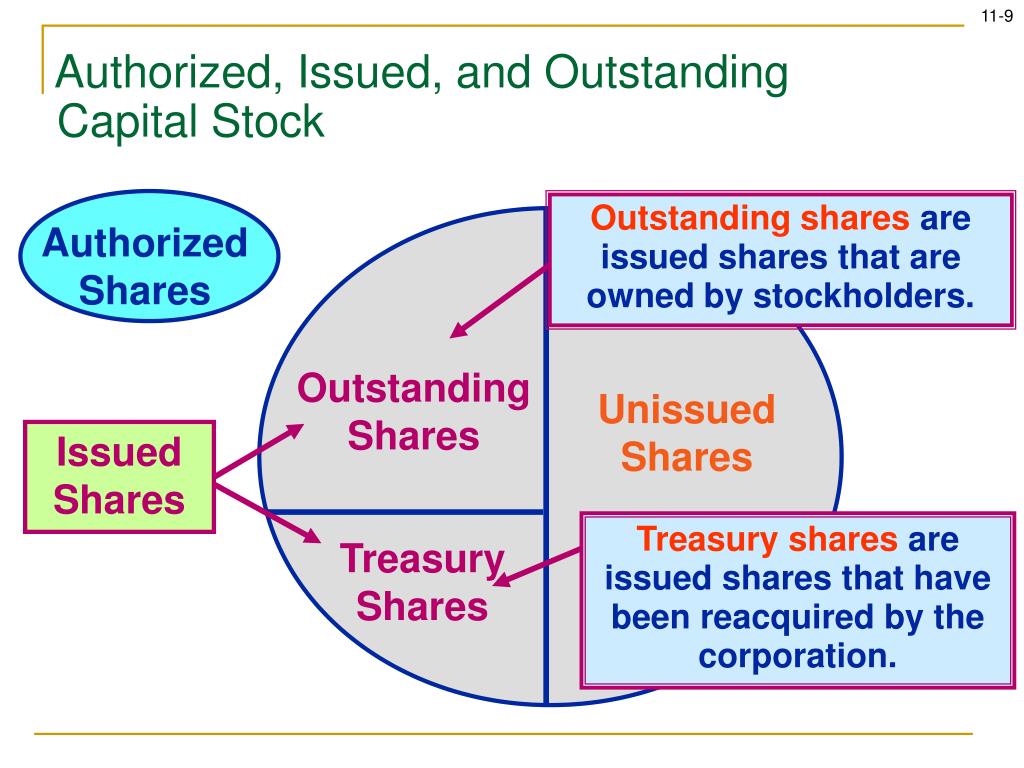
You might be asking: how can a share be issued but not outstanding? This happens when a company buys back its own stock from the market. These repurchased shares are called Treasury Shares. They are still considered issued (the "seats" exist), but they are no longer outstanding (no "fan" is sitting in them). They don't have voting rights and don't receive dividends.
This gives us a simple but powerful formula, which the resource "Shares Outstanding vs Authorized vs Issued" calls the "Golden Equation":
The following diagram provides a clear visual of how these categories relate to one another.
2. Strategic Use of Shares
Now that we have the definitions, let's explore the "why" behind them. Why would a company authorize millions of shares but only issue a fraction of them at the start? The answer is flexibility.
Watch this short video to understand the strategic reasoning.
How many shares should be authorized in the certificate of incorporation?
The video 'How many shares should be authorized in the certificate of incorporation?' from Startupedia quickly explains the practical reasons for authorizing a large number of shares.
Watch from 00:28 to 02:07. Pay attention to the distinction the speaker makes between authorized and issued shares and the reasons he gives for leaving 'room' for the future.
As the video explains, authorizing a high number of shares from the beginning (e.g., 10 million) allows the company to:
- Raise money from investors in future financing rounds.
- Create an employee stock option pool to attract and retain talent.
- Use stock to acquire other companies.
Doing this upfront avoids the costly and time-consuming process of amending the Articles of Incorporation every time the company needs to issue new shares, which requires formal board and shareholder approval.
3. The Impact on Shareholders: Dilution and Buybacks
The number of outstanding shares is arguably the most important number for a shareholder because it determines the size of their slice of the corporate pie. When a company changes the number of outstanding shares, it directly impacts the value and control of every existing shareholder.
Let's watch a video that explains these dynamics with some great analogies and real-world examples.
What are SHARES OUTSTANDING? | Stock Market Basics
The video 'What are SHARES OUTSTANDING?' by Everything Money explains the critical concepts of dilution and share buybacks. It uses a pizza analogy and compares the strategies of Apple and Tesla.
Please watch the following segments: (01:02 - 03:02): Focus on the 'silent killer' of dilution and how issuing more shares affects earnings per share, using the simple pizza pie analogy. (03:18 - 06:12): Pay attention to why a company might issue more shares (if its stock is overvalued) or buy back shares (if its stock is undervalued). (06:12 - 08:36): Note the real-world comparison between Apple (which buys back shares) and Tesla (which issues shares) and the effect on shareholder value.
As the video powerfully illustrates:
- Issuing New Shares (Dilution): When a company issues new shares to raise capital, it's like cutting the pizza into more slices. Even if the company becomes more profitable (a bigger pizza), each shareholder's existing slice becomes a smaller percentage of the whole. This is known as dilution. Your ownership stake is diluted.
- Buying Back Shares (Concentration): When a company uses its cash to buy back its own shares, it reduces the number of outstanding shares. This is like removing slices from the pizza pie. Each remaining slice now represents a larger percentage of the whole pizza. This action increases each shareholder's ownership stake and often boosts the stock price.
This is why investors and lawyers pay such close attention to changes in the number of outstanding shares. It's a direct reflection of how management is creating—or destroying—shareholder value.
Test your understanding!
A new startup, "Innovate Corp.," includes the following in its Articles of Incorporation: "The total number of shares of stock which the Corporation shall have authority to issue is 20,000,000."
- The founders initially issue 5,000,000 shares to themselves.
- A year later, they raise money by issuing 2,000,000 new shares to a venture capital investor.
- Two years later, Innovate Corp. uses its profits to buy back 500,000 shares from one of the founders who is leaving the company.
After all these transactions, what are the authorized, issued, and outstanding share counts?
Show answer
- Authorized Shares: 20,000,000. This number is set in the Articles of Incorporation and does not change unless the Articles are amended.
- Issued Shares: 7,000,000. This is the total number of shares that have ever been granted (5,000,000 to founders + 2,000,000 to the investor). The buyback does not reduce the issued share count.
- Outstanding Shares: 6,500,000. This is the number of issued shares (7,000,000) minus the shares the company bought back and now holds in its treasury (500,000).
Conclusion
In this lesson, you've learned to navigate the fundamental vocabulary of a corporation's capital structure. These terms are not interchangeable; they tell a story about a company's past, present, and future.
Key Takeaways:
- Authorized Shares are the legal maximum number of shares a company can issue, set in the Articles of Incorporation.
- Issued Shares are the shares that have been distributed to shareholders from the authorized pool.
- Outstanding Shares are the shares currently held by investors. This is the number used to calculate ownership percentages and per-share value.
- The difference between issued and outstanding shares is Treasury Shares—stock that the company has repurchased.
- Issuing new shares leads to dilution, reducing each shareholder's stake, while buybacks concentrate ownership and increase their stake.
So far, we've treated all shares as being equal. But are they? In our next lesson, we will explore how corporations can create different classes of stock with different rights. We will compare common stock and preferred stock based on economic, voting, and liquidation rights, adding another critical layer to your understanding of corporate finance.