Hello! Welcome to the first lesson in our module on Employment Law for Corporations.
In our last module, we explored how tax law profoundly influences corporate transactions like mergers and acquisitions. We saw that when one company buys another, it's not just acquiring assets and liabilities; it's also acquiring a workforce. The legal status of that workforce is of paramount importance, and that brings us to our topic today.
This lesson addresses a foundational question in employment law that carries immense legal and tax implications for any business: what is the difference between an employee and an independent contractor? As a future corporate lawyer, you will find this distinction is at the heart of many compliance, litigation, and advisory matters.
Your learning outcome for this lesson is to: Distinguish between employees and independent contractors for legal and tax purposes.
By the end of this lesson, you will be able to:
- Explain why the classification of a worker as an employee or independent contractor is critical for a business.
- Apply the IRS's three-factor "right to control" test to assess a worker's status.
- Recognize the key financial and legal consequences of misclassification.
- Understand that state laws can impose even stricter tests for classification.
1. Why the Distinction Matters: The High Stakes of Classification
At first glance, it might seem like a simple matter of labeling. A company wants to hire someone and calls them an "independent contractor" in an agreement. However, as you'll see throughout your legal studies, the law is concerned with the substance of a relationship, not just its label. The choice between classifying a worker as an employee versus an independent contractor determines a vast range of legal obligations and financial costs for a company.
Misclassifying a worker who is legally an employee as an independent contractor can expose a company to significant liability. Let's start by watching a short video that outlines why this is such a critical issue.
Independent Contractor vs Employee: What the IRS Says About It
The video 'Independent Contractor vs Employee: What the IRS Says About It' from attorney Aiden Durham provides an excellent overview of the legal and financial risks of misclassification.
Please watch the segment from 01:05 to 02:42. Focus on the different liabilities the speaker mentions, such as employment taxes, workers' compensation, and liability for a worker's actions.
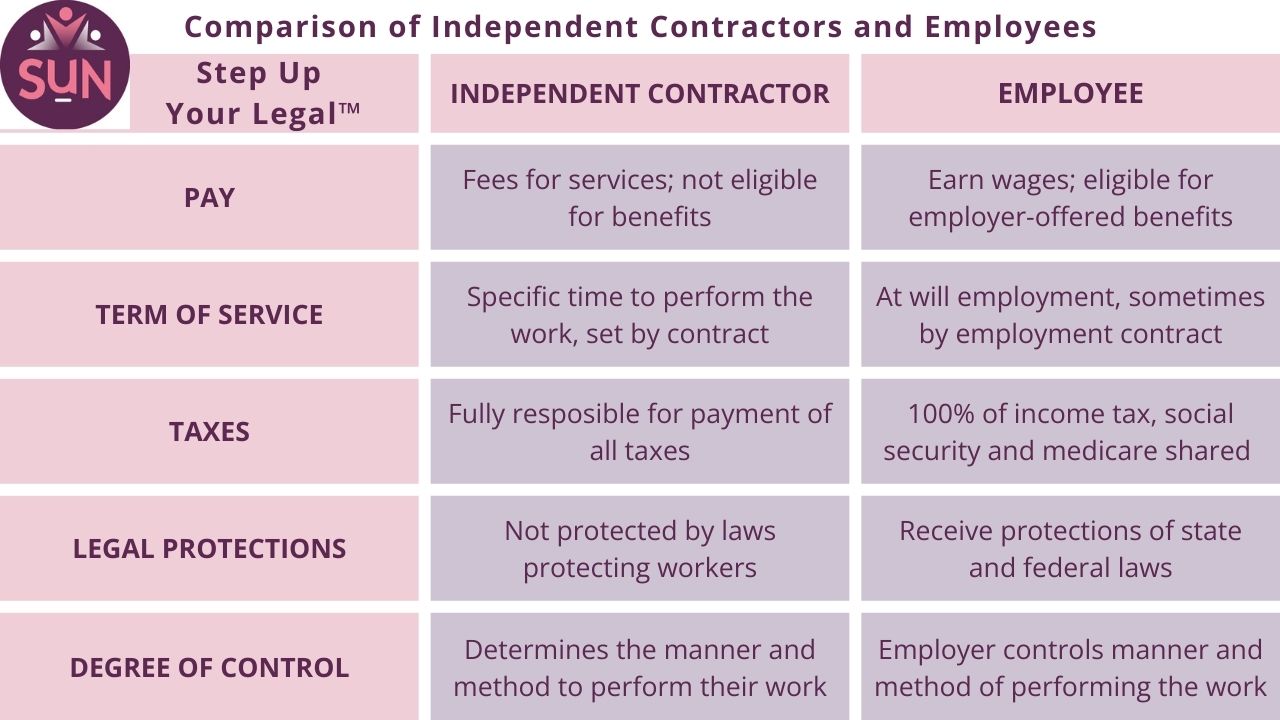
As the video explains, the stakes are high. Here’s a summary of the key obligations that apply to employees but generally do not apply to independent contractors:
- Tax Withholding: Employers must withhold federal and state income taxes, as well as Social Security and Medicare (FICA) taxes, from an employee's wages. They also pay their own share of FICA taxes and federal/state unemployment taxes. For a contractor, the company simply pays the agreed-upon fee, and the contractor is responsible for their own taxes.
- Wage and Hour Laws: The Fair Labor Standards Act (FLSA) mandates minimum wage and overtime pay for non-exempt employees. These protections do not extend to independent contractors.
- Employee Benefits: Employees are often eligible for benefits like health insurance, retirement plans (e.g., 401(k)s), and paid time off. Companies do not provide these to contractors.
- Workers' Compensation: Employers must carry workers' compensation insurance to cover employees who are injured on the job. Contractors are responsible for their own insurance.
- Anti-Discrimination Laws: Laws like Title VII of the Civil Rights Act protect employees from discrimination. While the scope of these laws is expanding, their core protections have traditionally been for employees.
- Vicarious Liability: Under the doctrine of respondeat superior, an employer can be held liable for the torts (wrongful acts) committed by an employee within the scope of their employment. This liability is far less likely to attach for the actions of an independent contractor.
The recent case involving Uber, which paid $100 million to New Jersey over the classification of its drivers, highlights just how significant the financial consequences can be.
2. The Core of the Analysis: The "Right to Control" Test
So, how do courts and government agencies like the IRS actually determine a worker's status? They use a multi-factor analysis that boils down to one central question: To what degree does the company have the right to direct and control the worker?
It's not about whether the company actually exercises that control, but whether it has the right to do so. A worker's preference or even a written contract stating they are an independent contractor is not the deciding factor.
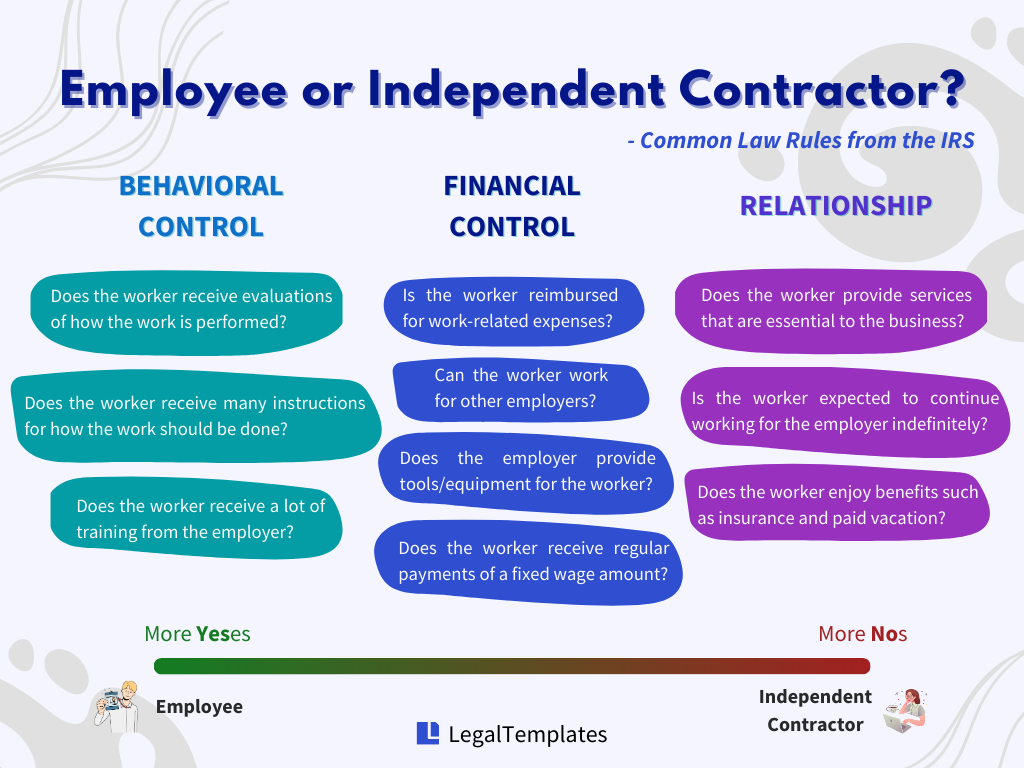
The most common framework, used by the IRS and based on common law principles, organizes the factors into three main categories.
Independent Contractor vs Employee: What the IRS Says About It
Let's return to the 'Independent Contractor vs Employee' video. The next sections break down the IRS's three-category test in a clear and structured way. This is the foundational framework you'll need to master.
Please watch from 06:05 to 13:01. As you watch, take note of the specific factors discussed within each of the three main categories: Behavioral Control (06:05): How the company controls the 'how' of the work. Financial Control (08:13): How the company controls the business aspects of the job. Type of Relationship (10:17): How the parties perceive their relationship.
Let's recap and consolidate those factors.
A. Behavioral Control
This category focuses on whether the company has the right to direct how the worker performs the job. The more control exerted, the more likely the worker is an employee.
- Instructions: Giving detailed instructions about when, where, and how to work, what tools to use, or the sequence of tasks points toward an employee relationship.
- Training: Providing training suggests the company wants the work done in a particular way, which is characteristic of an employer-employee relationship. Independent contractors are typically hired for their existing expertise and use their own methods.
- Evaluation: Evaluating the worker on the process and methods used to perform the work (not just the final result) indicates control.
B. Financial Control
This category examines the business aspects of the job and whether the worker has economic independence.
- Significant Investment: Independent contractors often have a significant investment in the equipment and tools they use.
- Unreimbursed Expenses: Contractors are more likely to have ongoing business expenses that are not reimbursed.
- Opportunity for Profit or Loss: A key hallmark of a contractor is the ability to make a profit or suffer a loss, which depends on how they manage their time and expenses. An employee, paid a salary or hourly wage, generally does not bear this risk.
- Services Available to the General Market: Contractors are generally free to seek out business opportunities and work for multiple clients simultaneously.
- Method of Payment: Employees are typically paid a regular wage (hourly, weekly, salaried), while contractors are more often paid a flat fee for a specific project.
C. Type of Relationship
This category looks at how the worker and the company perceive their relationship.
- Written Contracts: A contract specifying a contractor relationship is a relevant factor, but as noted, it is not determinative if the reality of the relationship suggests otherwise.
- Employee Benefits: Providing benefits like insurance, a pension plan, or paid leave is a strong indicator of an employee relationship.
- Permanency: An ongoing, indefinite relationship suggests employment. A relationship for a specific project or a fixed duration is more typical for a contractor.
- Services Provided as a Key Activity: If the worker's services are a core part of the company's primary business (e.g., a law firm hiring a lawyer), it is more likely the company will have the right to direct and control their work, pointing toward an employee status. If the services are ancillary (e.g., the same law firm hiring someone to design its website), it points toward a contractor.
To explore these factors with more legal depth, let's turn to a more detailed resource.
Independent Contractor or Employee? The Legal Distinction ...
The article 'Independent Contractor or Employee? The Legal Distinction...' from the UNC School of Government provides a thorough legal analysis. It uses a helpful hypothetical about 'Paradise County' to illustrate how these factors are applied in practice.
Please read the sections from 'Determining Worker Status' through 'Integral Part of the Employer’s Business.' This corresponds to pages 5-11 of the PDF. Focus on how each factor (Control, Profit/Loss, Investment, Skills, Duration, and Integral Nature of Work) is analyzed using both the swimming pool contractor example (a clear contractor) and the 'Paradise County' workers (clear employees).
Test your understanding!
A tech startup hires a software developer, "Alex," to build a new mobile app. The contract labels Alex an "independent contractor."
- The startup provides Alex with a high-end laptop and a license for specialized software.
- Alex works from home but is required to attend daily "stand-up" meetings via video call to report progress.
- The project has a fixed deadline, but the head of engineering frequently reviews Alex's code and dictates changes to the coding methodology.
- Alex is paid an hourly rate, billed weekly.
- Alex is not permitted to work for any other companies until the project is complete.
Based on the IRS's three-factor test, is Alex more likely an employee or an independent contractor? Justify your answer by referencing at least one factor from each of the three categories.
Show answer
Alex is more likely an employee, despite the contract's label.
- Behavioral Control: The startup exercises significant behavioral control. They require daily progress reports and dictate coding methodology, controlling how the work is done, not just the final outcome.
- Financial Control: The startup provides the key tools (laptop, software) and pays an hourly rate, which limits Alex's opportunity for profit or loss beyond simply working more hours. This points away from contractor status.
- Type of Relationship: The restriction on working for other companies and the fact that building an app is a key business activity for a tech startup both suggest a relationship closer to employment than to an independent engagement.
3. The Real-World Complexity: State Laws and the "ABC Test"
To make matters more complex for corporate counsel, you cannot stop your analysis at the IRS test. Many states have their own, often stricter, tests. A prominent example is the "ABC Test," which is used in states like California and New Jersey.
Under the ABC test, a worker is presumed to be an employee unless the employer can prove all three of the following conditions:
(A) The worker is free from the control and direction of the hiring entity.
(B) The worker performs work that is outside the usual course of the hiring entity’s business.
(C) The worker is customarily engaged in an independently established trade, occupation, or business.
This test is much harder for an employer to satisfy than the IRS's common law test. The failure to meet even one prong means the worker is an employee. This creates a "conundrum" where a worker might be an independent contractor for federal tax purposes but an employee for state unemployment or wage law purposes.
Worker Classification for Tax and Employment Purposes
The article 'Worker Classification for Tax and Employment Purposes' from the law firm Fredrikson & Byron provides a concise explanation of the ABC test and the complexities that arise from differing state and federal standards.
Please read the sections titled 'Common Law/Multiple Factors Tests', 'ABC/Modified ABC Tests', and 'Conundrum'. Notice how the ABC test is much more rigid and how this can lead to conflicting classifications under different laws.
Conclusion
Correctly classifying workers is a fundamental compliance duty for any corporation. As we've seen, the distinction between an employee and an independent contractor is not based on a simple label but on a detailed, fact-intensive analysis of the entire working relationship, with the "right to control" being the central theme. Getting it wrong can lead to staggering liabilities for back taxes, unpaid overtime, and other penalties.
Key Takeaways:
- Substance Over Form: The reality of the working relationship, not the contract's title, determines a worker's status.
- The Right to Control: The primary test revolves around whether the company has the right to direct and control the worker, assessed through factors related to behavioral control, financial control, and the nature of the relationship.
- High Stakes of Misclassification: Getting it wrong can result in significant liabilities for taxes, overtime pay, benefits, and other legal penalties.
- State Law Matters: Many states have stricter tests (like the ABC test), creating a complex compliance landscape where a worker may have different statuses under different laws. For a lawyer, this means the analysis must always consider both federal and applicable state law.
Preview of the Next Lesson:
Now that we have established how to determine if a worker is an employee, we will move on to the next critical topic. Our next lesson will explore the fundamental legal principle governing the employer-employee relationship in most of the United States: the doctrine of 'at-will' employment. We will analyze what this doctrine means and, just as importantly, examine its numerous and significant exceptions.