Hello! Welcome to your fifth lesson in the module on Employment Law for Corporations.
In our last lesson, we explored the Americans with Disabilities Act (ADA). We focused on how the ADA creates an affirmative duty for employers to provide reasonable accommodations, moving beyond simple non-discrimination to require proactive support for employees with disabilities.
Today, we will examine another area of federal law that imposes significant affirmative duties on employers: the legal framework governing employee benefits. When a company chooses to offer benefits like retirement savings plans or health insurance, it steps into a highly regulated world. The cornerstone of this regulation is a powerful and complex statute called the Employee Retirement Income Security Act of 1974 (ERISA). For a corporate lawyer, understanding ERISA is essential for advising clients on how to manage these plans and avoid costly liabilities.
Your learning outcome for this lesson is to: Describe the legal framework governing employee benefits, including key ERISA requirements.
By the end of this lesson, you will be able to:
- Explain the purpose of ERISA and the historical context of its enactment.
- Distinguish between the two main types of retirement plans: defined benefit and defined contribution plans.
- Identify the key fiduciary duties that ERISA imposes on plan managers.
- Describe the main reporting and disclosure requirements under ERISA.
- Explain the concept of ERISA preemption and its effect on state laws.
1. What is ERISA and Why Does it Exist?
Before diving into the rules, it's important to understand why ERISA was created. It wasn't born in a vacuum; it was a direct response to real-world failures that left thousands of workers without the retirement benefits they had been promised for decades. Understanding this history helps clarify the law's primary goal: protecting the interests of plan participants and their beneficiaries.
Overview of the Employee Retirement Income Security Act: Module 1 of 5
To understand the purpose and scope of ERISA, we'll start with the video 'Overview of the Employee Retirement Income Security Act' from LawShelf. It provides an excellent account of the historical events, like the Studebaker plant closure, that led to the law's creation.
Please watch from the beginning to 05:12. As you watch, focus on: The problems with early pension plans (e.g., lack of funding and vesting). The Studebaker case and its role as a catalyst for reform. ERISA's essential objective and the four ways it achieves it (disclosure, standards of conduct, enforcement, and participant rights).
As the video explains, ERISA does not require an employer to offer a benefit plan. However, if an employer chooses to establish one, it must comply with ERISA's strict rules. The law was designed to ensure that funds promised to employees are actually there when they retire.
This is achieved through several key mechanisms:
- Requiring disclosure of important plan information to employees.
- Establishing high standards of conduct for those who manage plans (fiduciaries).
- Providing for remedies and enforcement to protect plan funds.
2. Core Concepts: Plan Types and Key Roles
ERISA governs two main categories of employee benefit plans: retirement plans and welfare benefit plans (e.g., health, disability, life insurance). For retirement plans, the most fundamental distinction is between defined benefit plans and defined contribution plans. Understanding this difference is critical, as the risks and responsibilities for both the employer and employee are vastly different.
What You Should Know About Your Retirement Plan
The Department of Labor's guide, 'What You Should Know About Your Retirement Plan,' offers a very clear breakdown of these two plan types. Pay close attention to the table comparing their features.
Please read Chapter 1, 'TYPES OF RETIREMENT PLANS', including Table 1: Characteristics of Defined Benefit and Defined Contribution Plans. Focus on who bears the investment risk in each type of plan.
Let's summarize the key distinction:
- Defined Benefit (DB) Plan: This is the "traditional" pension. The employer promises a specific, pre-determined monthly benefit to the employee at retirement. The benefit is usually calculated using a formula based on salary and years of service. The employer bears the investment risk. If the plan's investments perform poorly, the employer is responsible for making up the shortfall.
- Defined Contribution (DC) Plan: A 401(k) is the most common example. The employer and/or employee contribute to an individual account for the employee. The final benefit is simply the amount in the account at retirement, which depends on contributions and investment performance. The employee bears the investment risk.
ERISA also defines several key roles with specific responsibilities:
- Plan Sponsor: The entity that establishes the plan (usually the employer).
- Plan Administrator: The person or entity responsible for the day-to-day management of the plan.
- Fiduciary: Anyone who exercises discretionary control or authority over the plan's management or assets. This is a crucial role with very high legal standards, which we will discuss next.
3. The Heart of ERISA: Fiduciary Duties
Perhaps the most important contribution of ERISA is the establishment of strict fiduciary duties. A fiduciary is someone who holds a position of trust and must act in the best interests of another party. Under ERISA, anyone managing a benefit plan is a fiduciary and is held to what courts have called the "highest known to the law."
A corporate lawyer's advice is often centered on helping clients understand and comply with these duties to avoid personal liability.
ERISA: Legal Framework and Recent Supreme Court ...
The Congressional Research Service report, 'ERISA: Legal Framework,' provides a concise, legally precise summary of these duties. This text is similar to what you might encounter in law school.
Please read the section titled 'Fiduciary Responsibility Requirements' and the subsection 'Standards of Conduct'. This clearly outlines the four primary duties.
As the report outlines, the four core fiduciary duties are:
- Duty of Loyalty: The fiduciary must act solely in the interest of plan participants and beneficiaries. The exclusive purpose must be providing benefits and defraying reasonable plan expenses. A fiduciary cannot use plan assets to benefit the company or themselves.
- Duty of Prudence: The fiduciary must act with the "care, skill, prudence, and diligence" of a prudent person familiar with such matters. This is often called the "prudent expert" rule. It's not enough to be careful; one must be knowledgeable.
- Duty to Diversify: Fiduciaries must diversify the plan's investments to "minimize the risk of large losses." Putting all the plan's assets into a single stock, for example, would almost certainly violate this duty.
- Duty to Follow Plan Documents: Fiduciaries must act in accordance with the plan's written documents, but only insofar as those documents are consistent with ERISA itself. If a plan document tells a fiduciary to do something illegal under ERISA, the fiduciary must follow ERISA.
Test your understanding!
A small tech company is facing a cash-flow problem and is two weeks away from securing a new round of funding. The CEO, who is also the plan administrator for the company's 401(k) plan, decides to "borrow" from the employee contributions that have been withheld from paychecks to cover payroll for one pay period. He intends to pay it all back with interest as soon as the new funding arrives.
Which, if any, fiduciary duties has the CEO violated?
Show answer
The CEO has clearly violated several core fiduciary duties under ERISA:
- Duty of Loyalty: He is not acting solely in the interest of the plan participants. He is using plan assets (the employee contributions) for the benefit of the company—to cover its own payroll expenses. This violates the "exclusive purpose" rule.
- Duty of Prudence: A prudent expert would never use retirement plan assets, which are held in trust for employees, as a short-term loan for the business. This is an extremely risky and improper handling of plan assets.
- Prohibited Transactions: This action also constitutes a "prohibited transaction" under ERISA. Specifically, it is a transfer of plan assets to a "party in interest" (the employer) and an act of self-dealing by a fiduciary (using plan assets in his own interest as CEO).
Even though the CEO intends to pay the money back, the action itself is a serious breach of his fiduciary responsibilities.
4. Reporting, Disclosure, and Preemption
To ensure transparency and accountability, ERISA imposes significant reporting and disclosure obligations. Fiduciaries can't just act prudently in secret; they must provide participants and the government with regular, detailed information about the plan.
ERISA 101 Compliance Training Series: ERISA Overview
The 'ERISA 101' video from HUB International offers a practical compliance overview, focusing on the specific documents employers must create and distribute.
Please watch from 03:12 to 04:35. This section quickly lists the key documents you need to know.
The key documents mentioned include:
- Plan Document: The formal legal document that establishes the plan.
- Summary Plan Description (SPD): A user-friendly booklet written in plain language that explains the plan's benefits, rules, and participant rights. This must be given to all participants.
- Summary of Material Modification (SMM): A notice sent to participants when the plan undergoes any significant changes.
- Form 5500: A comprehensive annual report filed with the federal government that contains detailed financial information about the plan.
ERISA Preemption
One of the most powerful and heavily litigated features of ERISA is its broad preemption clause. To create a single, uniform national standard for benefit plans, ERISA supersedes, or preempts, nearly all state laws that "relate to" employee benefit plans.
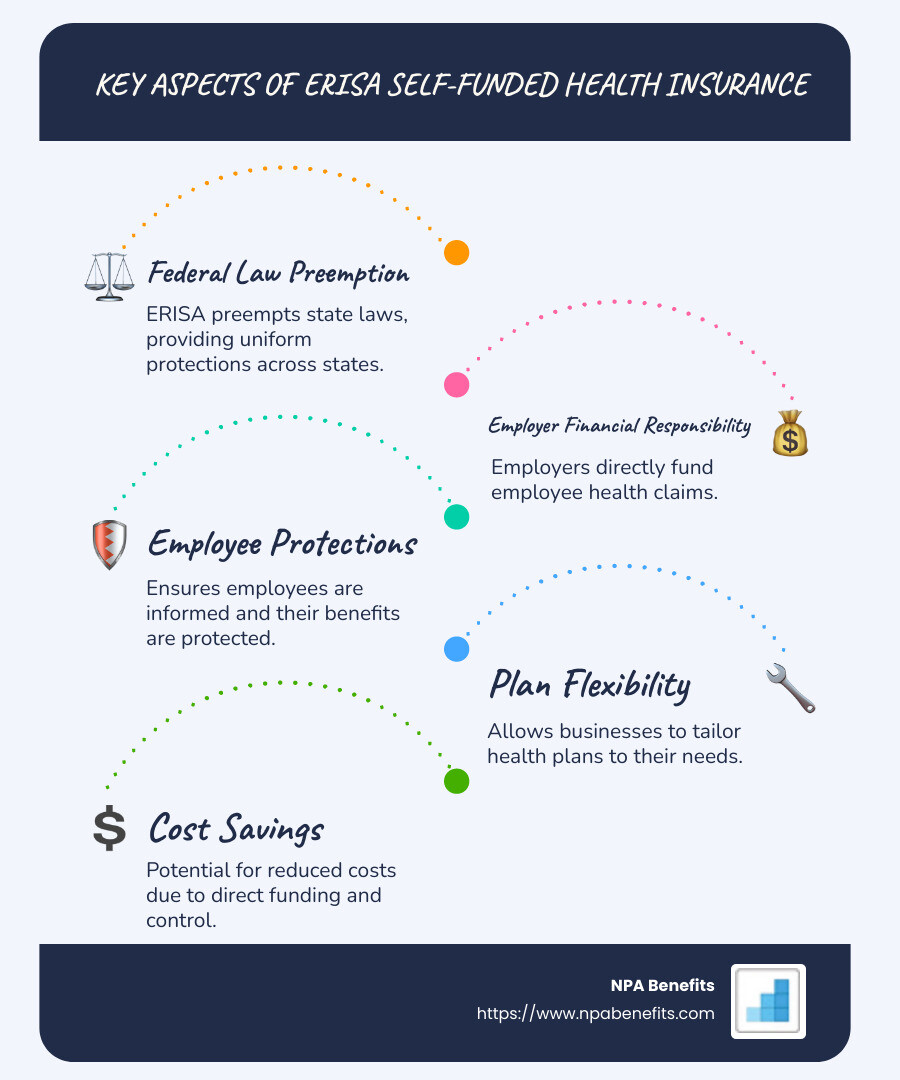
This means a company operating in 50 states does not have to navigate 50 different sets of rules for its retirement or health plan; it only has to follow ERISA.
ERISA: Legal Framework and Recent Supreme Court ...
We will return to the Congressional Research Service report for a detailed legal explanation of this crucial doctrine.
Please read the section 'Express Preemption of State Law'. Focus on understanding the goal of national uniformity and the 'relate to' standard. Pay attention to the two key exceptions: the 'savings clause' (which saves state laws regulating insurance) and the 'deemer clause' (which prevents a benefit plan from being deemed an insurance company).
The preemption analysis can be complex, but the core idea is to prevent states from interfering with the administration of benefit plans. As a future lawyer, understanding that a client's benefit plan issue will almost always be governed by federal law (ERISA), not state law, is a critical starting point.
Conclusion
Today, we've explored the foundational legal framework of ERISA. You learned that it was created to protect employee benefits after major plan failures and that it accomplishes this through a system of fiduciary duties, disclosure requirements, and a powerful preemption clause that ensures national uniformity. While it doesn't force employers to offer benefits, it heavily regulates them when they do, making ERISA compliance a major responsibility for any corporate legal department.
Key Takeaways:
- ERISA is a federal law that sets minimum standards for most private-sector employee benefit plans to protect participants.
- Retirement plans are primarily either defined benefit (employer bears risk) or defined contribution (employee bears risk).
- Plan managers are fiduciaries who must adhere to high standards, including duties of loyalty, prudence, and diversification.
- ERISA requires extensive reporting and disclosure to participants and the government through documents like the SPD and Form 5500.
- The broad preemption clause in ERISA means federal law, not state law, generally governs employee benefit plans.
Preview of the Next Lesson:
In our next lesson, we will move to a different aspect of the employment relationship: post-employment obligations. We will examine the enforceability of restrictive covenants, such as non-compete and non-solicitation agreements, which corporations use to protect their business interests when an employee leaves.