Hello! Welcome to your third lesson in the module on Employment Law for Corporations.
In our last lesson, we analyzed the doctrine of 'at-will' employment. We established that while it's the default rule, it is significantly limited by statutory exceptions that prohibit employers from firing employees for illegal reasons. You learned that one of the most powerful sets of exceptions comes from anti-discrimination laws.
Today, we will dive into the cornerstone of federal anti-discrimination law: Title VII of the Civil Rights Act of 1964. This statute is fundamental to corporate employment practice. Understanding how to analyze a claim under Title VII is a core skill for any lawyer advising a corporate client on employment matters, from hiring policies to termination decisions.
Your learning outcome for this lesson is to: Evaluate a discrimination claim under Title VII of the Civil Rights Act in a corporate context.
By the end of this lesson, you will be able to:
- Identify the scope of Title VII, including covered employers and protected classes.
- Distinguish between the two primary theories of discrimination: disparate treatment and disparate impact.
- Apply the
McDonnell Douglasburden-shifting framework to analyze a claim of intentional discrimination. - Recognize the legal test for a disparate impact claim.
1. Title VII: The Foundation of Anti-Discrimination Law
Title VII is a landmark piece of federal legislation that fundamentally reshaped the American workplace. Its primary goal is to ensure that employment decisions are based on merit, not on prejudice or stereotypes.
To begin, let's establish the basic scope of Title VII—who it applies to and what characteristics it protects.
The document 'Employment Discrimination' from the law firm Fisher Phillips provides a clear and practical overview for employers. We will use it to define the basic parameters of Title VII.
Please read the sections titled 'A. Who Is A Covered Employer Under Title VII?' and 'B. Title VII’s Protected Classes' (found on pages 1-2). As you read, focus on two key questions: 1) Would a small startup with 10 employees be subject to Title VII? 2) What are the five original protected classes?
As you just read, Title VII applies to employers with 15 or more employees. This is a critical threshold for corporate lawyers to be aware of. Once a company reaches this size, it must comply with the statute's requirements in all aspects of employment, including hiring, promotion, compensation, and termination.
The law forbids discrimination on the basis of an individual's membership in a protected class. The five core protected classes under Title VII are:
- Race
- Color
- Religion
- Sex (which courts have interpreted to include pregnancy, sexual orientation, and gender identity)
- National Origin
A claim under Title VII must allege that an employer took an adverse employment action against an employee because of their membership in one of these classes.
2. The Two Faces of Discrimination: Treatment vs. Impact
Discrimination is not always overt or intentional. The law recognizes two distinct ways in which discrimination can manifest in the workplace, leading to two different types of legal claims.

To understand this crucial distinction, let's watch a short video that uses clear, practical examples.
What is the difference between disparate impact and disparate treatment claims?
In 'What is the difference between disparate impact and disparate treatment claims?', an employment lawyer explains these two concepts. Pay close attention to the examples he uses, especially the one involving AI in hiring, as it connects directly to your interest in AI law.
Please watch from 00:46 to 04:09. Focus on how the lawyer defines each term and the examples he gives to illustrate the difference between intent and outcome.
Let's solidify those definitions:
-
Disparate Treatment: This is intentional discrimination. It occurs when an employer knowingly treats an employee or applicant less favorably than others because of their race, sex, religion, etc. The key element is a discriminatory motive.
- Example: Paying a male employee more than a female employee for the exact same job with the same qualifications. The employer's intent is to treat them differently based on sex.
-
Disparate Impact: This is unintentional discrimination. It occurs when a company policy or practice is neutral on its face (it applies to everyone), but its effect is to disproportionately harm members of a protected class. The employer's motive is irrelevant; what matters is the discriminatory outcome.
- Example from the video: A company uses an AI algorithm that selects candidates who were college football quarterbacks. This policy is facially neutral—it doesn't mention gender. However, because almost all college football quarterbacks are men, the impact of the policy is to exclude female applicants.
For a corporate lawyer, this distinction is vital. Disparate impact claims can arise from seemingly harmless policies, requiring a careful audit of practices that might have unintended discriminatory consequences.
3. How Courts Evaluate a Discrimination Claim
Now that we know the two main theories of discrimination, let's examine how a court would evaluate a claim. Since direct evidence of discrimination (like an email saying, "Don't hire him, he's too old") is rare, courts have developed a framework for analyzing claims based on indirect, or circumstantial, evidence.
The McDonnell Douglas Burden-Shifting Framework
For disparate treatment claims, the Supreme Court case McDonnell Douglas Corp. v. Green established a three-step analysis to determine if discrimination occurred. This "burden-shifting" framework is a foundational concept in employment law.
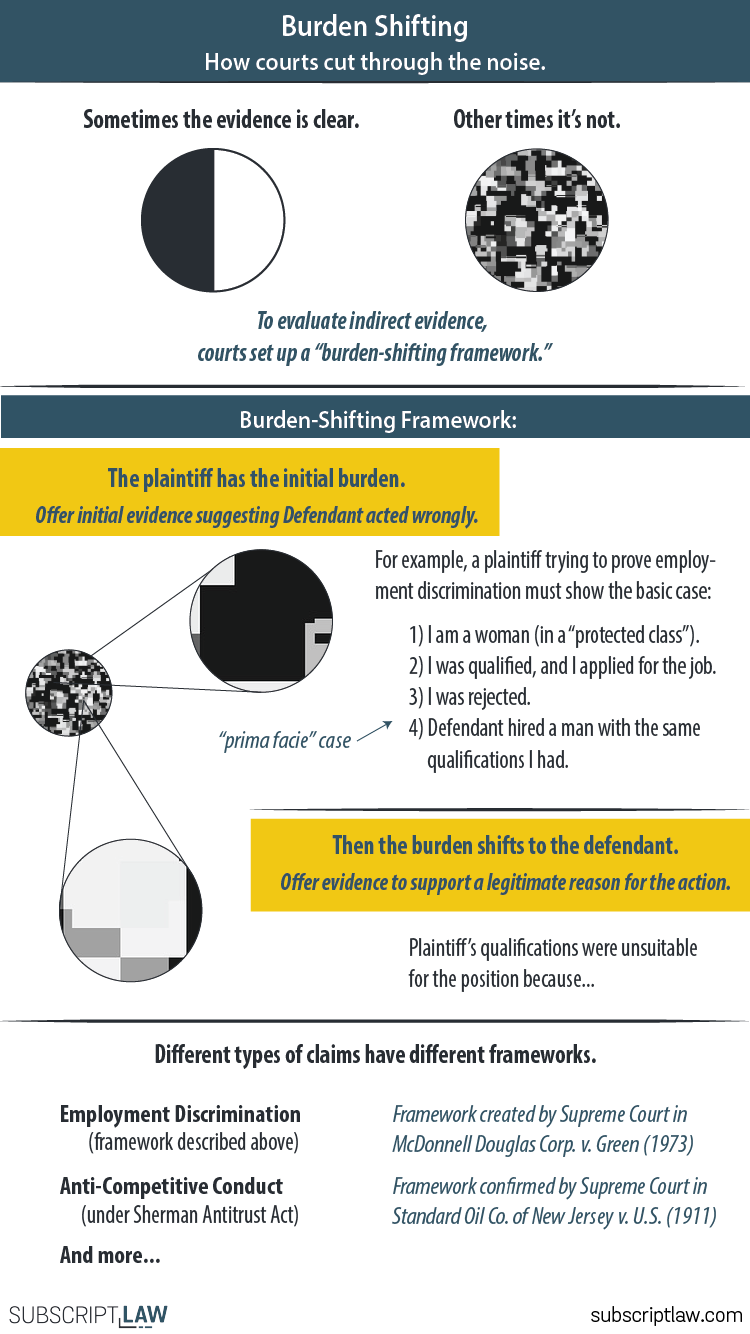
To explore this crucial legal framework in more detail, let's turn to an article written for lawyers that dissects its purpose and application.
McDonnell Douglas: The Oft-Misunderstood Method of Proof
The article 'McDonnell Douglas: The Oft-Misunderstood Method of Proof' from The Federal Lawyer provides an excellent analysis of this framework. It explains not just what the test is, but why it exists and how it fits into the broader context of litigation, which aligns with your preference for understanding underlying principles.
Please read the introduction and the sections that discuss the framework itself, its purpose, and the confusion around it. Don't worry about the case citations; focus on understanding the three main steps of the process and the rationale behind it. The key sections are near the beginning and end of the article.
Let's break down the three steps from the reading:
Step 1: Plaintiff's Prima Facie Case
The employee (plaintiff) must first establish a prima facie case—a set of facts that, if unexplained, would lead one to believe discrimination likely occurred. The classic formulation requires the plaintiff to show that they:
- Are a member of a protected class.
- Were qualified for the job (or were performing the job satisfactorily).
- Suffered an adverse employment action (e.g., were fired, not hired, not promoted).
- Were treated differently than similarly situated employees outside their protected class (e.g., the position was filled by someone of a different race).
Step 2: Employer's Legitimate, Non-Discriminatory Reason
If the plaintiff establishes their prima facie case, the burden of production (not proof) shifts to the employer (defendant). The employer must simply articulate a legitimate, non-discriminatory reason for the adverse action.
- Examples: Poor performance, violation of company policy, tardiness, business restructuring.
Step 3: Plaintiff's Proof of Pretext
The burden then shifts back to the plaintiff to prove that the reason offered by the employer was not the true reason, but was merely a pretext for discrimination. The plaintiff can do this by showing:
- The employer's reason is factually false.
- The reason was not the real motivation.
- The employer did not apply its own rules consistently (e.g., it fired a female employee for being late but only warned male employees for the same offense).
This framework provides a structured way for courts to analyze complex factual scenarios where motive is the central question.
Analyzing a Disparate Impact Claim
Disparate impact claims use a different, though conceptually similar, burden-shifting test:
- The plaintiff must use statistical evidence to show that a specific, facially neutral employment practice has a significantly disproportionate adverse impact on a protected group.
- If successful, the burden shifts to the employer to prove that the practice is job-related and consistent with business necessity. For example, requiring a pilot to have 20/20 vision is a business necessity, even if it excludes some people with disabilities.
- If the employer proves business necessity, the plaintiff can still win by showing that there was a less discriminatory alternative available that the employer refused to use.
Test your understanding!
A tech company has an opening for a senior software engineer. Maria, a Hispanic woman with 10 years of experience and excellent qualifications, applies for the job. She is rejected. The company instead hires Mark, a white man with 7 years of experience. The hiring manager states that Mark was hired because he was a "better cultural fit."
How would you evaluate Maria's potential disparate treatment claim using the McDonnell Douglas framework?
Show answer
-
Maria's Prima Facie Case: Maria can likely establish a prima facie case.
- She is a member of two protected classes (race/national origin: Hispanic; sex: female).
- She was qualified for the position (10 years of experience).
- She suffered an adverse employment action (rejection).
- The position was filled by someone outside her protected classes (a white man) who was arguably less qualified on paper.
-
Employer's Legitimate, Non-Discriminatory Reason: The employer's stated reason is that Mark was a "better cultural fit." While this sounds vague, a court would likely accept it as a facially non-discriminatory reason, shifting the burden back to Maria.
-
Maria's Proof of Pretext: This is where the case would be won or lost. Maria's lawyer would argue that "cultural fit" is a pretext for discrimination. They might do this by:
- Arguing that "cultural fit" is a subjective, vague term often used to mask bias against people who are different from the existing workforce.
- Presenting statistical evidence that the company's engineering team is overwhelmingly white and male.
- Finding evidence that the hiring manager has made biased comments in the past.
- Demonstrating that Maria's qualifications were objectively superior to Mark's.
The outcome would depend on how persuasive the evidence of pretext is. Vague justifications like "cultural fit" are legally risky for employers precisely because they can easily be challenged as pretext.
Conclusion
Title VII of the Civil Rights Act is a cornerstone of modern employment law, creating powerful protections against discrimination. As a future corporate lawyer, your role will often involve proactively advising clients on how to create fair policies and make decisions that comply with the law, as well as defending them when claims arise.
Key Takeaways:
- Title VII prohibits employment discrimination based on race, color, religion, sex, and national origin for employers with 15 or more employees.
- Disparate Treatment is intentional discrimination, where an individual is treated differently because of their protected status.
- Disparate Impact involves a facially neutral policy that has an unintentionally discriminatory effect on a protected group.
- The
McDonnell Douglasframework is the primary legal test for evaluating disparate treatment claims based on circumstantial evidence, involving a three-step process of establishing a prima facie case, articulating a legitimate reason, and proving pretext.
Preview of the Next Lesson:
In this lesson, we focused on the general principles of Title VII. Next, we will turn our attention to another critical anti-discrimination statute: the Americans with Disabilities Act (ADA). We will evaluate disability discrimination claims and explore the unique concept of "reasonable accommodation," which places an affirmative duty on employers to assist employees with disabilities.