Welcome back! In our last lesson, we established the fundamental laws of supply and demand, learning how they interact to determine market prices and quantities. We saw that when the price of a product goes up, the quantity demanded goes down. But that raises a crucial follow-up question: by how much?
Today's lesson tackles that question by introducing the concept of price elasticity of demand. You will learn how to measure the responsiveness of consumer demand to changes in price. This isn't just an academic detail; it is a concept with profound real-world implications. For your goal of becoming a corporate lawyer, understanding elasticity is essential, as it forms a cornerstone of antitrust analysis. Courts and regulators use it to define markets, assess a company's market power, and determine whether its actions are harming competition.
We will cover:
- What price elasticity of demand is and how to distinguish between elastic and inelastic demand.
- The key factors that determine whether demand for a product is elastic or inelastic.
- How elasticity is used in antitrust law to analyze market power and define relevant markets.
1. What is Price Elasticity of Demand?
Price elasticity of demand (PED) measures how sensitive the quantity demanded of a good is to a change in its price. In simple terms, it tells you how much your customers' buying habits change when you change your price.
To build an intuitive understanding of this, let's start with a helpful analogy.
How To Understand Elasticity (Economics)
The video 'How To Understand Elasticity' from the Market Power channel uses a great physical analogy with exercise bands to explain the core idea of elasticity. It will help you grasp the concept before we move to the formal definitions.
Please watch from the beginning to the 4:59 mark. Focus on: The exercise band analogy (0:00 - 3:26): Notice how the same force (a price change) stretches the bands (quantity demanded) by different amounts. How elasticity is represented on a demand curve (3:26 - 4:59): Pay attention to the idea that steeper demand curves represent less elastic (or more inelastic) demand.
As the video demonstrated, elasticity is about responsiveness. The formal definition is:
Price Elasticity of Demand (PED) = (% Change in Quantity Demanded) / (% Change in Price)

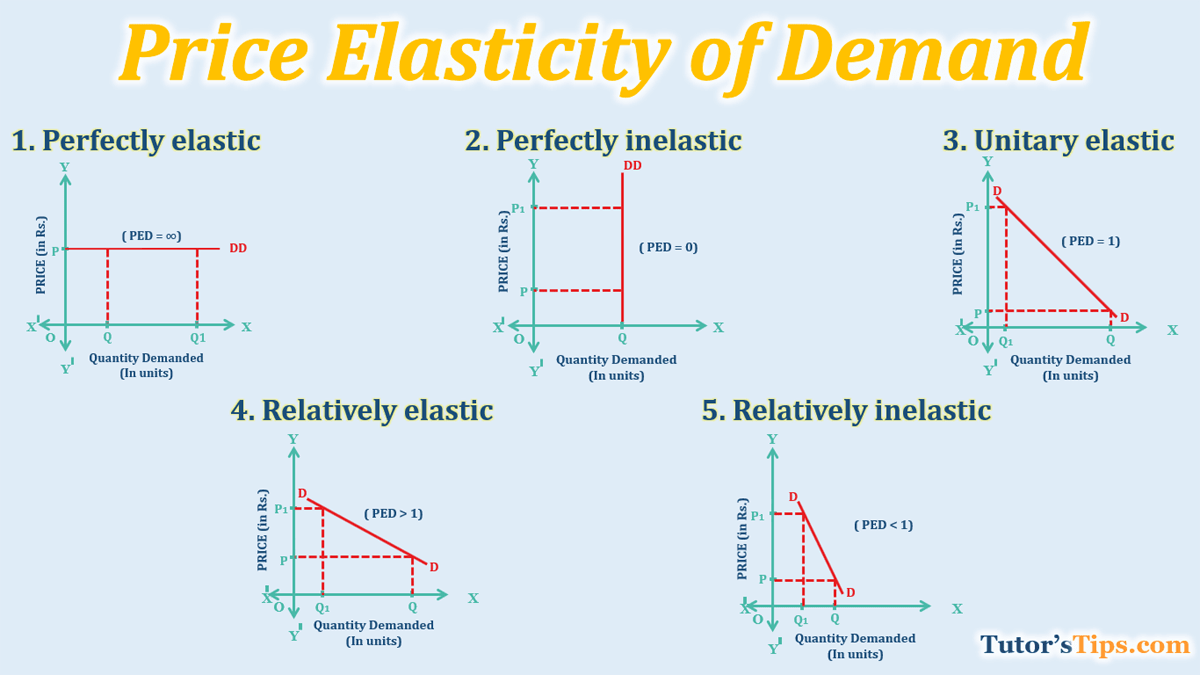
Based on the result of this calculation (which economists usually treat as a positive number by taking the absolute value), we can classify demand into several categories:
- Elastic Demand (PED > 1): A change in price leads to a proportionally larger change in quantity demanded. Consumers are very responsive to price changes. This is typical for goods with many substitutes, like a specific brand of soda. If its price rises, people will easily switch to another brand.
- Inelastic Demand (PED < 1): A change in price leads to a proportionally smaller change in quantity demanded. Consumers are not very responsive to price changes. This is common for necessities with few substitutes, like gasoline or life-saving medication.
- Unit Elastic Demand (PED = 1): A change in price leads to a proportionally equal change in quantity demanded.
The other two categories are theoretical extremes:
- Perfectly Inelastic Demand (PED = 0): The quantity demanded does not change at all, regardless of the price. The demand curve is a vertical line.
- Perfectly Elastic Demand (PED = ∞): Any price increase causes quantity demanded to drop to zero. The demand curve is a horizontal line.
2. What Determines Elasticity?
So, why is the demand for some goods elastic while for others it's inelastic? Several factors are at play, but the most important one is the availability of substitutes.
Let's watch a short video that breaks down the key determinants of price elasticity.
The video 'Elasticity of Demand' from Marginal Revolution University provides a clear and comprehensive explanation of the factors that make demand more or less elastic.
Please watch from 4:14 to 12:39. The video details five key determinants of elasticity. Try to think of an example for each one as you watch.
To summarize, here are the main determinants of price elasticity of demand:
| Determinant | More Elastic (More Responsive) | Less Elastic (Less Responsive) |
|---|---|---|
| Availability of Substitutes | Many substitutes are available (e.g., Bayer Aspirin vs. generic aspirin). | Few substitutes are available (e.g., insulin, oil in the short term). |
| Time Horizon | Long run. Consumers have more time to find alternatives (e.g., switch to smaller cars if gas prices stay high). | Short run. It's difficult to adjust behavior immediately. |
| Category of Product | Narrowly defined (e.g., lettuce). | Broadly defined (e.g., food). |
| Nature of the Good | A luxury good (e.g., a cruise). | A necessity (e.g., morning coffee for a daily drinker). |
| Size of Purchase | Large part of your budget (e.g., a car, rent). You notice and react to price changes. | Small part of your budget (e.g., toothpicks, salt). You may not even notice a price change. |
Test your understanding!
Consider the demand for Apple's iPhones. Would you expect the demand for "smartphones in general" to be more elastic or less elastic than the demand for "iPhones specifically"? Explain your reasoning based on the determinants of elasticity.Show answer
The demand for "smartphones in general" would be **less elastic** (more inelastic) than the demand for "iPhones specifically."The primary reason is the availability of substitutes and the classification of the good.
- iPhones (narrow classification): If the price of an iPhone increases, a consumer has several direct substitutes: Samsung Galaxy, Google Pixel, and other Android phones. It's relatively easy to switch. This makes demand for iPhones more elastic.
- Smartphones (broad classification): If the price of all smartphones increases, what are the substitutes? Basic feature phones? For most people in today's world, there are very few good substitutes for a smartphone. This makes the demand for the entire category of smartphones much less elastic.
3. Elasticity and Its Relevance to Antitrust Law
Now we arrive at the core connection to your future career. Understanding elasticity is not just for setting prices; it is a critical tool for lawyers and economists in antitrust cases.
Price Elasticity of Demand and Why It Is Relevant to Your Case
The article 'Price Elasticity of Demand and Its Relevance' from Econ One is written for a legal audience and directly explains why this concept matters in court. It clearly bridges the gap between economic theory and legal application.
Please read the section titled 'Why is Elasticity of Demand Evaluated?'. Focus on the three key applications presented: (1) defining the antitrust market, (2) analyzing market power, and (3) quantifying damages.
Let's break down these applications.
1. Analyzing Market Power
The central question in many antitrust cases is whether a firm has market power—the ability to raise prices above competitive levels without losing all of its customers.
How does elasticity reveal market power?
- If a company faces inelastic demand, it means consumers are not very sensitive to its price changes. The company can raise its price, and the quantity demanded will only fall by a little. This indicates the firm has significant market power.
- If a company faces elastic demand, it means consumers are very sensitive to price. If the company tries to raise its price, it will lose a large number of customers to competitors. This indicates the firm has little to no market power.
In essence, a low price elasticity of demand is evidence of market power. A monopolist, by definition, faces the entire market demand and can charge a higher price because consumers have few, if any, good substitutes.
2. Defining the Relevant Market
Before a court can assess market power, it must first define the "relevant market." Does Coca-Cola compete in the "cola market," the "carbonated soft drink market," or the "all non-alcoholic beverages market"? The answer determines Coca-Cola's market share and perceived power.
Elasticity is the key to answering this. The test often used is the Hypothetical Monopolist Test. It asks: if a hypothetical monopolist controlled all the products in a proposed market (e.g., all colas), could it profitably impose a "small but significant and non-transitory increase in price" (a SSNIP, typically 5-10%)?
- If the answer is yes, then the proposed market is a valid "relevant market." A 5% price increase on all colas would be profitable because not enough people would switch to non-cola substitutes (demand is inelastic for the group).
- If the answer is no, the market is too narrow. A 5% price increase on all colas would be unprofitable because too many people would switch to other drinks like juices or iced tea (demand is elastic). The market definition must be expanded to include those substitutes.
The Cellophane Fallacy
A classic trap in this analysis is the Cellophane fallacy, named after a famous 1956 Supreme Court case. DuPont, the sole producer of cellophane, argued it didn't have monopoly power because if it raised its price, customers would just switch to other flexible wrapping materials (like wax paper). The Court observed this high elasticity at the current price and agreed.
The fallacy? The fact that DuPont was already charging a high, monopoly price was the very reason customers were so sensitive to further increases! The high elasticity was a symptom of monopoly power being exercised, not proof of its absence. For an antitrust lawyer, it is crucial to consider whether elasticity is being measured at a competitive price level or at an already-inflated one.
4. Elasticity in Action: Real Court Cases
To solidify these principles, let's look at how courts have actually used elasticity arguments.
Price Elasticity of Demand and Why It Is Relevant to Your Case
This same article provides several concise summaries of actual U.S. court cases where elasticity was a deciding factor. These examples provide the practical reinforcement you're looking for.
Please read the section 'Recent and/or Noteworthy Case References to Elasticity of Demand'. Pay special attention to the FTC v. AbbVie case for market definition and the ICTSI Oregon case for damages.
As these cases show:
- In FTC v. AbbVie, the court looked at evidence of "little cross-elasticity of demand" to conclude that topical testosterone drugs and injectable ones were in separate markets. Doctors didn't readily switch patients from one to the other when prices changed.
- In Queen City Pizza v. Domino’s, the court dismissed the case because the plaintiffs failed to properly define the market using the principles of interchangeability and cross-elasticity.
- In ICTSI Oregon v. ILWU, the court found that damages were miscalculated because the model incorrectly assumed both prices and sales volume could increase simultaneously in a market with "a relatively elastic demand curve," which defies economic logic.
These examples demonstrate that elasticity is not just a theory but a practical, quantitative tool used to build and defeat legal arguments in high-stakes corporate litigation.
Conclusion
Today you've moved beyond the simple direction of market forces to understand their magnitude. Price elasticity of demand is the tool that measures the sensitivity of consumers to price changes, and it is a concept you will encounter repeatedly in your study of corporate and antitrust law.
Here are the key takeaways from this lesson:
- Price Elasticity of Demand (PED) measures the percentage change in quantity demanded in response to a percentage change in price.
- Demand can be elastic (responsive, PED > 1) or inelastic (unresponsive, PED < 1), largely determined by the availability of substitutes, the nature of the good (necessity vs. luxury), time, and budget share.
- In antitrust law, elasticity is crucial for analyzing market power (low elasticity suggests high market power) and defining the relevant market (using the Hypothetical Monopolist Test).
- Real-world court cases rely on evidence of elasticity to decide outcomes related to mergers, monopolies, and damages.
In our next lesson, we will shift our focus from the consumer back to the firm. We will explore marginal analysis, the process firms use to make profit-maximizing decisions. This will connect directly to elasticity, as a firm's optimal price depends critically on how its customers will respond to that price.