Welcome to your first lesson! We're starting with the foundational principles of business and economics that are essential for any corporate lawyer. Understanding how markets function is the first step toward analyzing complex corporate transactions, regulations, and disputes.
Today's lesson focuses on the core mechanism that drives all market activity: supply and demand. Your goal is to learn how to analyze the interaction between buyers and sellers to understand how the price and available quantity of any good or service are determined. This framework will be a vital tool for you, whether you're advising a startup on pricing strategy or analyzing the market impact of a merger for an antitrust case.
We will cover:
- The Law of Demand and what factors influence buyers' decisions.
- The Law of Supply and what factors influence sellers' decisions.
- How supply and demand interact to create market equilibrium.
- How to predict changes in price and quantity when market conditions change.
1. Understanding Demand
Demand, in economics, isn't just about wanting something. It's about being both willing and able to purchase it at a given price. The fundamental relationship between price and the quantity people are willing to buy is captured by the Law of Demand.
The law of demand states that, all other things being equal, as the price of a good or service increases, the quantity that consumers demand for it decreases, and vice versa. This creates a downward-sloping demand curve.
To get a quick and clear overview of the law of demand and the key reasons behind it, please watch the first part of the following video.
Supply and Demand in 8 Minutes
This video from Jacob Clifford's YouTube channel provides a very energetic and clear introduction to the concepts of supply and demand. We'll watch it in segments.
Please watch from the beginning until the 3:14 mark. Focus on: The definition of the demand curve and the reasons for its downward slope (0:23-1:28). The five 'shifters' that can cause the entire demand curve to move (1:28-3:14).
Movement vs. Shift in Demand
As the video explained, it's crucial to distinguish between two types of changes:
- A change in quantity demanded: This is a movement along the existing demand curve. It is caused only by a change in the price of the good itself. If a law firm lowers its hourly rate for contract review, it will see an increase in the quantity of hours demanded—a movement down along its demand curve.
- A change in demand: This is a shift of the entire demand curve to the left (a decrease in demand) or to the right (an increase in demand). This is caused by a change in one of the non-price "shifters" or "determinants."
The five key shifters of demand are:
- Tastes and Preferences: A new study praising a product, or a change in fashion.
- Number of Consumers: An increase in population or a new market opening up.
- Price of Related Goods:
- Substitutes: If the price of coffee (a substitute for tea) goes up, the demand for tea will increase.
- Complements: If the price of movie tickets (a complement to popcorn) goes up, the demand for popcorn at the theater will decrease.
- Income: For normal goods, as income rises, demand increases. For inferior goods (like instant noodles), as income rises, demand decreases.
- Future Expectations: If you expect the price of a new phone to drop next month, your demand for it today will decrease.
Test your understanding!
Imagine a new law is passed that requires all small business owners to file an additional complex annual report, which most will need legal help to complete. From the perspective of law firms offering compliance services, which of the five demand shifters is primarily affected, and how does it affect the demand curve for their services?Show answer
The **Number of Consumers** is the primary shifter affected. The law effectively creates a new pool of consumers who now need these specific legal services. This will cause the demand curve for legal compliance services to shift to the right, indicating an increase in demand at every price point.2. Understanding Supply
Now let's turn to the other side of the market: the sellers. The Law of Supply works in the opposite direction to the law of demand.
The law of supply states that, all other things being equal, as the price of a good or service increases, the quantity that producers are willing to supply increases. Why? Because a higher price generally means higher potential profit, which creates an incentive to produce more. This results in an upward-sloping supply curve.
Let's return to the video to see how this works.
Supply and Demand in 8 Minutes
We'll now watch the next segment of the 'Supply and Demand in 8 Minutes' video to cover the basics of supply.
Please watch from 3:14 to 5:01. Pay attention to: The definition of the supply curve and why it slopes upward (3:14-3:39). The five 'shifters' of supply (3:39-5:01).
Movement vs. Shift in Supply
Just like with demand, we must distinguish between a movement along the supply curve and a shift of the entire curve.
- A change in quantity supplied: A movement along the supply curve caused only by a change in the good's own price.
- A change in supply: A shift of the entire curve caused by a non-price determinant.
The five key shifters of supply are:
- Price of Resources/Inputs: If the cost of steel goes up, the supply of cars decreases (shifts left).
- Technology: A new, more efficient manufacturing process increases supply (shifts right).
- Government Actions (Taxes, Subsidies, Regulations): A new tax on production decreases supply (shifts left). A government subsidy increases supply (shifts right). A new environmental regulation that makes production costlier decreases supply (shifts left).
- Number of Sellers: More firms entering the market increases supply (shifts right).
- Future Expectations: If a farmer expects corn prices to be much higher next season, they might hold back some of their current crop, decreasing the current supply.
3. Market Equilibrium: Where Supply Meets Demand
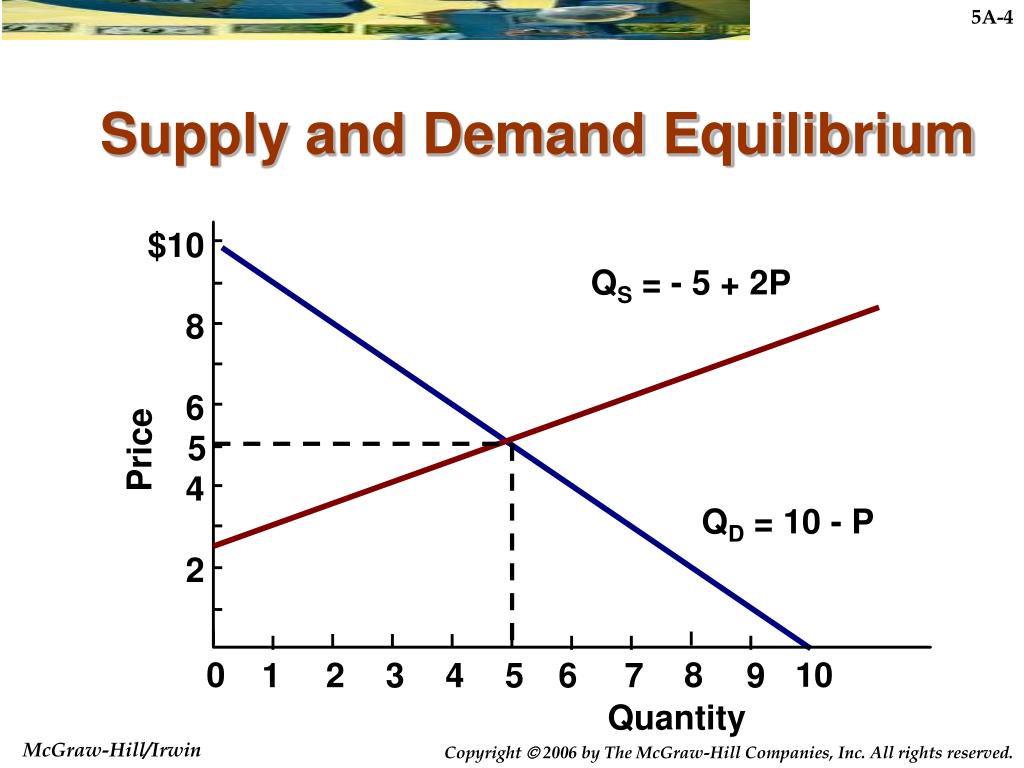
We've looked at buyers and sellers separately. Now, let's bring them together. The market reaches equilibrium at the price where the quantity consumers are willing to buy is exactly equal to the quantity producers are willing to sell.
- Equilibrium Price (P*): The price that balances quantity supplied and quantity demanded.
- Equilibrium Quantity (Q*): The quantity supplied and demanded at the equilibrium price.
Graphically, this is the single point where the supply and demand curves intersect.
What happens if the price is not at equilibrium?
- Surplus (Excess Supply): If the price is above equilibrium, suppliers are willing to sell more than consumers are willing to buy. To get rid of their excess inventory, sellers will be forced to lower prices, moving the market back toward equilibrium.
- Shortage (Excess Demand): If the price is below equilibrium, consumers want to buy more than suppliers are willing to sell. Eager buyers will bid the price up, and producers will be incentivized to supply more, moving the market back toward equilibrium.
To see a detailed walkthrough of how markets naturally adjust from a shortage or surplus back to equilibrium, please study the following reading.
Predicting Changes in Equilibrium Price and Quantity | Outlier
The article 'Predicting Changes in Equilibrium Price and Quantity' from Outlier provides a clear explanation of equilibrium and market adjustments.
Please read the sections titled 'What Are the Equilibrium Price and Equilibrium Quantity?' and 'Surpluses and Shortages'. Focus on how a price above or below equilibrium creates a surplus or shortage, and the market pressures that push the price back towards equilibrium.
4. Analyzing Changes in Equilibrium
The true power of this model lies in its ability to predict how events will impact market prices and quantities. As a lawyer, you might analyze the impact of a new regulation, a merger between two large competitors, or a disruptive technology.
This involves a simple, three-step process:
- Does the event affect supply, demand, or both?
- Which way does the curve shift? (Right for an increase, left for a decrease).
- How does the shift affect the equilibrium price and quantity? (Compare the new intersection point to the old one).
Let's use the resource from Outlier again for a structured approach.
Predicting Changes in Equilibrium Price and Quantity | Outlier
This reading will give you a step-by-step framework for analyzing how an event affects market equilibrium.
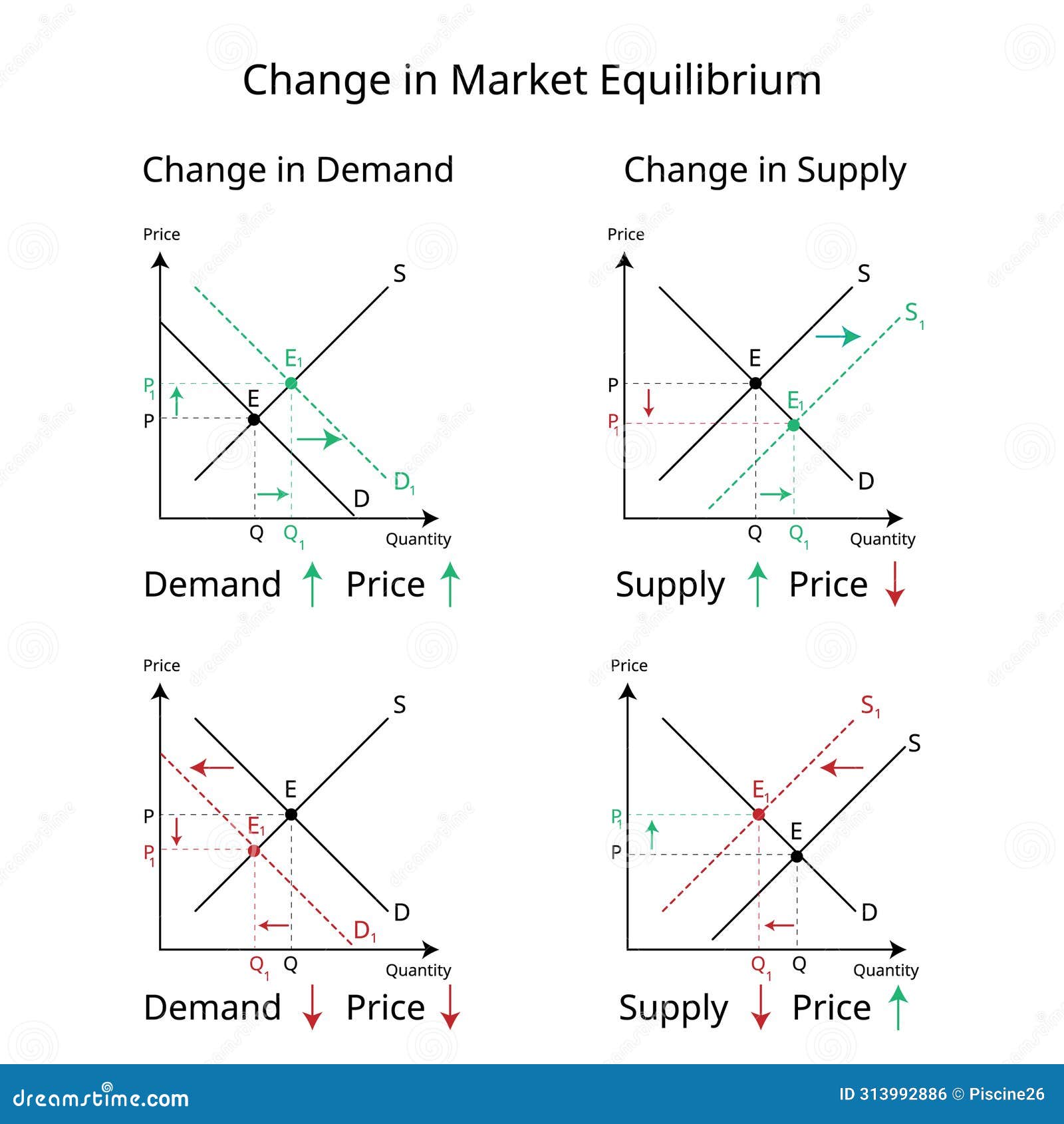
Please read the sections titled '5 Steps To Predict Changes in Equilibrium Price and Quantity' and 'Summary of How Supply and Demand Shifts Impact Equilibrium'. The '5 Steps' section provides a clear method, and the summary figures (like the image we saw earlier) are a great reference.
Here is a summary of the four basic shifts:
- Demand Increases: The demand curve shifts right. Result: Higher Equilibrium Price, Higher Equilibrium Quantity.
- Demand Decreases: The demand curve shifts left. Result: Lower Equilibrium Price, Lower Equilibrium Quantity.
- Supply Increases: The supply curve shifts right. Result: Lower Equilibrium Price, Higher Equilibrium Quantity.
- Supply Decreases: The supply curve shifts left. Result: Higher Equilibrium Price, Lower Equilibrium Quantity.
Test your understanding!
Let's consider the market for electric vehicles (EVs). Suppose the government introduces a significant new subsidy for EV manufacturers (a payment for each car they produce). At the same time, due to rising environmental awareness, consumer preferences are strongly shifting in favor of EVs.- How do these two events affect the supply and demand curves?
- What is the definite effect on the equilibrium quantity of EVs sold?
- What is the ambiguous or uncertain effect on the equilibrium price of EVs? Why is it uncertain?
Show answer
1. The subsidy to manufacturers **increases supply**, shifting the supply curve to the right. The change in consumer preferences **increases demand**, shifting the demand curve to the right. 2. Since both supply and demand are increasing (shifting right), the **equilibrium quantity will definitely increase**. 3. The effect on the **equilibrium price is ambiguous**. The increase in demand puts upward pressure on the price, while the increase in supply puts downward pressure on the price. The final effect on price depends on the *magnitude* of the shifts. If the demand shift is larger than the supply shift, the price will rise. If the supply shift is larger, the price will fall.Conclusion
Congratulations on completing your first lesson! You've learned the fundamental framework that economists and business leaders use to understand how markets operate.
Here are the key takeaways:
- The Law of Demand describes an inverse relationship between price and quantity demanded (downward-sloping curve).
- The Law of Supply describes a positive relationship between price and quantity supplied (upward-sloping curve).
- Changes in a good's own price cause movements along the curves, while other factors (shifters) cause the entire curve to shift.
- Market equilibrium occurs at the intersection of supply and demand, where quantity supplied equals quantity demanded. Prices naturally adjust to resolve shortages and surpluses.
- By analyzing shifts in supply and demand, we can predict the impact of real-world events on market prices and quantities.
In our next lesson, we will build directly on this foundation to explore price elasticity of demand. We will answer the question: how much does quantity demanded change when the price changes? This concept is not just a theoretical detail—it is a critical element in corporate pricing strategies and, most importantly for your goals, in antitrust analysis when determining a company's market power.