Hello! Welcome back to our module on Mergers and Acquisitions.
In our last lesson, we analyzed the legal steps for a statutory merger, culminating in a vote where the majority rules. This naturally raises a crucial question: what happens to the shareholders who vote "no"? Are they simply forced to accept a price they believe is unfair? Corporate law provides a powerful answer to this dilemma.
Today, we will delve into that answer: appraisal rights. This is a legal remedy that allows shareholders who dissent from a merger to have a court determine the "fair value" of their shares and be paid that amount in cash.
Your learning outcome for this lesson is to: Examine the appraisal rights available to dissenting shareholders in merger transactions.
By the end of this session, you'll understand the purpose of appraisal rights, the strict procedure required to exercise them, and how a court goes about the complex task of putting a "fair" price on a company's stock.
1. The "Why": A Shield for the Minority
Appraisal rights are one of the most important protections for minority shareholders in corporate law. Before these rights were established by statute, the common law required unanimous shareholder consent for fundamental corporate changes like a merger. This gave a single shareholder the power to block a deal, an obviously impractical rule for modern commerce.
States changed their laws to allow mergers to be approved by a majority vote. To balance this shift and protect the minority from being "squeezed out" at an unfair price, they created the statutory right of appraisal.
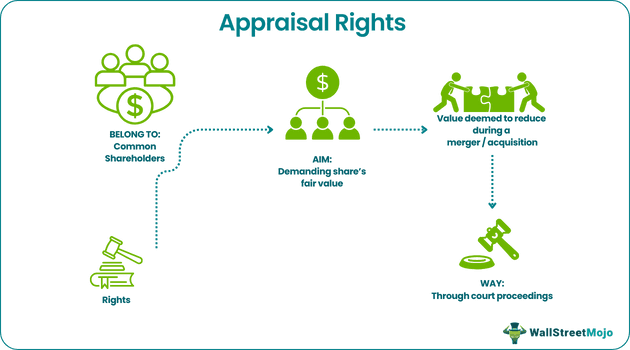
Essentially, appraisal rights are the grand bargain of corporate democracy: the majority gets to approve the deal, but the dissenting minority gets the right to a fair cash price for their shares, as determined by a neutral judge, instead of the merger consideration.
Appraisal Rights and Section 262 of the Delaware General ...
To understand this foundational concept, we'll start with a concise explanation from a Lexology article discussing Delaware's primary appraisal statute, Section 262 of the Delaware General Corporation Law (DGCL).
Please read the introductory paragraphs of this article. Focus on the core purpose of appraisal rights: to protect minority shareholders from being forced to accept merger consideration they deem unfair.
2. The "When": Triggering Events and Exceptions
While appraisal rights are most commonly associated with mergers, the specific events that trigger them are defined by statute.
Under Delaware law, appraisal rights are automatically available in most mergers and consolidations. However, there is a significant exception known as the "market-out" exception.
The logic is this: if you own stock in a large, publicly traded company (e.g., listed on the New York Stock Exchange) and you don't like the merger terms, you have a readily available alternative—you can simply sell your shares on the open market for cash. Therefore, the statute "cashes you out" of your appraisal right.
However, the market-out exception has its own exception! If the shareholders of that public company are being asked to accept anything other than stock in another publicly traded company or cash, then appraisal rights are still available. The most common scenario is an all-cash merger, where a public company is taken private. In that case, even if the company's stock is widely traded, shareholders still get appraisal rights.
An Appraisal of Appraisal Rights in Delaware
The academic paper 'An Appraisal of Appraisal Rights in Delaware' provides a clear explanation of these triggering events and the important market-out exception.
Read the section titled 'Triggering Events in Delaware'. Pay close attention to the general rule for mergers and the explanation of the 'market-out' exception and when it does not apply (e.g., when consideration is paid in cash).
3. The "How": A Strict Procedural Path
Exercising appraisal rights is not as simple as just voting "no." Corporate statutes lay out a very specific and unforgiving procedural path that a shareholder must follow. A misstep at any stage can result in the forfeiture of the right. This is often called "perfecting" the appraisal right.
While the exact deadlines vary by jurisdiction, the key steps are generally as follows:
- Continuous Ownership: The shareholder must hold the shares from the date of the demand through the effective date of the merger.
- Written Demand: The shareholder must deliver a formal written demand for appraisal to the corporation before the shareholder vote on the merger takes place. This demand must state the shareholder's identity and their intent to demand appraisal. This is a critical step; simply voting against the merger is not enough.
- Do Not Vote in Favor: The shareholder must not vote in favor of the merger. They can either vote against it or abstain.
- File a Petition in Court: If the shareholder and the company cannot agree on a value, the shareholder (or the company) must file a petition in the appropriate court (in Delaware, the Court of Chancery) within a set time period after the merger becomes effective (e.g., within 120 days under DGCL § 262).
This process is designed to put the company on notice of its potential liability before the deal closes, allowing it to assess the "appraisal risk." Sometimes, merger agreements even include a condition allowing the buyer to walk away if more than a certain percentage of shareholders demand appraisal.
Corporations 7: Stockholders - Rights, Powers, & Liabilities
To get a sense of this procedural flow, let's watch a segment from a lecture by Atty. Javier. While this is based on Philippine law, the core principles of dissenting, making a written demand, and the process for valuation are conceptually very similar to the U.S. approach and provide a great overview.
Watch the video from 17:46 to 20:30. Listen for the key steps a dissenting stockholder must take, such as voting against the action and making a written demand within a specific timeframe.
Now, let's anchor those general principles in the specific context of Delaware law.
An Appraisal of Appraisal Rights in Delaware
The article 'An Appraisal of Appraisal Rights in Delaware' details the Delaware-specific process.
Read the section 'The Appraisal Process in Delaware,' including the subsections 'The Process for Seeking an Appraisal' and 'Commencement of Appraisal Proceeding.' This will solidify your understanding of the strict procedural requirements under the DGCL.
4. The Courtroom: Determining "Fair Value"
Once the case is in court, the judge's sole task is to determine the fair value of the dissenter's shares. This is the heart of the proceeding.
Key Principles:
- Going Concern Value: The court values the company as a going concern, meaning its value as an operating business.
- Exclusion of Merger Value: The valuation is determined as of the moment just before the merger. Any value created by the merger itself—such as anticipated cost savings (synergies) or the buyer's strategic plans—is explicitly excluded. The question is not "what is this stock worth to the buyer?" but "what was the shareholder's proportionate interest in the standalone company worth?"
- No Minority Discounts: The court values the shareholder's piece of the overall company pie, not what their small, non-controlling block of shares would fetch in a private sale.
To arrive at this value, the court proceeding turns into a "battle of the experts," with each side presenting complex financial analyses.
An Appraisal of Appraisal Rights in Delaware
So how does a judge actually calculate this 'fair value'? The process involves sophisticated financial modeling. The following reading explains the primary methods used.
Please read the section 'Valuation Methodologies.' Focus on understanding the conceptual basis of the three main methods: Discounted Cash Flow (DCF), comparable companies, and comparable transactions. Note the article's emphasis on the subjectivity and uncertainty inherent in these models.
As you read, the Discounted Cash Flow (DCF) analysis is the most important method to understand conceptually. It involves projecting the company's future cash flows and then using a "discount rate" to calculate what that future stream of cash is worth today. Even small changes in the assumptions (like the growth rate or the discount rate) can lead to vastly different valuations, which is why the experts' conclusions often diverge so dramatically.
5. Risk vs. Reward: Is It Worth It?
Given the cost, time, and uncertainty, why would a shareholder pursue appraisal? The answer lies in the potential rewards.
- Risk: The biggest risk is that the court could determine a fair value that is lower than the price offered in the merger. The shareholder is not guaranteed to do better. They also face significant legal fees and years of waiting for their money.
- Reward #1 (Higher Valuation): The court may determine that the merger price was indeed too low and award a higher value. Empirical studies of Delaware cases show that this happens frequently.
- Reward #2 (Statutory Interest): This is a powerful incentive. Delaware law awards dissenting shareholders interest on the final award amount, calculated from the date of the merger until the date of payment. The rate is generous: 5% over the Federal Reserve discount rate. This compensates shareholders for the long wait and for the company's use of what was rightfully their money. This interest award can turn even a modest valuation increase into a very attractive return, which has led to a strategy known as "appraisal arbitrage," where hedge funds buy into deals specifically to pursue this remedy.
An Appraisal of Appraisal Rights in Delaware
Let's explore this risk/reward calculation, paying special attention to the crucial role of statutory interest.
Read the section 'Empirical Analysis of Appraisal Actions Since 2010.' Focus on the discussion of risks (cost, time, uncertainty) versus the unique benefits, especially the generous statutory interest rate and what the empirical evidence suggests about outcomes.
Test your understanding!
A corporation is acquired in a cash merger for $100 per share. A dissenting shareholder properly perfects her appraisal rights. The case goes to the Delaware Court of Chancery. After a lengthy trial, the judge rules that the "fair value" of the shares at the time of the merger was $110 per share. The final judgment is entered two years after the merger closed.
What will the shareholder receive, and why is it more than just $110 per share?
Show answer
The shareholder will receive $110 per share, which is the judicially determined fair value. In addition, she will receive statutory interest on that $110 per share award, calculated from the effective date of the merger to the date the payment is actually made. This interest, which compounds quarterly at a rate of 5% over the Federal Reserve discount rate, compensates her for the two-year delay and the fact that the company had use of her capital during that time.
Conclusion
Appraisal rights are a cornerstone of shareholder protection in M&A. They provide a vital check on the power of the majority, ensuring that dissenters have a path to a fair price, even if it requires a fight.
Key Takeaways:
- Appraisal rights are a statutory remedy for shareholders who dissent from a merger, allowing them to seek a judicial determination of the "fair value" of their shares.
- The remedy is a trade-off for abandoning the old common law rule of unanimous consent for mergers.
- Exercising the right requires strict adherence to a specific legal procedure, including making a written demand before the shareholder vote.
- The court's goal is to determine the company's value as a going concern before the merger, excluding any value from the deal itself. This often involves a "battle of experts" using financial models like DCF.
- While pursuing appraisal is risky, costly, and time-consuming, the potential for a higher valuation combined with a generous statutory interest rate makes it a powerful tool for shareholders.
In this lesson, we focused on the shareholder's remedy when they disagree with the price of a deal. But what if the problem isn't just the price, but the process itself? What if the board of directors that approved the deal was conflicted or failed to do its job properly?
In our next lesson, we will shift our focus from shareholder remedies to director responsibilities. We will apply fiduciary duty principles to evaluate board approval of M&A transactions, exploring the high standards to which directors are held when selling the company.