Hello! Welcome back to our module on Mergers and Acquisitions.
In our last lesson, we explored appraisal rights—a powerful remedy for shareholders who believe a merger price is unfair. We focused on the shareholder's perspective, viewing the deal from the outside in. Today, we shift our focus to the boardroom and examine the deal from the inside out. When a board of directors decides to sell the company, what are their obligations? How do we ensure they are acting in the shareholders' best interests?
This lesson will introduce you to the core legal principles that govern the board's conduct in M&A transactions: their fiduciary duties.
Your learning outcome for this lesson is to: Apply fiduciary duty principles to evaluate board approval of M&A transactions.
By the end of our session, you will be able to distinguish between the duties of care and loyalty, understand the different standards of judicial review that courts apply, and analyze how a board's process can be the difference between a protected business decision and a breach of duty.
1. The Foundation: What is a Fiduciary Duty?
At its heart, a fiduciary duty is a duty of trust. It is the highest standard of care recognized by law, requiring a person (the "fiduciary") to act in the best interests of another (the "principal"). In a corporation, the directors are fiduciaries for the corporation and its shareholders.
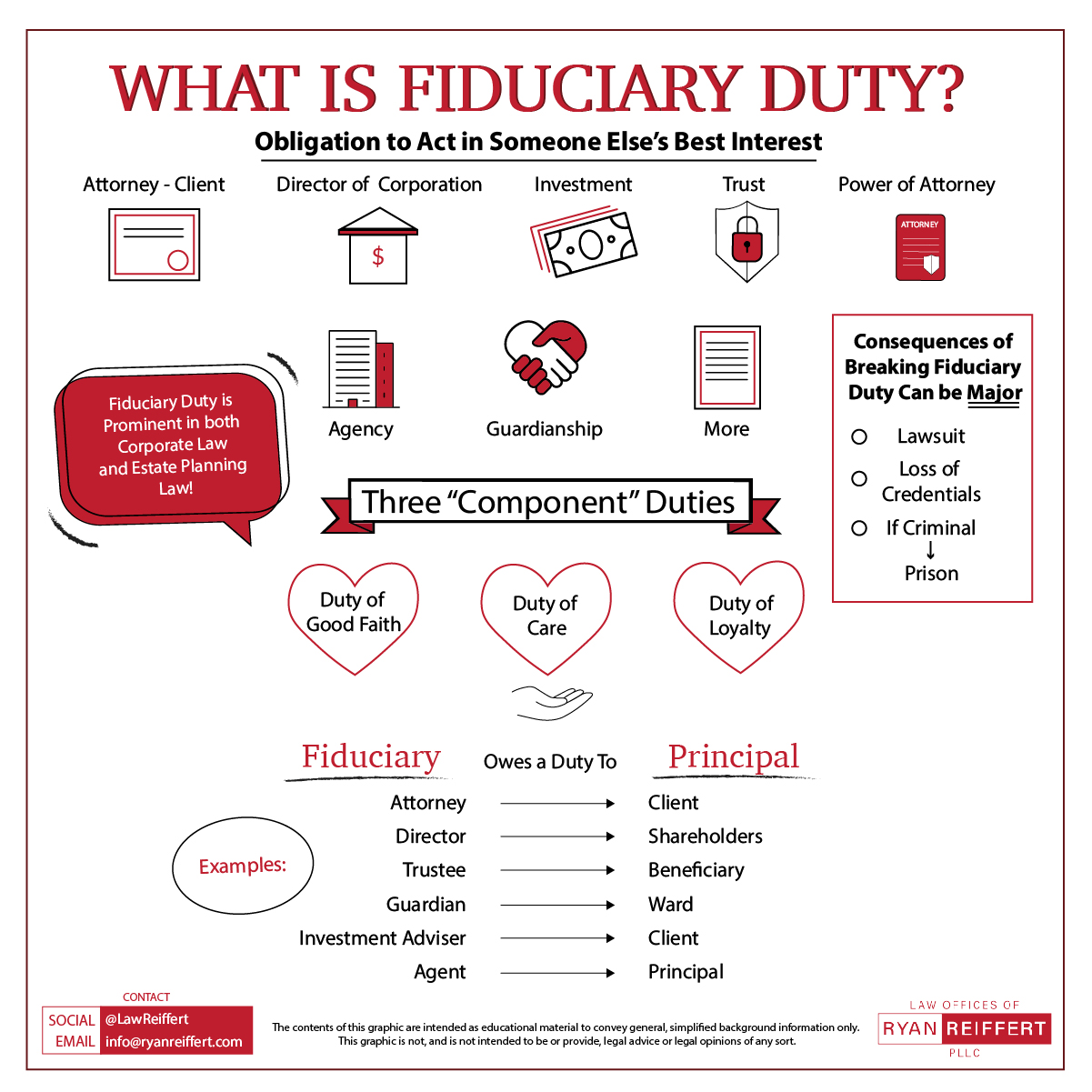
These duties are not just abstract ideals; they are enforceable legal obligations. They originate from the law of agency, where an agent is bound to act on behalf of a principal. Directors are agents entrusted with managing the shareholders' property—the corporation itself.
Corporate Law Fiduciary Duties of Directors (Review)
To ground our understanding, let's watch a brief introduction from the 'Corporate Law Fiduciary Duties (Review)' video by Business Law Education. This clip explains the origin of these duties in agency law.
Watch from the beginning to 02:49. Focus on the relationship described between directors (agents) and shareholders (principals) and the core problem fiduciary duties are designed to solve: ensuring agents work for the principals' benefit, not their own.
Under Delaware law, the general fiduciary duty of directors is composed of two primary duties:
- The Duty of Care: The duty to be informed and to make decisions with a level of care that a reasonably prudent person would exercise in a similar position.
- The Duty of Loyalty: The duty to act in good faith and to put the interests of the corporation and its shareholders ahead of any personal interests.
2. The Default Standard: The Business Judgment Rule
Courts are generally reluctant to second-guess the decisions of a board of directors. The law recognizes that business is inherently risky and that directors, not judges, are best equipped to make business decisions. This judicial deference is embodied in the Business Judgment Rule (BJR).
The BJR is a legal presumption that in making a business decision, the directors of a corporation:
- Acted on an informed basis (fulfilling the Duty of Care),
- Acted in good faith and without a disabling conflict of interest (fulfilling the Duty of Loyalty), and
- Acted in the honest belief that the action was in the best interests of the company.
If the BJR applies, a court will not overturn the board's decision unless it cannot be attributed to any rational business purpose. The burden is on the shareholder challenging the decision to rebut this powerful presumption.
A Brief Introduction to the Fiduciary Duties of Directors
For a concise legal summary of these core duties and the Business Judgment Rule, please read the introductory section of the following document from Stanford Law School.
Please read the section titled 'II. GENERAL FIDUCIARY DUTIES OF DIRECTORS' (pages 841-842). Focus on the definitions of the duties of care and loyalty, the presumption of the business judgment rule, and what happens when that presumption is rebutted (the shift to the 'entire fairness' standard).
3. The Duty of Care in M&A: The Van Gorkom Revolution
What does it mean for a board to be "informed" when approving a merger? The most famous—and cautionary—case on this subject is Smith v. Van Gorkom. This case fundamentally changed corporate practice by demonstrating that a flawed process could lead to director liability, even if the deal price seemed fair.
The case involved the sale of the TransUnion corporation. The CEO, Jerome Van Gorkom, privately negotiated a sale price with a buyer without any independent valuation. The board, composed of highly experienced business leaders, approved the sale after a mere two-hour meeting, without ever seeing the merger agreement or challenging the CEO's proposed price. They believed the significant premium over the market price was proof enough of a good deal.
They were wrong. The Delaware Supreme Court found the directors "grossly negligent" and held that they had breached their duty of care. The BJR did not protect them because their decision was not an informed one.
Van Gorkom: The Business Judgment Rule and the Duty of Care in Modern Corporate Governance Law
The story of Van Gorkom is a crucial lesson for any aspiring corporate lawyer. This video provides a detailed breakdown of the case.
Please watch the following segments, which cover the essential facts and failings of the board's process: Introduction (00:00 - 00:52): Sets the stage for the BJR and the case's importance. The People Involved (05:25 - 09:09): Explains the potential conflicts of the CEO and the pre-board negotiations. The Board Meeting (09:09 - 13:21): Details the sophisticated board members and the fatal flaws of their two-hour meeting. Why the BJR Didn't Apply (15:41 - 19:15): Explains the court's reasoning for holding the directors liable for their uninformed decision.
The Van Gorkom decision sent shockwaves through the corporate world. Its legacy is the modern M&A process, which now emphasizes:
- Process over Price: Demonstrating a careful, deliberative process is paramount.
- Independent Advice: Boards now routinely hire independent financial advisors (investment banks) to conduct a valuation and provide a "fairness opinion."
- Documentation: Meetings are longer, and decisions are meticulously documented in board minutes to create a record of informed deliberation.
In response to the fear of director liability after Van Gorkom, Delaware enacted Section 102(b)(7) of its corporate law. This allows corporations to include a provision in their articles of incorporation that exculpates (eliminates) monetary liability for directors for breaches of the duty of care. However, it does not protect them from breaches of the duty of loyalty.
4. The Duty of Loyalty: Conflicts of Interest and Entire Fairness
The duty of loyalty demands that a director's decisions be motivated by the corporation's best interests, not their own. This duty is most seriously tested when a director has a conflict of interest. In an M&A context, this can happen if a director:
- Stands on both sides of the transaction (e.g., has a significant financial interest in the acquiring company).
- Will receive a personal benefit not shared by other shareholders (e.g., lucrative employment with the new company after a management-led buyout).
When a plaintiff can show that a majority of the board was interested or that a conflicted director controlled the process, the Business Judgment Rule is rebutted. The standard of review shifts from deference to scrutiny, and the directors must prove the entire fairness of the transaction.
Entire fairness has two components:
- Fair Dealing (Process): How the deal was timed, initiated, structured, and negotiated. Was the process arm's-length?
- Fair Price (Substance): Was the price offered fair from a financial point of view?
This is a much higher bar for directors to clear. However, they can shift the burden of proving unfairness back to the plaintiff by using a "cleansing mechanism," such as:
- Approval by a Special Committee of independent, disinterested directors who are properly empowered to negotiate and say no.
- Approval by a majority vote of the disinterested shareholders (often called a "majority-of-the-minority" vote).
Corporate Law Fiduciary Duties of Directors (Review)
Let's return to the 'Corporate Law Fiduciary Duties (Review)' video, which explains how courts analyze these director conflict of interest transactions and the cleansing process.
Watch the segment on the Duty of Loyalty from 55:51 to 01:06:06. Pay close attention to how the BJR presumption is lost, the concept of a director on both sides of a transaction, and the methods for 'cleansing' the transaction.
Test your understanding!
A board is considering a merger proposal from a private equity firm. The deal is a management-led buyout where the CEO and CFO will be retained and given a large equity stake in the newly private company. The board is composed of seven directors: the CEO, the CFO, and five independent outside directors.
- What fiduciary duty is most directly implicated by the CEO and CFO's involvement?
- What standard of review would a court likely apply to the board's decision to approve this deal, and why?
- What procedural step could the board take to gain more favorable judicial treatment?
Show answer
- The Duty of Loyalty is most implicated. The CEO and CFO have a clear conflict of interest. Their personal financial interests (continued employment and new equity) may diverge from the shareholders' interest in getting the absolute highest price possible.
- A court would likely apply the Entire Fairness standard. Because the CEO and CFO are clearly "interested" directors, the shareholder plaintiff would argue they improperly influenced the process. This rebuts the presumption of the Business Judgment Rule. The board would then bear the heavy burden of proving the transaction was the product of both fair dealing and a fair price.
- The board should form a Special Committee composed solely of the five independent directors. This committee should be given its own independent legal and financial advisors and the full authority to negotiate the deal on behalf of the company, including the power to reject the offer. This "cleansing" mechanism can shift the burden of proof back to the plaintiff to show the deal was unfair.
5. Enhanced Scrutiny: The Revlon Duty
In certain situations, Delaware courts apply a special, heightened standard of review that falls between the BJR and Entire Fairness. This is triggered when the board initiates a sale of the company or when a sale or "change of control" becomes inevitable.
This is known as the Revlon duty, named after the case Revlon, Inc. v. MacAndrews & Forbes Holdings, Inc.
When Revlon duties apply, the board's role changes from defenders of the corporate bastion to "auctioneers charged with getting the best price for the stockholders." The directors' sole focus must be on maximizing immediate shareholder value. Their actions will be judged on whether they were reasonable in pursuit of that goal. This doesn't mean they must hold a formal auction, but they must have a logical, well-reasoned process for ensuring they got the best value reasonably attainable.
A Brief Introduction to the Fiduciary Duties of Directors
The shift to becoming 'auctioneers' is a critical concept in M&A law. This resource provides a succinct explanation of when Revlon duties are triggered.
Please read section 'B. Revlon Duties and the Revlon Standard of Review' on pages 852-853. Focus on the three circumstances that trigger this change in duty and the primary objective of the board once in 'Revlon-mode.'
Conclusion
Evaluating a board's approval of a merger requires moving through a hierarchy of legal standards. You start with the presumption of the Business Judgment Rule, but you must be on the lookout for facts that rebut it. Was the board uninformed? Was it conflicted? Did it enter "Revlon-land"? Answering these questions is central to the practice of M&A law.
Key Takeaways:
- Directors owe fiduciary duties of Care (be informed) and Loyalty (be disinterested) to the corporation and its shareholders.
- The Business Judgment Rule (BJR) is the default, deferential standard that presumes directors acted properly. A plaintiff must rebut this presumption.
- A failure to be properly informed, as shown in Van Gorkom, is a breach of the duty of care and can lead to director liability (unless exculpated by a 102(b)(7) provision).
- A conflict of interest implicates the duty of loyalty and shifts the standard of review to Entire Fairness, requiring the board to prove both fair dealing and fair price.
- When a sale of the company becomes inevitable, the board's duty under Revlon is to reasonably pursue the highest value for shareholders.
In this lesson, we focused on the board's duties when approving a transaction. But what happens when the board doesn't want to approve a deal? In our next lesson, we will explore how boards defend against unwanted or "hostile" takeover attempts, examining common defenses like poison pills and staggered boards.