Hello! Welcome to the fourth lesson in our module on Corporate Governance and Fiduciary Duties.
In our last lesson, we drew a crucial line between the duty of care (the process of decision-making) and the duty of loyalty (the motivation behind it). We established that while directors can be protected from personal liability for honest mistakes related to care, they cannot be shielded from breaches of loyalty or acts of bad faith.
This raises a vital question for any business: if a director can be sued for making a decision that turns out poorly, how can anyone be expected to take the necessary risks to grow a company? The answer lies in today's topic. Our learning outcome is to apply the business judgment rule to evaluate director decision-making and liability.
This rule is arguably the most important doctrine in corporate governance. It acts as a shield, protecting directors from being unfairly second-guessed by courts and shareholders. For you as a future corporate lawyer, understanding how this shield works—and when it can be broken—is fundamental.
1. What Is the Business Judgment Rule?
At its core, the business judgment rule (BJR) is a legal presumption that directors have acted correctly. It assumes that when directors make a business decision, they do so on an informed basis, in good faith, and with the honest belief that their actions are in the corporation's best interest.
Let's start with a video that introduces the rule and its purpose.
This video from LawShelf, 'The Business Judgement Rule,' provides a concise overview of the doctrine, its function, and the rationale behind it.
Please watch the first two sections (00:06 - 02:05). Focus on how the rule acts as a 'caveat' to the duty of care and its primary function of protecting directors from liability for decisions that are made in good faith, even if they end up being 'poor or unwise.'
As the video explains, the BJR is not a law written by a legislature, but a principle developed by courts over time. Its purpose is to prevent judges and juries, who lack business expertise, from substituting their own judgment for that of the directors. The rule acknowledges that business is inherently risky, and good-faith decisions that lead to losses should not automatically lead to personal liability.
This idea is so central that it shifts the entire dynamic of a lawsuit.
What Is the Business Judgment Rule? With Exemptions & Example
The article 'What Is the Business Judgment Rule?' from Investopedia reinforces this concept and explains the burden of proof.
Read the sections 'What Is the Business Judgment Rule?' and 'Understanding the Business Judgment Rule'. Note the explanation that the rule creates a presumption and shifts the burden to the plaintiff (the accuser) to prove that the directors acted improperly.
2. The Three Pillars of the Business Judgment Rule
The protection of the BJR is powerful, but it's not absolute. Directors must earn it by meeting three core conditions. If they fail any of these, the shield drops, and their decision can be challenged in court.
The presumption of the BJR applies only if the directors' decision was:
- Made on an Informed Basis: Directors must make a reasonable effort to gather and consider all material information reasonably available to them. This is the cornerstone of the duty of care.
- Made in Good Faith: The decision must not involve fraud, illegality, or a conscious disregard for their duties.
- Made without a Conflict of Interest: The directors must be disinterested and independent, acting in the best interests of the corporation, not for their own personal gain. This links directly to the duty of loyalty.
The LawShelf video you watched earlier details these requirements.
Let's return to the 'The Business Judgement Rule' video to see how these elements are formally stated and applied.
Now watch from 02:05 to 03:21. This part outlines the standards of conduct required for the BJR to apply, referencing the American Law Institute's model language. It clearly states the three key conditions: being disinterested ('not interested'), being informed, and rationally believing the judgment is in the corporation's best interests.
In essence, if a plaintiff wants to sue a director over a business decision, they can't just say "the decision was bad." They must prove that the board failed on one of these three pillars—that they were uninformed, acted in bad faith, or had a conflict of interest.
3. Applying the Rule: When the Shield Works and When It Fails
Theory is one thing; application is another. Let's examine two landmark cases from Delaware—the most influential state for corporate law—to see how the BJR works in practice.
Case Study 1: The Shield Holds (Stone v. Ritter)
What happens when a company breaks the law, costing shareholders millions? Are the directors automatically liable for failing to prevent it? Not necessarily.
The LawShelf video concludes with a discussion of Stone v. Ritter, a case where a bank's directors were sued after the bank was fined for failing to file anti-money laundering reports.
The final segment of 'The Business Judgement Rule' video explains how the court applied the BJR in the Stone v. Ritter case.
Please watch from 03:08 to 05:13. Focus on the court's reasoning. Why were the directors protected even though the company's compliance system failed? What level of failure did the court say was necessary to overcome the BJR?
In Stone, the court found that the directors had implemented a monitoring system and had relied on reports from employees. Even though this system ultimately failed, the board had made a good-faith effort to exercise oversight. The court ruled that to hold directors liable for a failure of oversight, a plaintiff must show a "sustained or systematic failure of the board to exercise oversight," which is evidence of bad faith. Because the directors had tried, the BJR protected them.
Case Study 2: The Shield Shatters (Smith v. Van Gorkom)
This 1985 case is perhaps the most famous in corporate governance history. It sent shockwaves through boardrooms by holding a well-respected board personally liable for millions because they failed to be properly informed. It is the classic example of a BJR failure.
The case involved the sale of a company called TransUnion. The CEO, Jerome Van Gorkom, arranged a sale price of $55 per share without any formal valuation study and presented it to the board for approval on very short notice.
Van Gorkom: The Business Judgment Rule and the Duty of Care in Modern Corporate Governance Law
This video, 'Van Gorkom: The Business Judgment Rule and the Duty of Care', dives deep into this pivotal case. It perfectly illustrates what not to do as a board.
This is a detailed analysis, so we will focus on two key parts: The Flawed Process (09:20 - 14:24): Watch this segment to understand the facts of the board meeting. Note the short duration of the meeting (2 hours), the lack of a formal valuation study, and the fact that the directors didn't even read the merger agreement they were approving. The Court's Ruling (14:24 - 19:15): Now, watch the analysis of the court's decision. Pay close attention to why the business judgment rule did not apply. The key was the board's failure to become informed at the time of the decision. The court found their process was grossly negligent. Focus on the contrast with Stone v. Ritter. In Van Gorkom, the issue wasn't a bad outcome; it was a complete failure of process.
The lesson from Van Gorkom is clear: process matters. The directors were experienced, and the price might have even been fair, but they failed their duty of care by not performing basic due diligence. Because they were not "informed," the business judgment rule did not protect them, and they were found personally liable.
4. Visualizing the BJR: The Path to Liability
The application of the BJR can be understood as a flowchart. The plaintiff has the initial burden to rebut the presumption. If they succeed, the burden shifts to the directors.
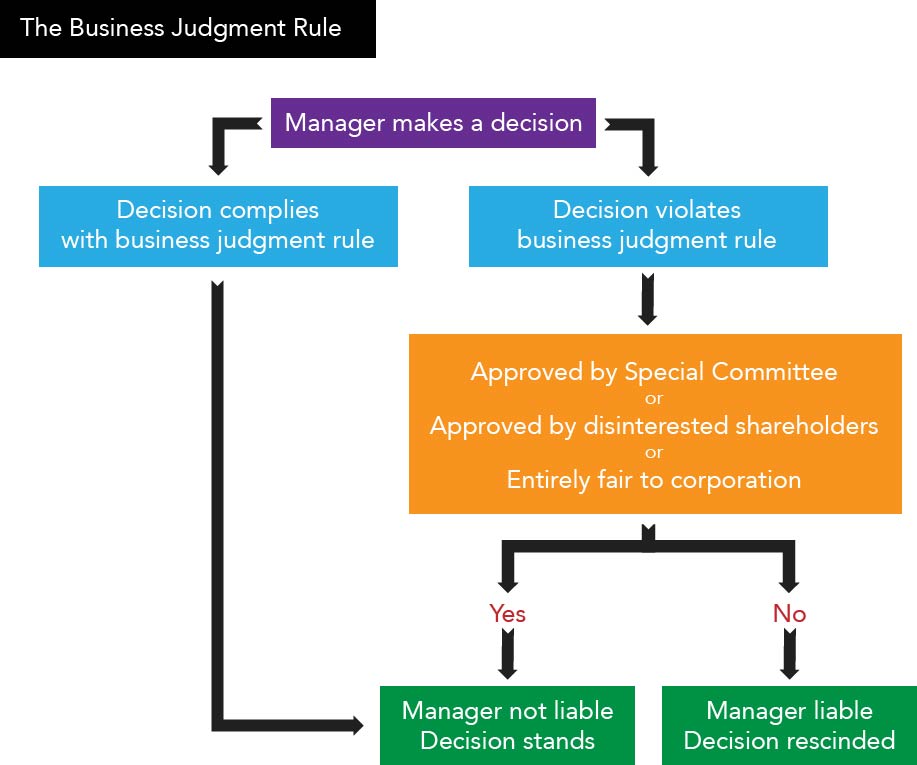
As you can see, the default path is "No Liability." It is the plaintiff's job to force the analysis down the more complex path by proving a failure of care, loyalty, or good faith.
Test your understanding!
A board of directors approves the acquisition of a tech startup for $100 million. Eighteen months later, the startup goes bankrupt, and the $100 million investment is lost. The shareholders sue the directors for breaching their duty of care.
Consider two scenarios:
- Scenario A: Before the vote, the board received and reviewed a 150-page due diligence report from an investment bank that analyzed the startup's technology, financials, and market position. They held three separate meetings, debated the high risks involved, and ultimately approved the deal based on its potential for long-term growth.
- Scenario B: The CEO, who was personal friends with the startup's founder, gave a passionate 15-minute presentation about the startup's "game-changing" potential. The board, impressed by the CEO's enthusiasm and without reviewing any financial documents or an independent analysis, approved the deal in a 30-minute meeting.
How would the business judgment rule likely apply in each scenario, and what would the outcome be?
Show answer
-
Scenario A: The BJR would almost certainly protect the board. They acted on an informed basis (commissioned and reviewed a report), had a deliberate process (three meetings, debate), and appeared to act in good faith with the corporation's best interests in mind. Even though the decision resulted in a massive loss, the process was sound. A court would not second-guess their business judgment. The case would likely be dismissed.
-
Scenario B: The BJR would likely not apply. The board's decision was not made on an informed basis. They relied solely on the CEO's enthusiasm without conducting their own due diligence, a failure of process reminiscent of the Van Gorkom case. A plaintiff could successfully rebut the BJR's presumption of care. The burden would then shift to the directors to prove that the transaction was "entirely fair" to the corporation—a very difficult standard to meet. They would face a high risk of being found personally liable.
Conclusion
Today, we've explored the business judgment rule, the most significant protection afforded to corporate directors.
Key Takeaways:
- The Business Judgment Rule (BJR) is a legal presumption that directors act on an informed basis, in good faith, and in the best interests of the corporation.
- Its purpose is to encourage rational risk-taking by preventing courts from second-guessing business decisions with the benefit of hindsight.
- To gain the BJR's protection, directors must be informed, act in good faith, and have no conflict of interest.
- A plaintiff can rebut the BJR presumption by showing a failure in one of these areas, most commonly by proving a grossly negligent decision-making process (as in Van Gorkom).
- If the BJR is rebutted, the shield drops, and the burden shifts to the directors to prove the decision was entirely fair to the corporation.
The BJR is the first line of defense in lawsuits alleging a breach of the duty of care. But what happens when the facts clearly show a conflict of interest, a breach of the duty of loyalty? In that situation, the BJR is unavailable from the start. In our next lesson, we will examine those scenarios and the much more stringent legal standard that applies: the entire fairness review.