Hello! Welcome to the final lesson in our module on Intellectual Property Strategy.
In our last lesson, we examined representations and warranties (R&Ws), the contractual promises a seller makes to a buyer in an M&A deal. We saw that these R&Ws are the buyer's primary tool for risk allocation, backed by the promise of indemnification. A key takeaway was that sellers use "disclosure schedules" to list exceptions to these R&Ws.
This naturally leads to a critical question: How does a buyer know if the seller's promises are accurate, and how does a seller know what needs to be disclosed? The answer to both is due diligence. This is the investigative process that underpins the entire transaction.
Your learning outcome for this lesson is to: Describe the process and purpose of conducting intellectual property due diligence.
We'll start by defining due diligence and its overall purpose in a corporate transaction. Then, we will zoom in on the specific goals and process of intellectual property due diligence, exploring the key questions a lawyer must ask to protect their client's interests.
1. What is Due Diligence? "Kicking the Tires" of a Business
At its core, due diligence is an investigation or audit of a company before entering into a transaction, such as a merger or acquisition. It is the process of verifying the information provided by the seller and uncovering any potential liabilities or risks. Think of it as the legal and financial equivalent of having a mechanic inspect a used car before you buy it.
To get a practical feel for what this process involves in an M&A context, let's start with a short video.
Mergers and Acquisitions Due Diligence Explained
The video 'Mergers and Acquisitions Due Diligence Explained' from attorney Brett Cenkus provides an excellent, high-level overview of the due diligence process, explaining its role and what it feels like for both the buyer and the seller.
Please watch the first two minutes of the video (from 00:00 to 02:22). As you watch, focus on: The fundamental purpose of due diligence: to "kick the tires" and ensure a buyer gets what they think they are buying. The types of information and documents that are typically requested. The nature of the process (often described as intensive and time-consuming).
As the video explains, due diligence is a comprehensive review covering all aspects of a business—finance, operations, HR, and, critically, its legal standing. For our purposes, we are focusing on one of the most important components of legal due diligence in the modern economy: intellectual property.
2. The Purpose of IP Due Diligence: Valuing the Crown Jewels
In today's technology- and brand-driven markets, a company's most valuable assets are often intangible. A buyer isn't just acquiring factories or inventory; they are acquiring patents, source code, customer data, and brand reputation. If these IP assets are flawed—if the seller doesn't truly own them, if they infringe on another company's patent, or if they are subject to a restrictive license—the value of the entire deal can be undermined.
The purpose of IP due diligence is to prevent this by systematically assessing the quality and status of a target company's IP assets.
Intellectual Property Due Diligence: A Critical Prerequisite to ...
The article 'Intellectual Property Due Diligence: A Critical Prerequisite' from FindLaw's corporate counsel section provides an excellent breakdown of the goals of this process. It explains why a thorough IP review is essential before any investment or acquisition.
Please read the section titled 'The Goals of Intellectual Property Due Diligence'. This section clearly lists five primary objectives. As you read, notice how each goal directly corresponds to a risk that a buyer would want to avoid.
The FindLaw article provides a clear framework. The five core goals of IP due diligence are:
- Identify and locate the IP assets. The first step is to create a complete inventory of all the patents, trademarks, copyrights, trade secrets, domain names, and software that the target company claims to own or use.
- Ascertain the nature and scope of the target's rights. Does the company truly own the IP, or does it merely have a license to use it? If it's a license, what are the terms? Is it exclusive? Can it be terminated?
- Evaluate the validity of the target's rights. For registered IP like patents and trademarks, this means checking if they were properly filed, if maintenance fees are paid, and if they are legally enforceable. An expired patent or an abandoned trademark application is worthless.
- Evaluate potential infringement claims. This is a two-way street. First, does the target's technology infringe on a third party's IP? (This is an "outbound" risk, as it could lead to the buyer inheriting a lawsuit). Second, is a third party infringing on the target's IP? (This is an "inbound" risk, as it could devalue the asset being purchased).
- Analyze any grants of rights made by the target. Has the company already licensed its key technology to someone else? If it granted an exclusive license to a competitor, the buyer may not be able to use the IP as intended.
These goals directly inform the representations and warranties we discussed in the last lesson. The findings from due diligence provide the buyer with the information needed to negotiate specific R&Ws and identify what must be included in the seller's disclosure schedules.
3. The Process of IP Due Diligence: A Systematic Investigation
Now that we understand why IP due diligence is done, let's look at how it is done. It's a systematic process of requesting information, reviewing documents, and conducting independent searches.
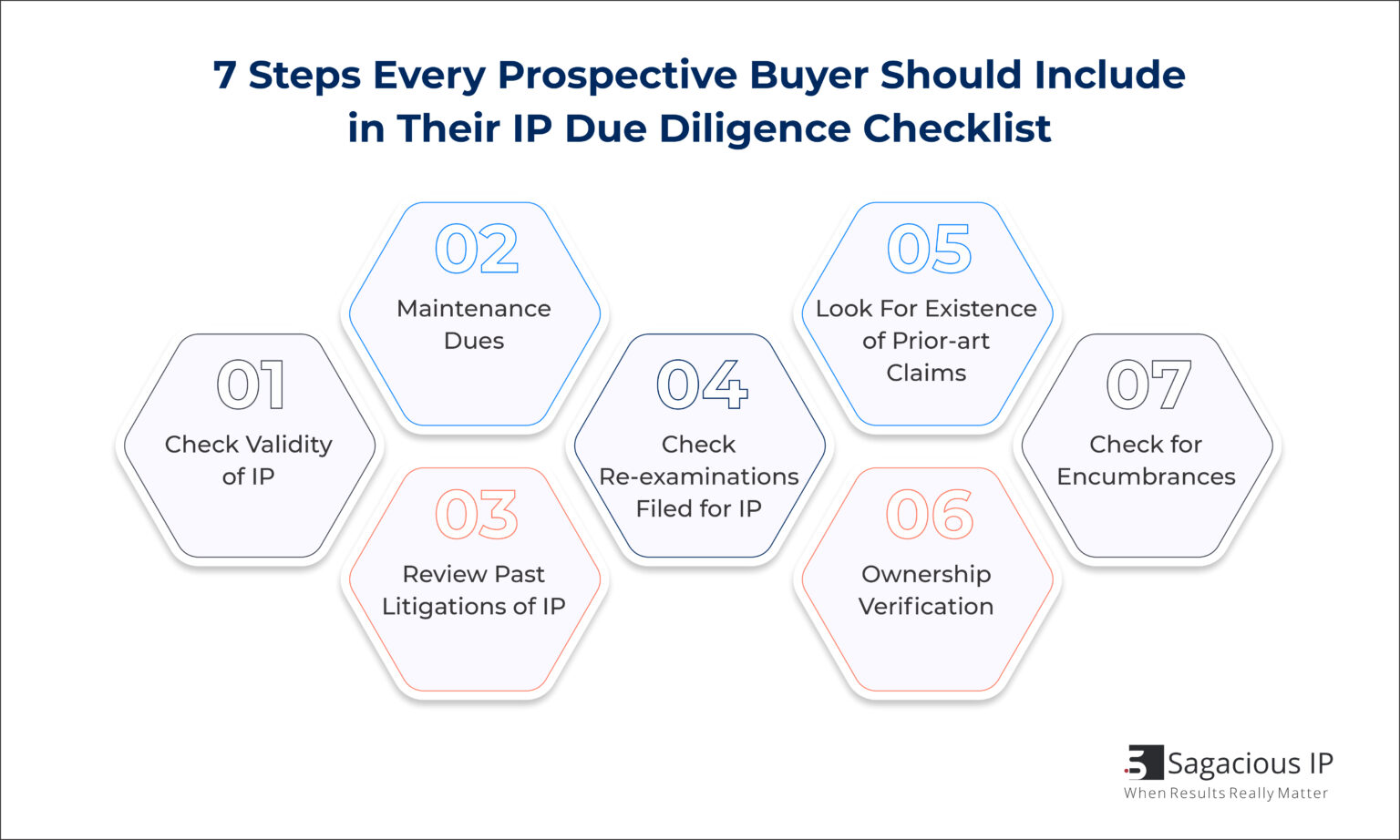
A comprehensive due diligence process involves several key steps. The following article from the Association of Corporate Counsel (ACC) provides a best-practice framework.
Getting Intellectual Property Due Diligence Right
The article 'Getting Intellectual Property Due Diligence Right' outlines a practical, step-by-step process for conducting IP due diligence. It emphasizes a systematic approach to gathering and analyzing data.
Please read the numbered list (steps 1-14) under the heading 'In-house IP due diligence best practices'. You don't need to memorize every step, but focus on the logical flow: starting with identifying the assets, tracing their ownership, checking for legal issues, and finally evaluating their commercial value.
Synthesizing from that list and other standard practices, here is a simplified, structured view of the process a lawyer would follow:
- The Due Diligence Request: The buyer's lawyer sends the seller a detailed "due diligence request list," asking for documents and information related to all IP assets.
- The Data Room: The seller gathers the requested documents and places them in a secure virtual data room (VDR), an online repository where the buyer's team can review everything.
- Document Review & Analysis: This is the heart of the process. The legal team meticulously reviews the provided documents, focusing on key areas for each type of IP.
- Independent Verification: Lawyers don't just take the seller's word for it. They conduct independent searches in public databases (e.g., patent and trademark office records) to verify ownership, status, and chain of title.
- Reporting and Issue Resolution: The legal team prepares a report summarizing its findings, flagging any red flags or risks. These issues then become negotiation points in the M&A agreement.
Category-Specific Review
The specific questions and documents reviewed depend on the type of intellectual property.
Intellectual Property Due Diligence: A Critical Prerequisite to ...
Let's return to the FindLaw article, which provides a useful checklist of specific items to review for each major category of IP.
Please read the section titled 'Specific Recommendations By Category of Intellectual Property Asset'. Focus on one or two key questions for each category (Patents, Trademarks, Copyrights, Trade Secrets) to understand how the investigation is tailored to the asset type.
Here's a summary of the critical focus areas:
- Patents:
- Chain of Title: Have all inventors properly assigned their rights to the company?
- Maintenance: Are all government maintenance fees current? A failure to pay can render a patent invalid.
- Scope: Do the patent claims actually cover the company's key products?
- Trademarks:
- Use: Is the company actively using the trademark for the goods/services listed in the registration? Non-use can lead to cancellation.
- Geographic Scope: Where is the trademark registered? A U.S. registration offers no protection in Europe.
- Quality Control: If the mark is licensed to others, does the company exercise quality control? (This is a legal requirement for licensing).
- Copyrights:
- Ownership: For software or creative materials, were they created by employees within the scope of their employment (making them "works for hire")? If created by independent contractors, is there a signed written agreement assigning the copyright to the company? This is a very common and critical issue.
- Open Source: What open-source software is used in the company's products? Have all licenses been complied with?
- Trade Secrets:
- Confidentiality Measures: What steps has the company taken to keep its secrets secret? This includes using non-disclosure agreements (NDAs) with employees and partners.
- Employee Mobility: Have key employees recently left to join a competitor, potentially taking trade secrets with them?
Test your understanding!
A tech startup's main asset is its innovative software. During due diligence, you, as the buyer's lawyer, discover that a significant portion of the core code was written by a freelance developer who never signed a formal contract. Why is this a major red flag, and what goal of due diligence does this finding relate to?
Show answer
This is a major red flag because under U.S. copyright law, the freelance developer (as an independent contractor, not an employee) is the default owner of the copyright in the code they wrote. Without a written agreement explicitly assigning those rights to the company, the startup does not actually own its main asset.
This directly relates to Goal #2 of IP due diligence: Ascertain the nature and scope of the target's claimed rights in the intellectual property assets. The company may claim to own the software, but the due diligence investigation reveals that its rights are, at best, a non-exclusive license to use the code, and at worst, non-existent. The buyer would be paying for an asset the seller doesn't own.
4. The Impact: How Due Diligence Shapes the Deal
Due diligence is not a theoretical exercise. Its findings have direct and significant consequences for the transaction.
- Price Adjustments: As the ACC article LINK powerfully illustrates in an anecdote (section 4), if due diligence reveals significant flaws in the IP—such as a failure to register trademarks in key markets—the buyer can use this information to negotiate a lower purchase price.
- Resolving Issues Pre-Closing: Sometimes, issues can be fixed before the deal is finalized. For instance, the FindLaw article LINK gives an example (section 4) where a company had to track down former consultants to get them to sign IP assignment agreements after this gap was discovered during due diligence.
- Specialized R&Ws and Indemnities: If a risk is identified that can't be fixed, the buyer might demand a specific indemnity to cover any potential losses from that issue. For example, if there's a pending lawsuit, the buyer will insist the seller be 100% responsible for the outcome.
- Walking Away: In the most extreme cases, if due diligence uncovers a fatal flaw—a "deal-breaker"—the buyer may decide to terminate the transaction entirely.
Conclusion
Today we've completed our journey through corporate IP strategy by examining the critical process of due diligence. We've seen that it is the bedrock on which M&A transactions are built, transforming legal promises into verified facts. It is the process that gives a buyer the confidence to invest millions of dollars and allows a seller to stand behind the value of their company. For a corporate lawyer, mastering the art and science of due diligence is fundamental to protecting a client and adding tangible value to a deal.
Key Takeaways:
- Purpose: IP due diligence is an investigation to verify the ownership, validity, and scope of a target company's IP assets and to uncover potential risks like infringement.
- Process: It is a systematic process involving document requests, review in a virtual data room, independent searches, and analysis tailored to each type of IP (patents, trademarks, copyrights, trade secrets).
- Connection to R&Ws: The findings from due diligence are used to confirm the seller's representations, identify necessary disclosures, and negotiate the allocation of risk in the M&A agreement.
- Impact: The results of due diligence can lead to purchase price adjustments, specific indemnities, or even the cancellation of a deal.
Preview of the Next Module:
This lesson concludes our module on Intellectual Property Strategy. We've covered the what, why, and how of protecting and transacting a company's most valuable intangible assets.
Our next module, "The Corporate Lawyer: Professional Responsibility," shifts our focus from the substance of the law to the ethical duties that govern lawyers themselves. We will begin by exploring the foundational principles that shape a lawyer's obligations to their clients, the courts, and the public, starting with the ABA Model Rules of Professional Conduct.