Hello! Welcome to the sixth lesson in our module on Intellectual Property Strategy.
In our previous lessons, we explored the different types of intellectual property and the legal strategies used to protect them, from keeping trade secrets confidential to defending a famous trademark against dilution. We've established that IP is a critical corporate asset.
Today, we shift our focus to a pivotal moment in a company's life: a merger or acquisition (M&A). When a company is bought or sold, its IP is often a huge part of the deal's value. How does a buyer ensure they are actually getting what they are paying for? How does a seller provide assurances about the quality of their IP assets without taking on unlimited risk? The answer lies in a heavily negotiated part of the M&A agreement.
Your learning outcome for this lesson is to: Analyze the role of IP representations and warranties in M&A transactions.
We will break down what "representations and warranties" are, examine their crucial role in allocating risk between buyer and seller, and then dive into the specific representations and warranties that relate to intellectual property. By the end of this lesson, you'll understand how these contractual clauses serve as a legal foundation for valuing and transferring IP in a corporate transaction.
1. What Are Representations and Warranties?
In any major transaction, especially an M&A deal, the buyer has limited information about the target company, while the seller knows its own business intimately. To bridge this information gap, the seller makes a series of statements in the purchase agreement about the state of the business. These statements are known as representations and warranties (often abbreviated as "R&Ws" or "reps and warranties").
To get a clear, practical introduction to this concept, let's start with a short video.
Representations and Warranties in Mergers and Acquisitions (M&A)
The video 'Representations and Warranties in Mergers and Acquisitions (M&A)' by attorney Brett Cenkus provides a great overview of what R&Ws are and why they are so important in any purchase agreement.
Please watch the first four minutes of the video (from 00:00 to 04:27). As you watch, focus on these key ideas: What R&Ws are (statements about the 'shape' of a company). Why they are important (they form the basis for a buyer's claim if they were misled). How they relate to due diligence (they are a layer of protection for things you can't uncover during your investigation).
As the video explains, R&Ws are essentially promises from the seller to the buyer that certain facts are true. For example, a seller might represent that "the company is not involved in any litigation" or "the company has paid all its taxes."
While often used together, "representation" and "warranty" have slightly different legal meanings. You have a good handle on legal distinctions, so let's clarify them.
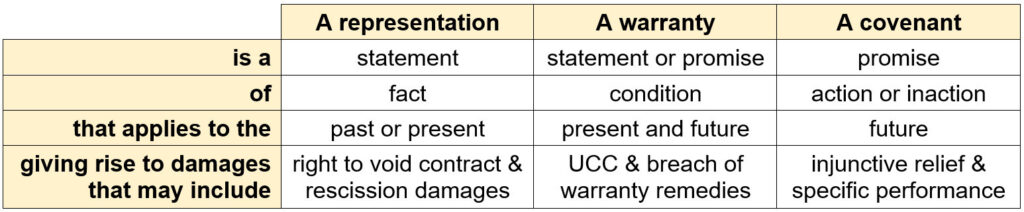
In M&A agreements, lawyers bundle them together to ensure the buyer has the broadest possible legal recourse if a statement turns out to be false. For the rest of this lesson, we'll use the common shorthand "R&Ws."
2. The Purpose of R&Ws: Risk Allocation and Indemnification
The fundamental purpose of R&Ws is to allocate risk. When a seller makes a representation, they are taking on the risk that the statement is true. If it's not, the buyer is contractually protected.
This protection usually takes the form of an indemnity. An indemnity is a legal obligation for the seller to compensate the buyer for any loss or damage suffered because of a breach of the R&Ws. Think of it as the "or else" clause: "The seller represents X is true, or else they will have to pay for any damages if it's not."
This next video provides an excellent explanation of how R&Ws and indemnities work together as risk mitigation tools.
Warranties & Indemnities in M&A Transactions
The video 'Warranties & Indemnities in M&A Transactions' by law firm Khaitan & Co uses a simple analogy to explain how these concepts bridge the information gap and gives a clear overview of the indemnity framework.
Please watch two segments from this video: 04:25 to 07:02: This part explains the purpose of R&Ws using a simple mango-buying analogy and introduces the different types of warranties. 15:42 to 18:00: This segment introduces the core concepts of 'indemnity', explaining who indemnifies whom and for what kind of 'loss'. Focus on how R&Ws are a tool to give the buyer 'comfort' and how indemnity is the mechanism for making the buyer whole if that comfort proves to be misplaced.
The key relationship to remember is:
- A Representation & Warranty is a statement of fact about the business.
- A Breach of that R&W occurs if the statement is untrue.
- An Indemnity clause provides the remedy, requiring the seller to pay for losses resulting from the breach.
3. Key Intellectual Property R&Ws
Now let's apply this framework specifically to intellectual property. In any technology, media, or brand-focused company, the IP assets are the crown jewels. A buyer needs ironclad assurances about them.
Please read the following article, which outlines the core areas that IP representations and warranties cover in an M&A deal.
A Primer on IP Representations and Warranties in Asset Purchase and M&A Deals
The article 'A Primer on IP Representations and Warranties' from the law firm Whiteford, Taylor & Preston provides a concise and clear summary of the specific assurances a buyer seeks regarding a seller's IP assets.
Please read the first three paragraphs of the article and the two paragraphs under the heading 'Specific assurances about those IP rights...'. Focus on identifying the main categories of IP-related promises a buyer demands from a seller.
As the article details, the buyer will demand R&Ws covering several critical areas. Here are the most common ones, which a corporate lawyer on the buyer's side would insist on:
- Ownership: The seller represents that it exclusively owns (or has a valid license to use) all the IP necessary for the business, free and clear of any liens or claims from third parties. They must have good title to the assets.
- Non-Infringement (Outbound): The seller represents that its business operations and products do not infringe, misappropriate, or otherwise violate the intellectual property rights of any other person or company. This protects the buyer from inheriting a lawsuit.
- Non-Infringement (Inbound): The seller also represents that, to its knowledge, no third party is infringing on the seller's IP. This assures the buyer that the IP's value isn't being eroded by competitors.
- Validity and Enforceability: The seller represents that its registered IP (like patents and trademarks) is valid, enforceable, and has been properly maintained.
- Sufficiency of Assets: A crucial representation where the seller warrants that the IP assets being transferred are all the IP assets necessary to operate the business as it is currently being conducted. This prevents the buyer from discovering post-closing that a critical piece of software or a key patent was left out of the deal.
More recently, especially in tech M&A, R&Ws have expanded to cover other areas closely related to IP:
- Open-Source Software: Assurances that the company has complied with the licenses for all open-source code used in its products, and that no "viral" licenses (which could force the company to disclose its proprietary source code) have been used improperly.
- Data Privacy and Cybersecurity: Representations that the company complies with all data protection laws (like GDPR or CCPA) and has taken reasonable steps to protect its systems and data from breaches.
- Artificial Intelligence: As AI becomes more prevalent, buyers are demanding R&Ws about the lawful use of training data, the integrity of AI models, and compliance with emerging AI regulations.

4. The Negotiation: Qualifiers and Disclosures
A seller is rarely willing to make these broad promises without some limitations. The negotiation of R&Ws is a "tug-of-war" where the buyer wants absolute promises and the seller wants to limit their post-closing liability. Sellers use two primary tools to achieve this: qualifiers and disclosures.
Qualifiers
A qualifier is language added to an R&W to limit its scope. The two most common are:
- Knowledge Qualifier: The seller limits the representation to what they actually know. Instead of saying, "No third party is infringing the company's patents," they will negotiate to say, "To the seller's knowledge, no third party is infringing..." This protects the seller from being liable for an infringement they could not have reasonably known about.
- Materiality Qualifier: The seller limits the representation to matters that are significant or "material." For example, they might represent that the company has complied with all laws, "except for non-compliance that would not have a material adverse effect on the business." This prevents the buyer from making an indemnity claim for a trivial, unimportant breach.
The article from Whiteford Law explains these qualifiers very well.
A Primer on IP Representations and Warranties in Asset Purchase and M&A Deals
Let's return to the Whiteford Law article to understand how sellers limit the scope of their promises.
Please read the section starting with the heading 'Each of the RWs can become a heavily negotiated point...'. Focus on the examples given for 'knowledge' and 'materiality' qualifiers and understand why a seller would push for these.
Disclosure Schedules
The second tool is the disclosure schedule. This is a separate document attached to the purchase agreement where the seller lists specific exceptions to the R&Ws.
For example, an R&W might state: "The company is not a party to any pending litigation." However, if the company is currently involved in a minor lawsuit, it will list the details of that lawsuit on the disclosure schedule for that specific R&W. By disclosing the lawsuit, the seller effectively carves it out of the representation. The buyer is now aware of the issue and cannot later claim a breach of warranty for that specific, disclosed matter.
Test your understanding!
You are the lawyer for a company that is buying a small software firm. The purchase agreement contains the following representation from the seller:
"The Company owns or has a valid right to use all Intellectual Property used in its business."
The software firm's main product uses a key piece of code that it licenses from a third party, and this license agreement will expire in six months. As the seller's lawyer, what two things should you do to avoid a breach of this representation?
Show answer
As the seller's lawyer, you must ensure this situation does not create liability after the deal closes. You should:
- Disclose the License: In the disclosure schedule corresponding to the IP ownership representation, you must clearly list the third-party license agreement, including its key terms and its upcoming expiration date. By disclosing it, you are making the buyer aware of the fact that this specific piece of IP is not owned but is licensed, and the license is not perpetual.
- Negotiate the Representation (Optional but advised): You could also try to soften the language of the representation itself. For instance, you could confirm that all such license agreements are "in full force and effect" and that the seller "has not received any notice of breach" under them. The key is to make the representation an accurate reflection of the reality that was laid out in the disclosure schedule.
Conclusion
Today, we've unpacked a crucial component of corporate law practice. We saw that representations and warranties are not just legal boilerplate; they are the contractual heart of an M&A transaction, serving to build trust, disclose information, and allocate risk. For deals where intellectual property is a primary driver of value, the IP R&Ws are among the most intensely negotiated and important clauses in the entire agreement.
Key Takeaways:
- Representations & Warranties (R&Ws) are contractual statements of fact made by a seller to a buyer about the target company.
- Their primary roles are to bridge the information gap and allocate risk. A breach of an R&W typically entitles the buyer to indemnification (compensation for losses).
- Key IP R&Ws cover ownership, non-infringement, validity, and the sufficiency of IP assets to run the business.
- Sellers limit their liability through qualifiers (e.g., "to seller's knowledge," "materiality") and by listing exceptions in disclosure schedules.
Preview of the Next Lesson:
A logical question arises from today's lesson: How does a seller know what to disclose? And how does a buyer know which R&Ws to demand and what issues to look for? The answer is a deep investigative process called due diligence. In our next and final lesson of this module, we will describe the process and purpose of conducting intellectual property due diligence.