Hello! Welcome to the final lesson in our module on Financial Accounting for Lawyers.
In our last lesson, we explored how to use financial ratios to analyze a company's performance, answering critical questions about its liquidity, risk, and profitability. We learned that these ratios are powerful tools for interpreting the story told by financial statements.
Today, we delve into a fundamental principle that governs how one of the most important lines on the income statement—revenue—is recorded in the first place. Our learning outcome is to describe revenue recognition principles and their application in typical business transactions. This topic is a crucial intersection of accounting and law. For a corporate lawyer, understanding when a company can legitimately claim it has "earned" money is vital for drafting contracts, advising on compliance, and identifying potential financial misrepresentation in due diligence or litigation.
1. What is Revenue Recognition? Earned, Not Received
At its core, the revenue recognition principle is a cornerstone of accrual accounting, a topic we've touched on before. It dictates that revenue should be recognized when it is earned by fulfilling a promise to a customer, regardless of when the payment is actually received.
This contrasts sharply with cash accounting, where revenue is recorded only when cash comes in the door. While simpler, cash accounting can provide a misleading picture of a company's performance.
To solidify your understanding of this distinction and why it's so important, please read the following brief article.
Revenue Recognition: What It Means in Accounting and the 5 Steps
This article from Investopedia, 'Revenue Recognition: What It Means in Accounting and the 5 Steps,' clearly defines revenue recognition and contrasts the accrual method with the cash method. It also highlights why these rules are critical for financial transparency and preventing fraud.
Please read the sections 'What Is Revenue Recognition?', 'How Revenue Recognition Works' (including the subsections on Cash and Accrual Accounting), and 'Importance of Accurate Revenue Recognition'. Focus on the fundamental difference in timing between the two methods and the legal and regulatory risks of improper revenue recognition.
As the article notes, misstating revenue has been at the heart of many major corporate scandals. For a lawyer, the key takeaway is that revenue reporting is not just an accounting detail; it's a matter of legal compliance and corporate integrity.
2. The Five-Step Model for Recognizing Revenue
In the past, revenue recognition rules were fragmented across different industries, leading to confusion and inconsistency. To fix this, accounting standard-setters around the world converged on a single, unified framework. In the U.S., this is known as ASC 606, and its global counterpart is IFRS 15.
This framework is built on a five-step model that applies to all contracts with customers. It provides a logical and consistent roadmap for determining when and how much revenue to recognize.

Let's walk through this model using a practical example. Many modern contracts bundle multiple goods and services together. Think of a mobile phone contract that includes a "free" handset with a two-year service plan. How should the company account for the revenue? It's not as simple as just recording the monthly fee.
The following video provides an excellent walkthrough of the five-step model using this exact scenario. It demonstrates how accountants deconstruct the contract to reflect the economic reality of the transaction.
IFRS 15 Explained: 5-Step Model + Telecom Example + Free Journal Entry Template
The video 'IFRS 15 Explained' by Silvia of CPDbox demonstrates the five-step model with a clear, practical example of a telecom contract. This will help you see how the principles are applied in a real-world business transaction.
Please watch the video from the beginning to 09:45. As you watch, follow how each of the five steps is applied to the telecom contract example: Identify the contract (01:56) Identify performance obligations (02:11) Determine the transaction price (02:51) Allocate the price (03:05) - Pay close attention to this step, as it's the most complex. Recognize revenue (06:42)
Let's recap and expand on those five steps, focusing on the concepts relevant to a lawyer.
Step 1: Identify the Contract with the Customer
This first step is the most explicitly "legal." The model applies only when a valid contract exists. For accounting purposes, a contract is an agreement between two or more parties that creates enforceable rights and obligations. Interestingly, it doesn't have to be a formal written document.
Revenue Recognition ASC 606. Step 1: Identify the Contract.
The channel Farhat Lectures offers a detailed explanation of the criteria a contract must meet under the revenue recognition standard. This aligns closely with your interest in legal definitions and requirements.
Watch from 05:45 to 10:42. Focus on the five specific criteria a contract must meet, including 'commercial substance' and 'collectibility'. Note that a contract can be written, oral, or even implied by business practices.
Step 2: Identify the Performance Obligations
A performance obligation is a promise in a contract to transfer a distinct good or service to a customer. In the telecom example, the two distinct promises were:
- The physical handset.
- The monthly network service for 12 months.
Identifying these separate obligations is crucial because revenue will be recognized separately for each one.
Step 3: Determine the Transaction Price
This is the total amount of consideration a company expects to receive in exchange for the goods or services. In the video's example, it was simple: 100 currency units/month × 12 months = 1,200. In more complex contracts, this step would also involve estimating the impact of discounts, rebates, or performance bonuses.
Step 4: Allocate the Transaction Price to Performance Obligations
This is often the most challenging step. The total transaction price must be allocated to each separate performance obligation based on its relative standalone selling price. This is the price at which the company would sell the good or service separately.
In the telecom example, even though the phone was marketed as "free," it has a standalone value (300). The service also has a standalone value (80/month or 960/year). The 1,200 transaction price was allocated proportionally between these two items, ensuring the "free" handset was assigned a portion of the revenue. This prevents companies from manipulating profits by shifting value between bundled items.
Step 5: Recognize Revenue When (or As) the Obligation is Satisfied
This is the final step where revenue is actually recorded. Revenue is recognized when the company transfers control of the good or service to the customer. This can happen:
- At a point in time: For the handset, control transferred to the customer at the start of the contract. The revenue allocated to the phone (285.70) was recognized immediately.
- Over time: For the network service, control is transferred continuously over the 12-month period. The revenue allocated to the service (914.30) is recognized in equal parts each month (76.20/month).
Test your understanding!
A software company sells a 1-year subscription package to a client for a single upfront payment of $12,000. The package includes:
- The software license for one year.
- A one-time professional installation and setup service.
The company sells the software license by itself for $11,000/year and offers the installation service separately for $1,000.
How should the company recognize the $12,000 in revenue according to the five-step model?
Show answer
- Identify the Contract: A valid contract for $12,000 exists.
- Identify Performance Obligations: There are two distinct obligations: (1) the software license and (2) the installation service.
- Determine Transaction Price: The price is $12,000.
- Allocate the Price: The standalone selling prices are $11,000 (license) and $1,000 (installation). The total is $12,000. Since the transaction price equals the sum of the standalone prices, the allocation is straightforward:
- $11,000 is allocated to the software license.
- $1,000 is allocated to the installation service.
- Recognize Revenue:
- The $1,000 for the installation is recognized at a point in time—when the installation is complete.
- The $11,000 for the software license is recognized over time—ratably over the 1-year subscription period (approximately $916.67 per month).
3. Common Applications and Pitfalls
The five-step model applies to a wide range of modern business transactions.
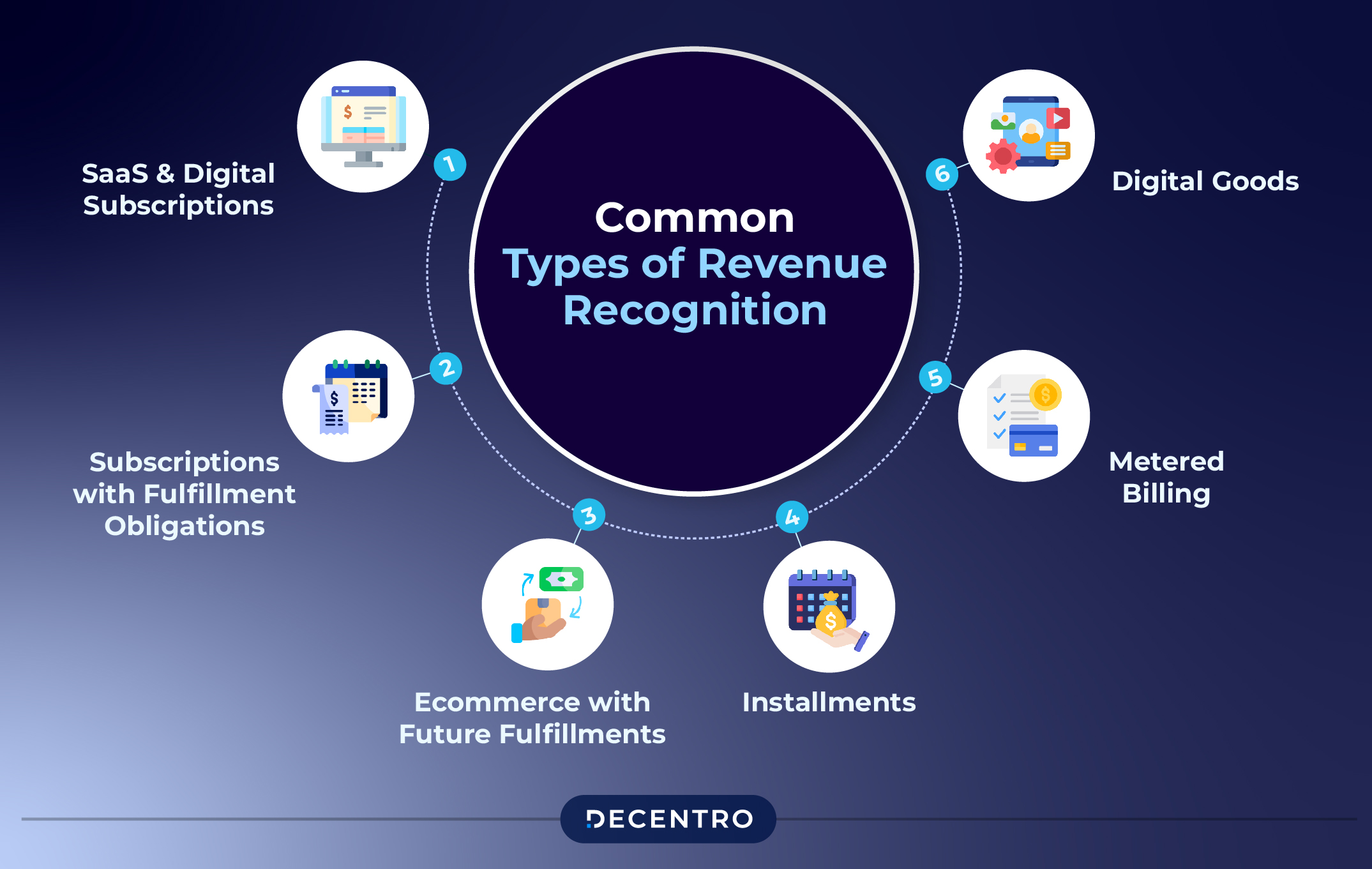
As you prepare for a career in corporate law, it's also useful to be aware of common mistakes companies make.
The 5 Steps of Revenue Recognition: A Simple Guide
The article 'The 5 Steps of Revenue Recognition: A Simple Guide' by Hubifi offers a great summary of the five-step model and concludes with a practical list of common errors.
Please read the sections 'Common Pitfalls to Avoid' and 'Frequently Asked Questions'. Focus on understanding the distinction between cash and revenue, the concept of deferred revenue as a liability, and the typical questions that arise for businesses implementing these rules.
As a lawyer reviewing a contract or a company's financials, keeping an eye out for these pitfalls—confusing cash with earned revenue, mismanaging deferred revenue, and incorrect timing—is a form of legal and financial due diligence.
Conclusion
This lesson concludes our module on Financial Accounting for Lawyers. You have built a strong foundation, from understanding the basic accounting equation to interpreting financial statements with ratios, and now, to grasping the critical principles of revenue recognition.
Key Takeaways:
- The Core Principle: Revenue is recognized when a company earns it by satisfying a performance obligation, not necessarily when it receives cash.
- The Modern Framework: A unified five-step model (ASC 606/IFRS 15) governs how companies recognize revenue from all customer contracts, ensuring consistency and comparability.
- The Five Steps: 1. Identify the contract, 2. Identify performance obligations, 3. Determine transaction price, 4. Allocate the price, and 5. Recognize revenue as obligations are satisfied.
- Legal Relevance: Understanding these rules is essential for lawyers in drafting and interpreting contracts, advising on compliance, and identifying potential financial fraud or misstatement.
In our next module, "Choosing the Right Business Structure," we will transition from analyzing existing companies to the foundational legal decisions involved in creating a new one. We will begin by comparing the primary forms of business entities: sole proprietorships, partnerships, LLCs, and corporations.