Hello! Welcome to the fourth lesson in our module on Financial Accounting for Lawyers.
In our previous lessons, we explored the Balance Sheet—a "snapshot" of a company's financial position—and the Income Statement, the "movie" of its profitability over time. We ended by noting that profit isn't the same as cash, a crucial distinction we will unpack today.
This lesson focuses on the third pillar of financial reporting: the Statement of Cash Flows (SCF). This statement bridges the gap between the other two, showing exactly how a company's cash position changes over an accounting period. For a corporate lawyer, this is arguably the most important statement for assessing a company's true financial health and short-term viability. A profitable company on paper can still face bankruptcy if it runs out of cash to pay its bills.
Our learning outcome for this lesson is to examine cash flow statements to assess a company's liquidity and financial health. We'll break down the statement's structure, analyze each component, and learn to spot the red flags that signal financial trouble.
1. The Core Concept: Profit Is Not Cash
Before diving into the statement itself, let's solidify the difference between profit and cash. An income statement is prepared using accrual accounting, which you'll learn more about in the next lesson. In simple terms, this means revenue is recorded when it's earned, not necessarily when the cash is received.
For example, if a company sells $100,000 of goods on credit, its income statement will show $100,000 in revenue, contributing to its profit. However, its bank account won't see that money until the customer actually pays the invoice. The cash flow statement cuts through these accounting conventions to track only the hard cash moving in and out of the business.
How to Read & Understand a Cash Flow Statement
This article from Harvard Business School Online, 'How to Read & Understand a Cash Flow Statement,' provides a great introduction to the statement's purpose and its three main sections.
Please read the sections 'What is a Cash Flow Statement?' and 'How to Interpret a Cash Flow Statement.' Focus on the definitions of the three activities and the distinction between positive/negative cash flow and profitability.
As the article notes, "You can have positive cash flow without actually making a profit," and vice-versa. This is why a company's survival often depends more on its cash flow than its reported net income.
2. The Three Sections of the Cash Flow Statement
Every cash flow statement is organized into three standard sections that tell a story about where a company's cash comes from and where it goes.
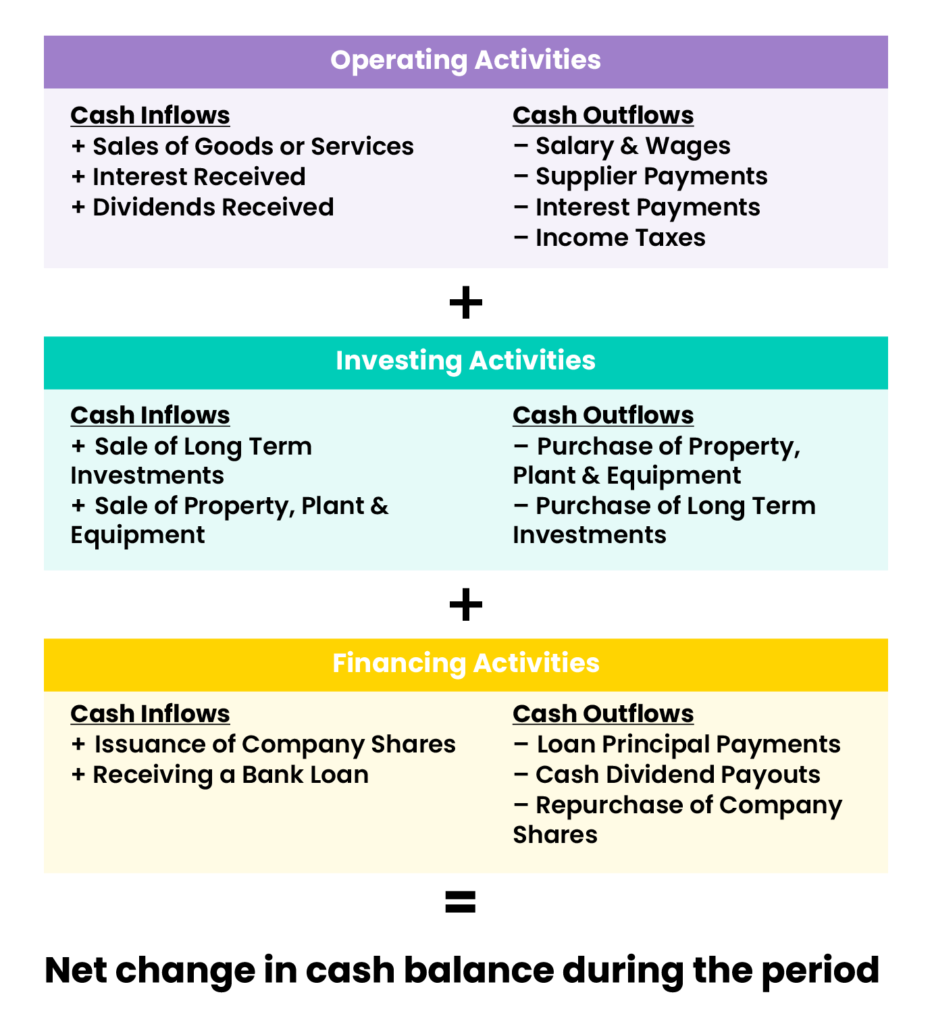
Let's watch a short video that introduces these three pillars.
The CASH FLOW STATEMENT: all the basics in 9 minutes
This concise video, 'The CASH FLOW STATEMENT: all the basics in 9 minutes' by Brian Feroldi, clearly explains the purpose of each of the three sections.
Watch from the beginning to 03:38. As you watch, pay attention to the primary function of each section: Operating Activities: Cash from core business operations. Investing Activities: Cash used for long-term investments. Financing Activities: Cash from investors and lenders.
To summarize:
- Cash Flow from Operating Activities (CFO): This is the cash generated by a company's main business activities (e.g., selling goods, providing services). It is the most important section for assessing financial health. A consistently positive CFO indicates the core business can sustain itself and generate cash.
- Cash Flow from Investing Activities (CFI): This section shows cash spent on or generated from investments. It typically includes purchases or sales of long-term assets like property, plant, and equipment (often called Capital Expenditures or "CapEx"), as well as acquiring other companies. For a healthy, growing company, this number is usually negative, as it reinvests in its future.
- Cash Flow from Financing Activities (CFF): This tracks cash flow between a company and its owners and creditors. This includes issuing or repurchasing stock, taking on or repaying debt, and paying dividends.
Finally, the net changes from these three sections are added to the beginning cash balance to arrive at the ending cash balance, which is the same cash amount you see on the company's balance sheet.
3. A Step-by-Step Analysis of a Cash Flow Statement
Now, let's move from theory to practice by walking through a real-world example line by line. Most public companies use the indirect method to prepare their operating activities section. This means they start with Net Income (from the income statement) and make adjustments to reconcile it back to actual cash flow.
This next video provides a detailed walkthrough of Delta Air Lines' cash flow statement, explaining what each line item means.
How To Analyze a Cash Flow Statement
The video 'How To Analyze a Cash Flow Statement' by Daniel Pronk offers an excellent, practical guide. We will break it down section by section.
First, watch the walkthrough of the Operating, Investing, and Financing sections (from 03:08 to 12:58). Focus on understanding the logic behind the key adjustments: Operating: Why are non-cash expenses like Depreciation added back? Why does an increase in Accounts Receivable result in a decrease in cash flow? Investing: What does spending on Property, Plant, and Equipment (CapEx) tell you about the company's strategy? Financing: How do debt repayment, stock repurchases, and dividends paid affect the company's cash?
Calculating Free Cash Flow (FCF)
One of the most valuable metrics derived from the SCF, though not always explicitly listed, is Free Cash Flow (FCF). It represents the cash a company has left over after paying for its operations and investing in its long-term growth. This is the cash that is "free" to be returned to investors (via dividends or share buybacks) or to pay down debt.
The formula is:
Capital Expenditures (CapEx) is the money spent on acquiring or maintaining long-term assets like property, plant, and equipment, which you find in the Investing Activities section.
Let's see how this is calculated.
How To Analyze a Cash Flow Statement
We'll continue with the same video to understand how Net Change in Cash and Free Cash Flow are calculated.
Now, watch from 12:47 to 16:39. Pay close attention to the definition and calculation of Free Cash Flow (FCF). Understand why analysts and investors value this metric so highly.
Test your understanding!
A company reports a net income of $50 million. Its cash flow from operations is $80 million. Which of the following is the most likely reason for this difference?
a) The company sold a factory for $30 million.
b) The company took out a new loan for $30 million.
c) The company had a large non-cash depreciation expense of $30 million.
Show answer
c) The company had a large non-cash depreciation expense of $30 million. Depreciation is an expense that reduces net income on the income statement, but it doesn't involve an actual cash outflow. Therefore, when reconciling net income to cash from operations (using the indirect method), depreciation is added back. Selling a factory is an investing activity, and taking a loan is a financing activity; neither would directly explain the difference between net income and operating cash flow in this way.
4. Spotting Red Flags: A Tale of Two Companies
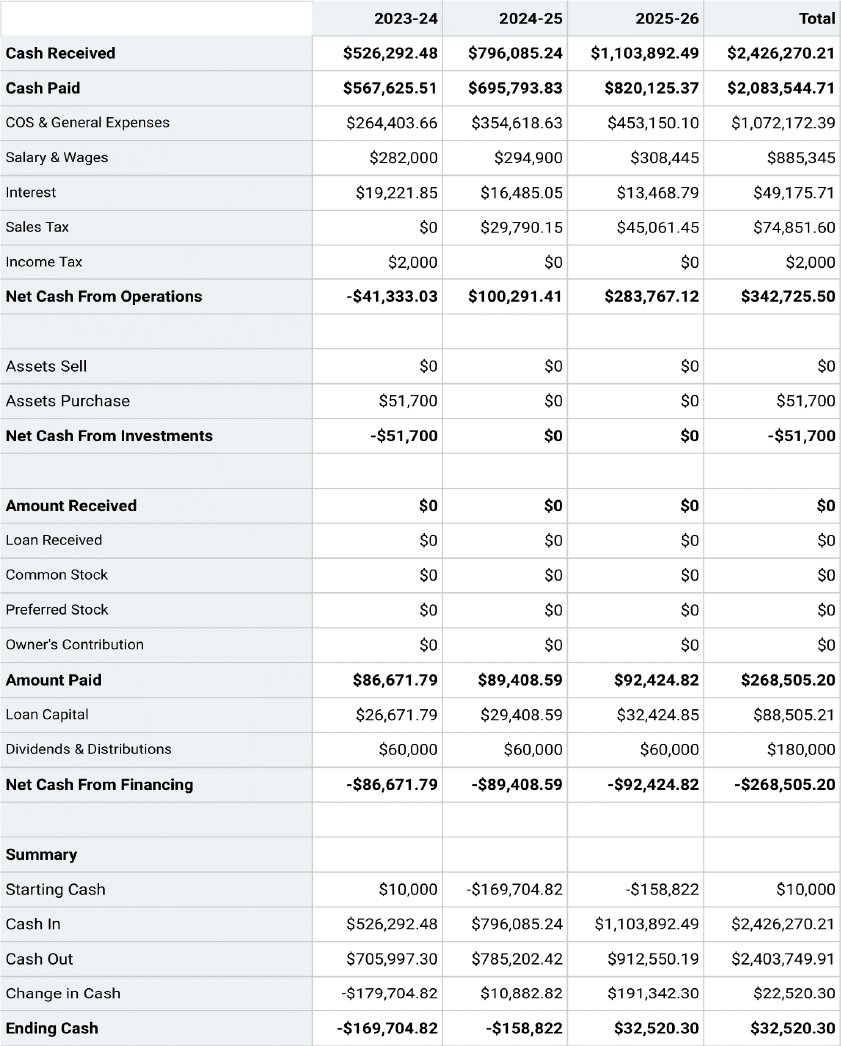
Analyzing a single period is useful, but the real insights come from spotting trends over time and understanding what a "healthy" versus "unhealthy" cash flow profile looks like.
A healthy, mature company typically has:
- Positive and growing Cash Flow from Operations (CFO).
- Negative Cash Flow from Investing (CFI), as it reinvests in the business.
- Negative Cash Flow from Financing (CFF), as it repays debt and returns cash to shareholders.
A startup or a company in distress might show a very different pattern. Let's look at a powerful comparison.
How To Analyze a Cash Flow Statement
This final segment from the same video contrasts a healthy cash flow statement with one full of red flags, using Uber as an example.
Watch from 16:39 to the end (21:56). Focus on the key red flags identified in Uber's statement at the time: Negative Cash Flow from Operations: The core business was losing cash. Heavy Reliance on Financing: The company was surviving by raising money from investors (issuing stock), not by generating it from operations. This is what's referred to as an 'OPM' or 'Other People's Money' company. High Stock-Based Compensation: A large non-cash expense that, in the context of massive losses, raises questions about resource allocation.
This analysis is directly relevant to your future work as a corporate lawyer. During due diligence for a merger, acquisition, or financing, you would scrutinize the cash flow statement to ensure the target company has a sustainable business model and isn't simply burning through investor cash.
Conclusion
You have now completed the trilogy of core financial statements. You understand how the balance sheet shows financial position, the income statement shows profitability, and the cash flow statement reveals the true story of a company's liquidity and cash-generating ability.
Key Takeaways:
- The Statement of Cash Flows tracks the movement of actual cash, which is often different from accounting profit.
- It is divided into three sections: Operating (core business), Investing (long-term assets), and Financing (investors and lenders).
- A healthy company should consistently generate positive cash flow from operations. This is the most crucial indicator of financial health.
- Free Cash Flow (FCF), calculated as operating cash flow minus capital expenditures, shows the cash available to reward shareholders after reinvesting in the business.
- Negative operating cash flow funded by massive financing cash flow is a major red flag, indicating the company is dependent on "other people's money" to survive.
In our next lesson, we will formalize the distinction between cash and profit by exploring accrual vs. cash basis accounting. Your understanding of the income statement and cash flow statement has given you a perfect head start on this topic.