In our last lesson, we took a significant step into the world of topological matter by defining the Chern number, , as a quantized integer that classifies the energy bands of 2D insulators. We saw how this invariant arises from integrating the Berry curvature over the entire Brillouin zone and used the Haldane model to understand how a system with broken time-reversal symmetry can acquire a non-zero Chern number.
Today, we address the crucial follow-up question: what are the physical consequences of these topological numbers? You will learn how these abstract integers, calculated from the bulk properties of a material, lead to remarkably robust and directly observable phenomena at the material's boundaries. This principle, known as the bulk-boundary correspondence, is one of the most profound ideas in modern condensed matter physics. By the end of this lesson, you will be able to explain how topological invariants predict the existence of protected edge states and quantized electrical conductance.
The Bulk-Boundary Correspondence
The central idea is strikingly elegant. Consider the interface between two different insulators. For example, a topological insulator with Chern number placed next to a trivial insulator (like the vacuum) with .
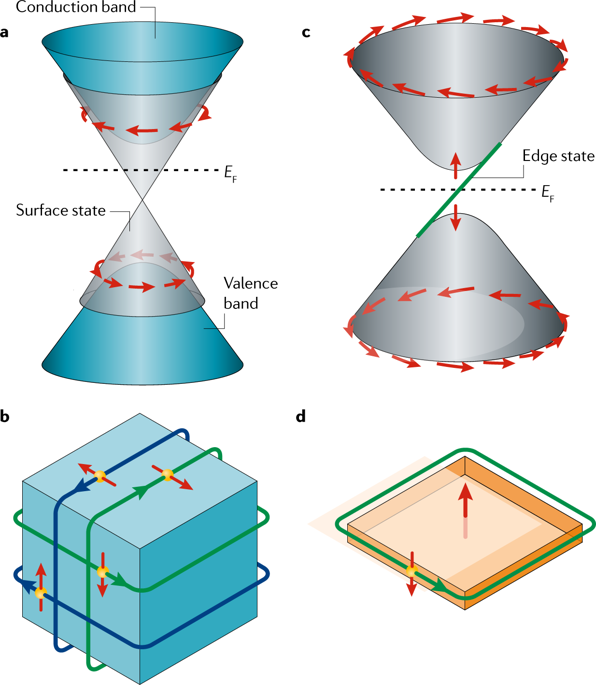
The Chern number is a topological invariant; it's an integer and cannot change its value under any smooth, continuous deformation of the system's Hamiltonian. However, as we cross the physical boundary from the topological material () to the trivial one (), the invariant must change. Since it cannot change continuously, something dramatic must happen exactly at the boundary.
As you learned in the previous lesson, the only way for a topological invariant to change is for the bulk energy gap to close. Therefore, at the interface where the invariant jumps, the gap must close. This implies the existence of states at the Fermi energy that are spatially localized at the boundary. These are the celebrated gapless edge states. The bulk of both materials remains insulating, but the boundary is forced to be metallic.
The following video provides a concise and clear explanation of this fundamental argument.
Topological Insulators in a Nutshell - Theory and Experiment
The video "Topological Insulators in a Nutshell" presents the core logic of the bulk-boundary correspondence.
Please watch the segment from the bulk-boundary argument. The speaker explains that to change the topological invariant from non-trivial (in the material) to trivial (in the vacuum), the energy gap must close at the boundary, creating gapless edge states.
Topological Protection
What makes these edge states so special is their robustness. They are protected by the same bulk topology that created them. Small perturbations, such as impurities, defects, or even deformations of the sample's edge, cannot destroy these states or open a gap in their energy spectrum. To do so would require changing the bulk topological invariant, which is impossible as long as the perturbation is local to the edge and doesn't close the bulk gap.
This protection distinguishes them from "accidental" surface states that might exist on conventional materials, which can be easily removed by surface chemistry or disorder.

Consequence 1: Quantized Conductance and the Quantum Hall Effect
The most famous physical manifestation of a non-zero Chern number is the Integer Quantum Hall Effect (IQHE). Experimentally, this effect is observed in a 2D electron gas at very low temperatures and in a strong perpendicular magnetic field. The key observation is that the Hall resistance, , is not continuous but instead exhibits perfectly flat plateaus quantized to extraordinary precision:
where is Planck's constant, is the electron charge, and is a remarkably precise integer. The quantity is a fundamental constant of nature, the von Klitzing constant.
To get a feel for the experimental phenomenon, the following video gives an excellent overview.
Steven Girvin - Quantum Hall Effect
In "Steven Girvin - Quantum Hall Effect," Prof. Girvin introduces the classical and quantum Hall effects.
First, watch the explanation of the classical Hall effect to understand the basic setup. Then, watch the segment introducing the quantum Hall effect, paying close attention to the description of the quantized plateaus and their universality—their independence from sample details like size, shape, or purity.
The theoretical breakthrough, pioneered by Thouless, Kohmoto, Nightingale, and den Nijs (TKNN), was the realization that the integer is a topological invariant. Specifically, it is the sum of the Chern numbers of all the occupied electron bands (called Landau levels in this context):
This equation provides the direct link between the abstract topological number we calculated in the last lesson and a measurable quantity. The quantization of the Hall conductance is robust for the same reason the Chern number is: it's a topological property.
The physical mechanism behind this quantization is beautifully explained by the edge states. A system with a net Chern number has exactly chiral edge states propagating along its boundary. "Chiral" means they only travel in one direction (e.g., clockwise). An electron moving in one of these edge channels cannot scatter backward, because there are no available states moving in the opposite direction at the same edge. This lack of backscattering means transport is dissipationless.
According to the Landauer-Büttiker formalism, each of these perfect one-dimensional channels contributes exactly to the conductance. With channels in parallel, the total Hall conductance is , which corresponds exactly to the measured quantized resistance .
The following reading explains this edge state picture of conduction with great physical clarity.
[PDF] The integral QHE: Topological considerations, edge states
These lecture notes by Anthony Leggett provide an intuitive account of the role of edge states in the IQHE.
Please read the section titled "An alternative approach to the IQHE relies on the concept of edge states." This part explains how the Hall current is carried entirely by states at the sample's boundary. Then, continue to the next section that begins <span data-type="resource_reading_textrange" data-resource-subitem-id="ad250403" data-range-start="It is interesting to make contact" data-range-end="where n is the number of Landau levels, as obtained previously.">"It is interesting to make contact...", which connects this picture to the Landauer-Büttiker theory of 1D conductance, solidifying the link between the number of edge channels and the quantized conductance value.
Consequence 2: Time-Reversal Invariant Topological Insulators
The Chern number and the IQHE require broken time-reversal (TR) symmetry, which is provided by the external magnetic field. A natural question arises: can topological phases exist if TR symmetry is preserved? The answer is yes, and these are the materials now famously known as topological insulators (TIs).
These systems are classified not by the integer Chern number (), but by a different invariant called the invariant, which can only take two values: 0 (trivial) or 1 (topological). The presence of different symmetries (like TR) leads to a rich classification of topological matter.
Topological Insulators in a Nutshell - Theory and Experiment
Let's return to the "Topological Insulators in a Nutshell" video.
Watch the segment from the classification of insulators. The speaker presents a table showing how dimensionality and fundamental symmetries (Time-reversal, Particle-hole, Sublattice) determine the type of topological invariant a system can have (\mathbb{Z}, \mathbb{Z}_2, or trivial). This provides a broader context for the invariants we are studying.
In a 2D TI (also known as a quantum spin Hall insulator), the bulk-boundary correspondence still holds. A non-trivial invariant in the bulk mandates gapless edge states. However, because of TR symmetry, for every right-moving state, there must be a corresponding left-moving state. In a TI, these counter-propagating states are carried by electrons with opposite spins. For example, spin-up electrons might only move right, while spin-down electrons only move left. This is called a helical edge state.
These states are also topologically protected, but in a more subtle way. An electron cannot simply backscatter from a non-magnetic impurity. To do so, a right-moving spin-up electron would need to become a left-moving spin-up electron, but there are no such states available. The only way to reverse direction is to flip its spin. TR-symmetric interactions cannot cause such a spin-flip, so scattering is suppressed, and conduction remains robust.
Experimental Verification
These theoretical predictions are not just mathematical curiosities; they have been stunningly verified in experiments.
-
Transport Measurements: As predicted, topological insulators are insulating in the bulk but have conducting surfaces or edges. By making a sample smaller or going to very low temperatures, the contribution from bulk carriers is reduced, and the resistance measurement reveals a residual, finite conductance from the topologically protected boundary states.
-
Angle-Resolved Photoemission Spectroscopy (ARPES): This powerful technique acts like a camera for electron bands. It can directly visualize the band structure of a material. In topological insulators like Bismuth Selenide (BiSe), ARPES measurements have famously revealed the insulating bulk gap with the characteristic linear "Dirac cone" of the gapless surface states sitting right inside it, just as predicted by theory (see image LINK again).
The following clip provides an overview of how transport experiments confirm the existence of these states.
Topological Insulators in a Nutshell - Theory and Experiment
The final segment of "Topological Insulators in a Nutshell" discusses experimental probes.
Please watch from the discussion of experimental tests. This part covers how the temperature dependence of resistance differs between a trivial and a topological insulator, providing a clear experimental signature for the presence of gapless edge states.
Conclusion
In this lesson, you have seen the profound physical implications of the topological invariants introduced previously. The connection between the bulk topology and the boundary physics is a powerful predictive framework in modern physics.
Key Takeaways:
- The bulk-boundary correspondence dictates that an interface between materials with different bulk topological invariants must host gapless boundary states.
- These states are topologically protected: they are robust against local perturbations like disorder and impurities because their existence is guaranteed by the global topology of the bulk.
- In systems with broken time-reversal symmetry (Chern insulators), the number of chiral edge states is equal to the Chern number. These states give rise to the precisely quantized Hall conductance seen in the Integer Quantum Hall Effect.
- In systems with preserved time-reversal symmetry, a invariant can lead to helical edge states (counter-propagating states with opposite spins), which are the defining feature of topological insulators.
- These predictions have been confirmed by experiments like electrical transport measurements and ARPES, which directly observe the conducting boundary states and their unique band structure.
You have now completed our two-part exploration of topological methods, moving from the mathematical definition of invariants to their concrete physical manifestations. This journey exemplifies a core pattern in theoretical physics: developing an abstract mathematical framework and then using it to predict new, non-intuitive, and ultimately measurable physical phenomena.
In our next module, we will shift gears. Having assembled a powerful toolkit of theoretical methods—from symmetry and scaling to effective theories and topology—we will turn to the overarching research process itself. We will begin by learning how to navigate the scientific literature to identify interesting and tractable research problems.