Welcome to the third lesson in our module on Geometric and Topological Methods. In our last discussion, we explored the Berry phase, a geometric quantity that arises during the adiabatic evolution of a quantum system. We found that for a closed loop in parameter space, this phase is given by the flux of the Berry curvature through the surface enclosed by the loop: . The value of this phase depends on the specific geometry of the loop—its shape and the area it encloses—and can take any continuous value.
This lesson addresses a subtle but crucial distinction that is at the heart of much of modern condensed matter physics. We will learn to differentiate between properties that are merely geometric and those that are truly topological. You will see that while geometric properties depend on the continuous details of a system, topological properties are quantized, discrete, and remarkably robust against smooth deformations. This distinction is the key to understanding why some physical phenomena, like the quantum Hall effect, exhibit such extraordinary stability.
The Fundamental Distinction: Local Metrics vs. Global Invariants
At its core, the difference between geometry and topology lies in what properties of a space are considered significant.
- Geometry is the study of local properties that depend on a notion of distance, angle, and curvature. Quantities like the length of a path, the area of a surface, or the value of the Berry phase for a specific loop are all geometric. They are typically continuous and will change if you deform the space or the path within it.
- Topology, on the other hand, studies the global properties of a space that are preserved under any continuous deformation, such as stretching or bending, but not tearing or gluing. Topology is concerned with properties like the number of connected pieces, the presence of holes, and whether the space has a boundary. Topological properties are captured by discrete numbers, often integers, called topological invariants.
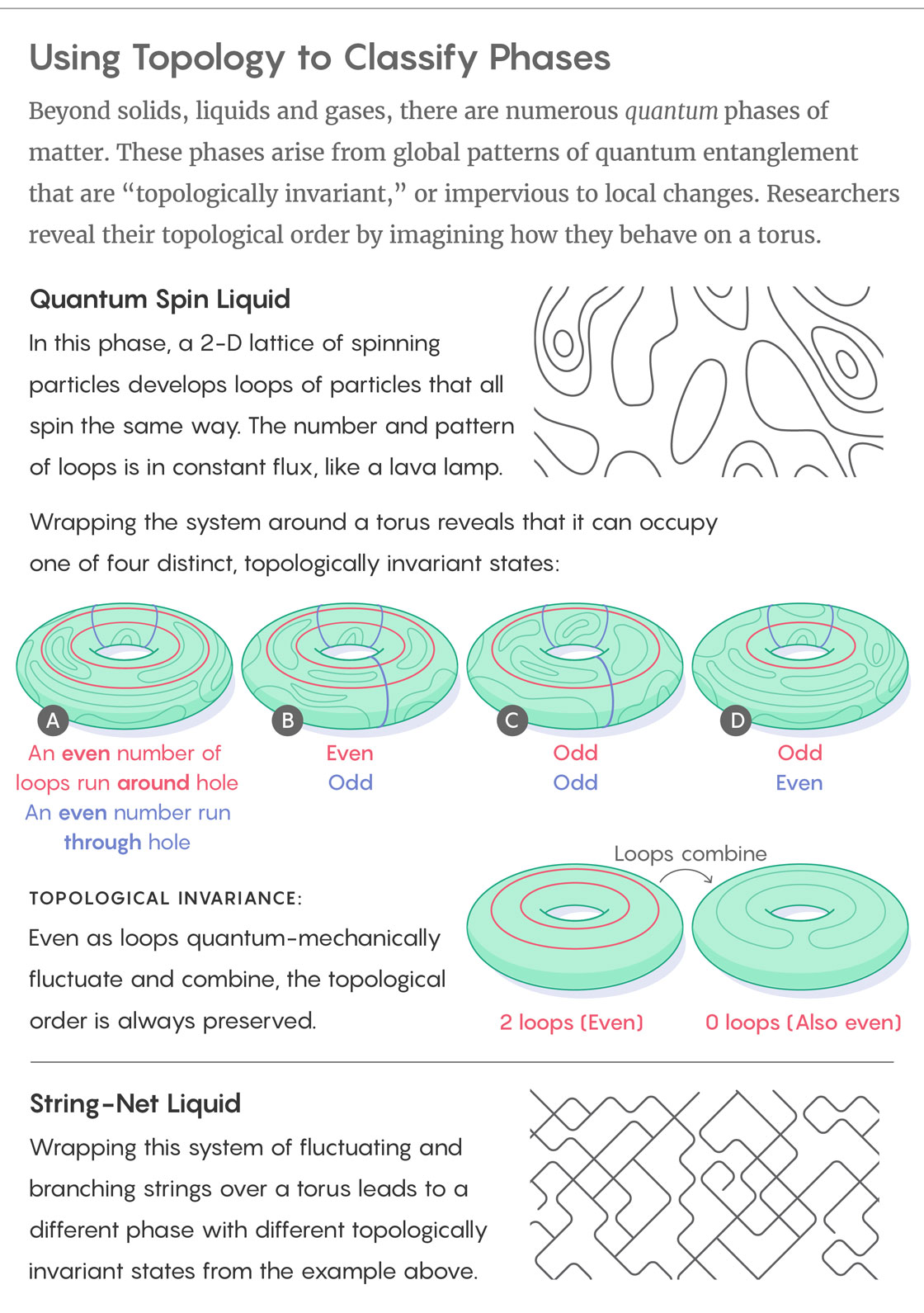
A classic example is the difference between a sphere, a torus (the surface of a donut), and a coffee mug. Geometrically, they are all very different—they have different surface areas and local curvatures. Topologically, however, the torus and the coffee mug are equivalent because each has exactly one hole, while the sphere has none. You can smoothly deform a coffee mug into a torus without cutting or pasting, but you cannot turn a sphere into a torus without creating a hole.
The following short text and video provide a clear and intuitive introduction to these foundational ideas.
Topology and geometry for physicists
This excerpt from a lecture note by Emanuel Malek provides a concise and direct comparison between geometry and topology from a physicist's perspective.
Please read the section What about geometry?. The key distinction to focus on is that geometry deals with local structures (like a metric), while topology deals with global structures that are locally trivial.
The Biggest Ideas in the Universe | 13. Geometry and Topology
In this segment from his "Biggest Ideas" series, physicist Sean Carroll gives a wonderfully clear conceptual overview of topology.
Watch the portion from the introduction to topology. Pay attention to his examples (sphere vs. torus, coffee cup vs. donut) and his definition of topology as the study of properties that are invariant under smooth deformations. This will help solidify the core concept.
The Bridge: Integrating Local Geometry to Find Global Topology
How can these abstract ideas of topology manifest in a physical system described by local physics? A powerful theme in physics and mathematics is that integrating a local geometric quantity over a closed global space can yield a global topological invariant.
The classic mathematical example is the Gauss-Bonnet Theorem. This theorem states that if you take a two-dimensional compact surface (like a sphere or a torus), integrate its local Gaussian curvature over the entire surface, the result is always an integer multiple of . Specifically:
Here, is a geometric quantity that varies from point to point on the surface. But the integral over the whole closed surface gives , the Euler characteristic, which is a topological invariant—an integer that counts the "holes" in the surface (for a surface with holes, ). For a sphere, , so , and the integral is . For a torus, , so , and the integral is 0. No matter how you stretch or dent the sphere, the total curvature integral remains .
An introduction to topological phases of electrons
This text by Joel E. Moore provides a beautiful and intuitive example of the Gauss-Bonnet theorem, making the connection between local geometry and global topology very clear.
Please read the subsection An intuitive example. Follow the calculations for the sphere and the torus. The essential point is that a local, continuous property (Gaussian curvature) sums up to a global, quantized integer when integrated over a closed space.
This provides a profound analogy for the physics of topological materials. The Berry curvature we studied in the last lesson is a local geometric property of the Brillouin zone. The total Berry phase for a loop depends on the loop's geometry. However, if we integrate the Berry curvature over the entire closed surface of the Brillouin zone (which is topologically a torus), we can obtain a quantized integer known as a Chern number. This number is a topological invariant of the electronic band structure, and it is precisely this integer that determines robust, quantized physical observables like the Hall conductance.
The Physicist's Topological Toolkit
To classify topological properties, physicists primarily use two related mathematical frameworks: cohomology and homotopy. Your mathematics minor will have introduced these, but here we'll focus on their physical intuition.
Cohomology: Closed but Not Exact Forms
This framework is a natural extension of our discussion of Berry curvature. In the language of differential forms, the Berry connection is a "1-form" and the Berry curvature is its exterior derivative, a "2-form" .
- An exact form is a form that is the derivative of another form, like a conservative force field . The line integral of an exact form around any closed loop is always zero.
- A closed form is a form whose own derivative is zero, like a curl-free vector field .
Every exact form is automatically closed (since , or ). The interesting topological features arise when a form is closed but not exact. This happens in spaces with "holes". The vector potential in the Aharonov-Bohm effect is a prime example: everywhere outside the solenoid, so is locally closed. However, for a loop around the solenoid, so is not globally exact. De Rham cohomology is the mathematical tool that classifies a space by counting its "closed but not exact" forms. The topological invariants we compute, like Chern numbers, are elements of these cohomology groups.
An introduction to topological phases of electrons
This section explains how integrals can be topologically invariant, using the language of closed and exact forms. This directly connects to the Berry phase.
Read the subsection Topologically invariant integrals. Focus on the example of the vector field that looks like the gradient of the polar angle. This is the quintessential example of a closed-but-not-exact form, and its integral gives the integer "winding number". This is the simplest manifestation of a non-trivial cohomology.
Homotopy: Winding and Wrapping
Homotopy is an even more fundamental way to classify spaces. It asks: how many fundamentally different ways can you map a sphere of one dimension into your space?
- The first homotopy group, , classifies closed loops (maps from a 1-sphere, ) on a manifold . If any loop on can be continuously shrunk to a point, is trivial. If has a hole (like the plane minus a point), loops are classified by an integer winding number, and .
- Higher homotopy groups, , classify maps from higher-dimensional spheres .
In condensed matter physics, homotopy groups are invaluable for classifying topological defects. For instance, in a 2D system where the order parameter lives on a circle (like the phase of a superconductor), a vortex is a point defect. A loop in real space around the vortex corresponds to a map from to the order parameter space . The winding number of this map classifies the vortex.
An introduction to topological phases of electrons
This reading introduces homotopy theory and its direct application to physics.
Read the two short subsections Homotopy and Application to defects. This will provide the physical intuition for homotopy groups and their relevance to your field of interest.
A Final Word from Michael Berry
To conclude our discussion, let's hear the distinction made by the originator of the geometric phase himself. In this brief clip, Sir Michael Berry precisely distinguishes between what makes a phase geometric versus topological.
Geometric phases and the separation of the world by Michael Berry
In this excerpt from a talk at the International Centre for Theoretical Sciences, Sir Michael Berry clarifies the distinction.
Watch the short segment from this definition. He emphasizes that geometric phases depend on the specific path and can be continuous, while topological phases are path-independent (as long as they enclose the topological feature) and quantized.
Conclusion
Today we've drawn a sharp line between two profound concepts that are often used interchangeably. Understanding this difference is a key step in developing the research methodology of a theoretical physicist.
Key Takeaways:
- Geometric properties (e.g., Berry phase for an arbitrary loop) are continuous, depend on local details like metric and curvature, and change smoothly as the system is deformed.
- Topological properties (e.g., winding numbers, Chern numbers) are discrete, quantized, and invariant under continuous deformations. They capture the global "connectedness" of a space.
- A key mechanism in physics is the emergence of topological invariants from the integration of local geometric quantities over a closed space (like the Gauss-Bonnet theorem or integrating Berry curvature over the Brillouin zone).
- Physicists use cohomology (classifying closed but not exact forms) and homotopy (classifying maps and winding) to formalize and calculate these topological invariants.
In the next lesson, we will put these ideas into practice. We will move from the abstract to the concrete by constructing our first topological model, the Su-Schrieffer-Heeger (SSH) model of polyacetylene, and explicitly calculating its topological invariant—the winding number. This will be our first step towards understanding how these mathematical ideas lead to astonishing and robust physical phenomena like protected edge states.