Welcome to the next lesson in our module on the Effective Field Theory (EFT) framework. In our last session, we explored the various ways an EFT can signal its own breakdown, revealing clues about the higher-energy physics it approximates. We saw that these "breakdowns" are not failures, but rather the very source of an EFT's predictive power for probing the unknown.
Today, we will synthesize these ideas into a cohesive case study. We will apply the full machinery of the EFT perspective to one of the most historically important and pedagogically rich examples in particle physics: the Fermi theory of weak interactions. Our goal is to move beyond a collection of principles and see how they are applied in practice to analyze a real physical problem. This exercise will serve as a template for the kind of thinking that underpins much of modern theoretical physics research.
By the end of this lesson, you will be able to perform a complete analysis of the Fermi theory, treating it first from a "bottom-up" perspective as a standalone low-energy model, and then from a "top-down" perspective as a derivative of the Standard Model.
A Tale of Two Theories: The Weak Interaction
The story of the weak interaction is a perfect illustration of the evolution of physical theories. It began with a puzzling observation—nuclear beta decay—that seemed to violate energy conservation, leading to the postulation of the neutrino and a new, mysterious force.
Let's begin by setting the historical stage. The following video provides an excellent overview of the initial experimental puzzles and the formulation of Fermi's theory.
What's Up with Weak Decays? (Standard Model Part 6)
This video discusses the historical context of beta decay and the development of Fermi's theory. It also introduces the key issue of non-renormalizability and frames the theory as an effective one.
Please watch the first two segments: The introduction covering the phenomenology of beta and muon decay, leading to the idea of a four-fermion interaction (the four-fermion interaction). The discussion of the problems with this theory and its interpretation as an effective theory (effective theory interpretation).
The "Bottom-Up" Analysis: Building from Low-Energy Data
As you've just seen, the earliest model of the weak force was constructed phenomenologically to explain observed decays. This is a classic "bottom-up" approach to building an EFT. Let's analyze it with our modern toolkit.
-
Degrees of Freedom: At the low energies relevant for muon decay ( MeV) or neutron decay ( MeV), the only relevant particles (degrees of freedom) are the light fermions: electrons, muons, neutrinos, and the up and down quarks that constitute protons and neutrons. Heavy particles like the W and Z bosons are not included in the theory.
-
Symmetries: The theory must respect the established symmetries of Lorentz invariance and U(1) electromagnetism.
-
Operators and Power Counting: To describe a decay like , we need an interaction that involves four fermion fields. The simplest possible local operator we can write down that respects the known symmetries and involves these fields looks like this:
This is a four-fermion contact interaction. The term ensures the correct parity-violating structure of the weak force, a detail we won't delve into here but which you've encountered in your QFT course. The crucial parameter is the Fermi constant.
From a power-counting perspective, we analyze the dimension of this operator. In spacetime dimensions, fermion fields have a mass dimension of . Therefore, the four-fermion operator has dimension . Since the action must be dimensionless, the Lagrangian density must have dimension 4. This forces the coupling constant to have a mass dimension of .
Operators with mass dimension greater than 4 are called irrelevant operators. As we discussed in the previous lesson, they become less important at low energies. The fact that the weak interaction is described by a dimension-6 operator is precisely why it is "weak" at low energies.
This also explains why the theory is non-renormalizable in the traditional sense. Calculating loop diagrams with this interaction leads to divergences that cannot be absorbed by a finite number of parameters. However, in the EFT framework, this is not a problem; it's a feature. The theory is not meant to be valid to arbitrarily high energies. The value of , determined experimentally from the muon lifetime to be , sets the scale where the theory must break down.
The "Top-Down" Analysis: Deriving from the Standard Model
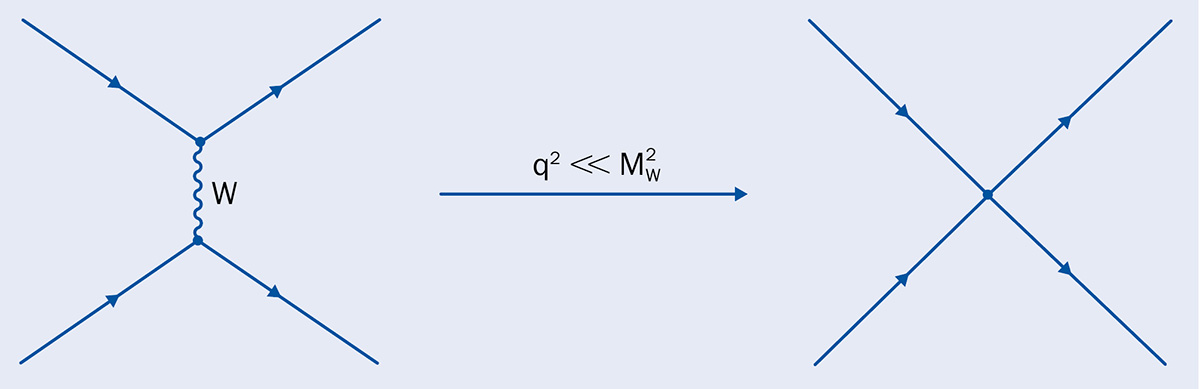
Decades after Fermi, the development of the Standard Model provided the "UV completion" of his theory. From this "top-down" perspective, we can derive the Fermi theory by integrating out the heavy W boson.
In the Standard Model, the weak interaction is mediated by the massive W and Z bosons. The interaction Lagrangian for charged currents is:
where is the weak current (e.g., , with being the left-handed projection operator) and is the SU(2) gauge coupling.
A process like muon decay is described at tree-level by the exchange of a virtual W boson. The amplitude for this process will contain the W boson propagator:
where is the momentum carried by the W boson. At low energies, the momentum transfer is small compared to the W mass, . We can therefore perform a Taylor expansion of the propagator:
Keeping only the leading term, the propagator collapses to a constant, . The interaction effectively becomes a local point interaction. The following reading walks through this crucial "matching" calculation in detail.
This excerpt provides the explicit derivation of the Fermi Lagrangian from the Standard Model. This is the central technical calculation for this lesson.
Please read the section titled 4.8 Low energy weak interactions. Focus on how the amplitude in eq. (4.43), which comes from the full theory, is approximated in the low-momentum limit to give the amplitude in eq. (4.45). This resulting amplitude is then shown to be derivable from a local Lagrangian, eq. (4.46). This process is what we call "matching".
By completing the calculation from the reading, we find that the tree-level amplitude from the Standard Model in the low-energy limit is identical to the amplitude derived from the effective Fermi Lagrangian, provided we make the identification:
This is a hallmark result of the EFT methodology. It provides a direct, quantitative link between the parameters of the low-energy effective theory () and the parameters of the underlying high-energy theory ( and ). This "matching condition" allows us to use low-energy precision measurements (like the muon lifetime, which fixes ) to constrain the physics of a much higher energy scale.

Predictions and Probing the Next Scale
The power of the EFT is not just in its construction, but in its application. Having an effective Lagrangian simplifies calculations enormously. For example, using the Fermi Lagrangian, one can calculate the muon decay rate, finding the classic result:
This calculation is far simpler than the full Standard Model loop calculations would be, yet it is extremely accurate because corrections are suppressed by powers of .
Furthermore, the EFT predicts its own doom. As we saw in the previous lesson, a cross-section calculated from a dimension-6 operator must grow with energy.
[PDF] Lectures on effective field theory - University of Washington
This reading revisits the dimensional analysis argument for neutrino scattering, which you first saw in the previous lesson. Seeing it again here will solidify its place in the overall analysis.
Please read the paragraph in section 2.1.1 that begins with "Since the four-fermion Fermi interaction..." and the subsequent paragraph that starts with "This explains why...".
The result (where is the center-of-mass energy squared) cannot hold indefinitely, as it would eventually violate the unitarity of quantum mechanics. This signals that the effective theory must be replaced by a more fundamental theory at an energy scale GeV. This argument correctly predicted the energy scale of new physics (the W and Z bosons) long before it was discovered.
What about the higher-order terms we dropped from the propagator expansion? The next term, , corresponds to a dimension-eight operator in the EFT. Its effects are suppressed by an additional factor of compared to the leading Fermi interaction. While tiny, these effects slightly alter the energy spectrum of the decay products. Historically, extremely precise measurements of beta decay spectra were used to place bounds on the size of these dimension-eight effects, providing the first experimental estimates for the mass of the W boson. This is a beautiful example of using the EFT framework to extract information about a high-energy scale from precision low-energy experiments.
Conclusion
This case study of the Fermi theory provides a complete illustration of the EFT research paradigm. We have seen how to analyze a physical problem from two complementary perspectives:
- Bottom-Up: We started with low-energy observations and constructed the most general theory consistent with symmetries. This led to a non-renormalizable theory with a dimension-6 operator. While non-renormalizable, this EFT is predictive, allowing for systematic calculations and even predicting the energy scale at which it must fail.
- Top-Down: We started with a known high-energy theory (the Standard Model) and systematically derived the low-energy approximation. This "matching" procedure rigorously determines the coefficients of the effective Lagrangian (like ) in terms of the fundamental parameters of the high-energy theory ().
This powerful interplay between top-down derivation and bottom-up construction is at the heart of the modern approach to physics beyond the Standard Model.
Key Takeaways:
- Analyzing a problem from an EFT perspective involves identifying the low-energy degrees of freedom, symmetries, and organizing the effective Lagrangian via a power-counting expansion.
- Fermi's theory is the EFT of the Standard Model below the electroweak scale, where the leading interaction is a dimension-6 four-fermion operator.
- The "matching" procedure of integrating out heavy particles provides a direct link between the parameters of the low-energy EFT and the high-energy UV completion.
- The structure of the EFT (e.g., the energy-dependence of cross-sections) contains information about its own regime of validity and can be used to predict the scale of new physics.
The process of "integrating out" heavy particles and flowing from a high-energy description to a low-energy one may seem somewhat heuristic. In our next and final lesson of this module, we will explore the Renormalization Group, the formal theoretical structure that puts this procedure on a rigorous mathematical footing and provides the ultimate justification for the entire effective field theory framework.