In our previous lesson, we established that an effective field theory (EFT) is a systematic, predictive framework built on an expansion in powers of , where is the characteristic momentum of a process and is the "cutoff" scale. We learned how power counting allows us to organize the infinite tower of operators and truncate it to achieve any desired precision. This naturally leads to a crucial question: What exactly is , and how do we determine its value?
This lesson will address that question head-on. We will explore the physical meaning of the cutoff and investigate the various ways physicists determine the regime of validity of an EFT. You will learn to recognize the theoretical and experimental signals that herald the breakdown of an effective description, which is not a failure of the theory, but rather a signpost pointing toward new, undiscovered physics at higher energies.
The Modern View: All Theories are Effective
Before diving into the technical details, it's valuable to absorb the modern perspective on this topic from one of its pioneers, Steven Weinberg. He argues that we should view our most successful theory, the Standard Model of particle physics, not as a final theory, but as an incredibly precise low-energy approximation to a more fundamental theory that lives at some very high energy scale .
Steven Weinberg | On the Development of Effective Field Theory
This video provides a masterclass in the philosophy of EFT. Weinberg explains why the very idea of a "final theory" has been replaced by a picture of a tower of effective theories, each valid within its own domain.
Please watch two key segments: First, watch from the beginning of his "new and cooler view" at the Standard Model as a low energy approximation. Then, jump to his concluding remarks from the survival of theories, where he contrasts the EFT viewpoint with Thomas Kuhn's paradigm shifts.
Weinberg's point is profound: successful theories aren't overthrown; they are subsumed. Newton's gravity is the correct low-velocity, weak-field limit of General Relativity. Similarly, the Standard Model will almost certainly survive as the low-energy limit of whatever theory replaces it. The central task of an effective field theorist is to understand the limits of their current theory and to search for the subtle effects of the higher-energy physics encoded in corrections to it.
The Physical Meaning of the Cutoff
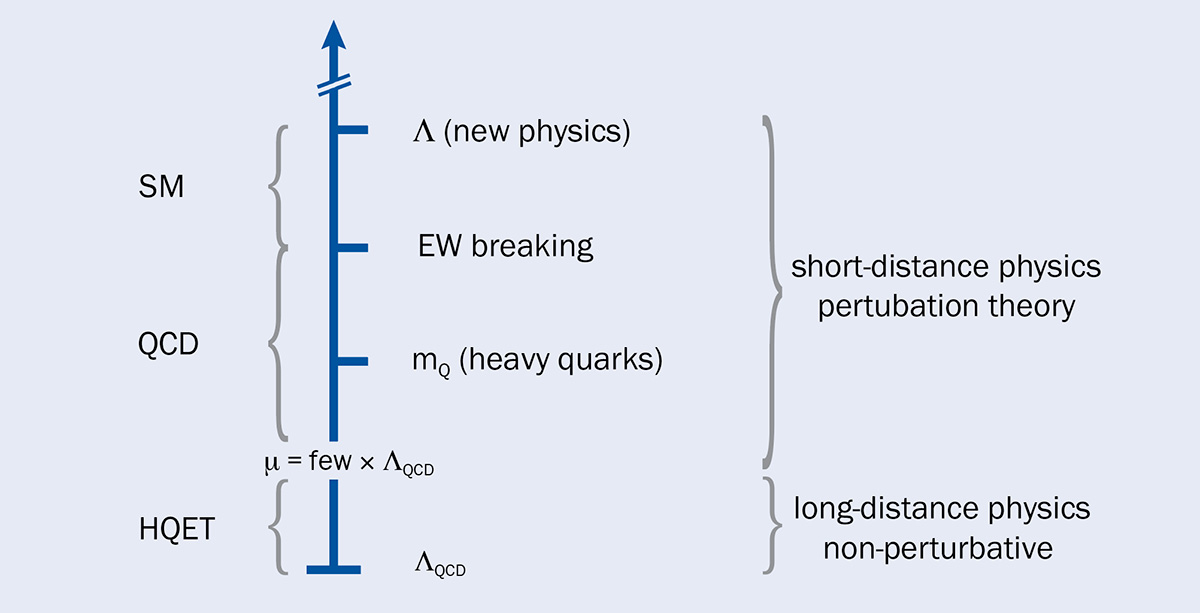
The cutoff is not merely a mathematical device for organizing an expansion. It has a direct physical meaning: is the energy scale at which new degrees of freedom, which were not included in the EFT, become active and can be produced.
- Top-Down View: If you know the underlying high-energy theory, is simply the mass of the lightest particle you chose to "integrate out". The classic example is the Fermi theory of weak interactions. It describes processes like neutron decay perfectly at low energies. It is the low-energy EFT of the Standard Model's electroweak sector. In this case, , the mass of the W boson. At energies far below , the W boson can only be exchanged as a virtual particle over very short distances. Its propagator, , can be Taylor expanded for small momentum transfer , yielding a local four-fermion contact interaction.
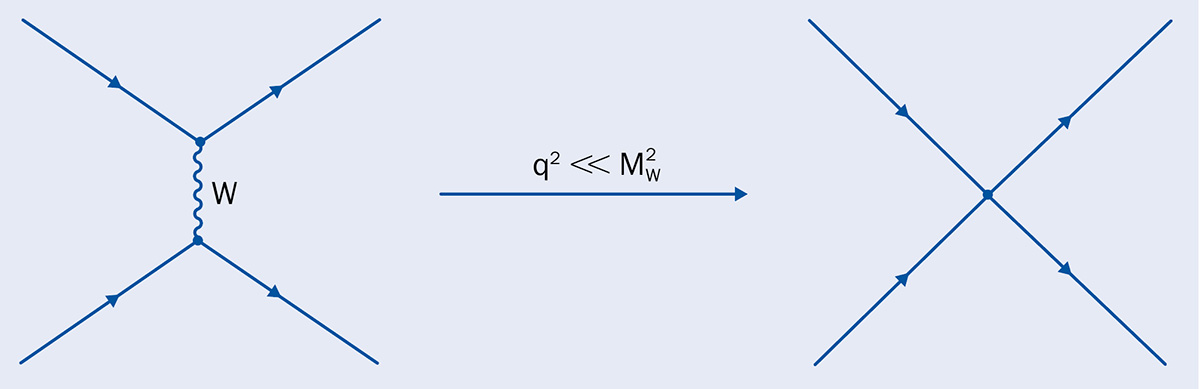
- Bottom-Up View: If you don't know the underlying theory (the situation we are in with the Standard Model), is an unknown parameter of your EFT. The goal then becomes to use experimental data and theoretical consistency to place bounds on . Finding a finite value for is tantamount to discovering new physics.
Signals of EFT Breakdown
How do we determine the value of from a bottom-up perspective? There are several key indicators that an EFT is approaching its limit.
1. Direct Discovery of New Particles
The most straightforward, albeit expensive, method is to build a particle accelerator with enough energy to create the new, heavy particles on-shell. The discovery of the W and Z bosons at CERN in 1983 with masses around 80-90 GeV was the definitive confirmation that the Fermi theory's regime of validity ended there.
2. Violation of Fundamental Principles (Unitarity)
Long before we can build a -energy collider, our EFT may predict nonsensical results. A key example is the violation of unitarity. Unitarity is a fundamental tenet of quantum mechanics that, among other things, requires the probability of a given scattering process to be less than or equal to one.
In an EFT, cross-sections involving irrelevant operators often grow with energy. Consider neutrino-electron scattering in the Fermi theory. The interaction is described by a dimension-6 operator with a coefficient .
Lectures on effective field theory
David Kaplan's lecture notes provide a clear, practical example using Fermi's theory.
Please read the subsection 2.1.1 Dimensional analysis. Pay close attention to the dimensional argument that leads to the conclusion that the neutrino scattering cross-section, \sigma_\nu, must scale with the center-of-mass energy squared, s.
As you've just read, dimensional analysis forces the cross-section to scale as . This growing cross-section will eventually conflict with the unitarity bound, which demands that for a point-like interaction, . The violation occurs when , or . Since , this implies a breakdown at . This unitarity argument correctly predicted that the Fermi theory must break down and be replaced by a more fundamental theory at an energy scale of a few hundred GeV, decades before the W boson was discovered.
3. Measurement of Higher-Dimension Operator Effects
The core idea of EFT is that physics beyond the Standard Model (BSM) will manifest as a tower of higher-dimension operators added to the SM Lagrangian. Measuring the (tiny) effects of these operators allows us to estimate the scale from which they arise.
The lowest-dimension operators one can add to the Standard Model are dimension-five. It turns out there is only one, the Weinberg operator, and it has profound consequences.
This segment of Professor Stewart's lecture applies the power-counting formalism directly to the Standard Model, treated as an EFT. It clearly shows how the leading-order corrections from new physics appear.
Please watch from application of EFT to the Standard Model. Focus on the construction of the unique dimension-five operator and how it generates a Majorana mass for neutrinos after electroweak symmetry breaking.
As the video explains, the dimension-five operator gives neutrinos a mass , where GeV is the Higgs vacuum expectation value. The observation of neutrino oscillations implies that neutrinos have tiny, non-zero masses. If we assume the dimensionless coefficient is of order 1, the observed masses ( eV) point to a staggeringly high scale for new physics:
This is a hallmark EFT argument: the observation of a process forbidden in the renormalizable Standard Model (lepton number violation leading to neutrino mass) is interpreted as the effect of a higher-dimension operator, allowing us to estimate the scale of the new physics responsible. Similar arguments using dimension-six operators that would mediate proton decay (which is not observed) place even stronger bounds, GeV.
4. Breakdown of Perturbativity
The EFT expansion relies on contributions from loops being smaller than contributions from tree-level diagrams. This hierarchy can break down. The loop expansion parameter in an EFT is not just a coupling constant like , but typically involves the energy scale.
A powerful rule of thumb called Naive Dimensional Analysis (NDA) suggests that in a theory with a characteristic interaction scale (like the pion decay constant ), quantum corrections from loops become as important as tree-level effects when energies approach . This gives an upper bound on the cutoff: .
[PDF] Effective Field Theory - High Energy Physics
This section of Ben Gripaios's notes provides a concise argument for estimating the cutoff scale by comparing the size of tree-level and one-loop diagrams.
Please read the section 5.3 Estimate of the cut-off scale. The argument compares the momentum scaling of a tree-level 4-point interaction with its one-loop correction to show that the expansion parameter is effectively p^2 / (4\pi f)^2, implying a breakdown when p \sim 4\pi f.
This argument is crucial. It shows that there is a consistency requirement relating the cutoff and the interaction scales within the EFT itself. A large separation between and is generally not possible without fine-tuning.
5. The "Naturalness" Problem
Finally, a more subtle and controversial signal comes from the behavior of relevant operators. The Standard Model contains one such operator: the Higgs mass term, . Quantum corrections to scalar mass-squared parameters are typically quadratically sensitive to the cutoff: .
If the cutoff is very high (e.g., the Planck scale, GeV), then the quantum correction is enormous. To obtain the observed Higgs mass ( GeV), the "bare" mass in the Lagrangian must be fine-tuned to cancel this huge quantum correction to dozens of decimal places.
Lectures on effective field theory
Kaplan's notes give a succinct summary of this "naturalness" or "fine-tuning" problem.
Read the section 3.2 Relevant operators and naturalness. This section explains why light scalar particles are considered 'unnatural' in an EFT with a very high cutoff.
This fine-tuning is seen by many physicists as "unnatural". It suggests that the EFT paradigm is breaking down. The problem would be solved if the cutoff were not far above the weak scale, for instance, TeV. In this case, the quantum corrections are manageable. This naturalness argument was a primary motivation for expecting new physics at the TeV scale to be discovered at the Large Hadron Collider. The fact that no such physics has been found (so far) has deepened this mystery and is a major topic of current research.
A Note on Calculation and Power Counting
A crucial technical point is that the beautiful power-counting hierarchy can be ruined by a clumsy choice of regularization. Using a hard momentum cutoff in loop integrals can introduce unsuppressed contributions from high-dimension operators, destroying the predictive power of the EFT. To preserve the power counting, one must use a mass-independent regularization scheme, such as dimensional regularization.
[PDF] Effective Field Theory - High Energy Physics
Gripaios's notes explain this important technical pitfall.
Please read the two sections 3.3 The right way to do EFT and 4.10 Two pitfalls. This will solidify why the choice of regulator is not just a technical detail but is essential for the consistency of the EFT program.
Conclusion
You now have a toolkit for probing the limits of an effective theory. The breakdown of an EFT is not a crisis but an opportunity—it is the whisper of new particles and new forces lurking at higher energies.
Key Takeaways:
- An EFT's regime of validity is bounded by the cutoff scale , which represents the energy where new, excluded degrees of freedom become physically accessible.
- The breakdown of an EFT can be signaled in several ways:
- Direct discovery of new particles.
- Theoretical inconsistency, such as the violation of unitarity in calculated cross-sections.
- Experimental measurement of processes forbidden by the renormalizable part of the theory, which are interpreted as effects of higher-dimension operators (e.g., neutrino mass).
- Breakdown of perturbativity, where loop corrections become as large as tree-level terms, suggesting .
- Naturalness problems associated with relevant operators, which hint that cannot be vastly separated from the electroweak scale without incredible fine-tuning.
In our previous lessons, we built the EFT framework. Today, we learned how to find its boundaries. In the next lesson, we will synthesize these ideas by performing a detailed case study, analyzing the Fermi theory of weak interactions from a complete EFT perspective, from construction to breakdown.