Hello! Welcome to the first lesson in our course on the methodology of theoretical physics. We'll begin by building up our mathematical toolkit, starting with a topic you've encountered in your mathematics minor: group theory. Our goal today is not to re-derive the subject from first principles, but to re-frame it as a powerful, practical tool for the working physicist. By the end of this lesson, you will be able to apply the core concepts of groups and their representations to the essential task of classifying quantum states and operators. This approach, where physical principles guide our use of mathematical structures, will be a recurring theme throughout our course.
1. From Physical Symmetries to Abstract Groups
In physics, we are deeply interested in symmetries—transformations that leave a system looking the same. Consider rotating a square by 90 degrees, or waiting for a certain amount of time to pass in a time-independent system. These are symmetry operations. A key insight is that collections of such operations are not just random sets; they possess a definite mathematical structure.
Let's think about the properties a set of symmetry operations must have to be physically consistent:
- Composition: If you can perform one symmetry operation, and then another, the combined result should also be a symmetry operation.
- Identity: There must be an operation corresponding to "doing nothing," which is trivially a symmetry.
- Inverse: If you can perform a symmetry operation, you must be able to undo it. The "undo" operation should also be a symmetry.
- Associativity: If you have three operations A, B, and C, performing (A then B) then C should be the same as performing A then (B then C).
These simple physical requirements are precisely the axioms that define a mathematical group.
Symmetries and quantum mechanics: basics, Wigner's theorem, linear representations of groups
To build on this intuition, watch the first part of this lecture by Tobias Osborne from Leibniz University Hannover. He provides a compelling argument for how the structure of a group emerges naturally from the consistency conditions we expect physical symmetries to obey.
Please watch from the beginning of the "Sets of Symmetries" discussion at the motivation for group structure. Pay close attention to how the physical requirements of 'doing nothing', composition, and 'undoing' map directly onto the group axioms.
Now that we have the physical intuition, let's formalize it.
[PDF] Introduction to Group Theory
This document by Roland Winkler provides a concise summary of the core definitions. We will use it to establish our terminology.
Please read the section titled "Definition: Group". This formally lays out the axioms we just motivated and introduces the concepts of Abelian (commutative) groups and the order of a group.
2. Representations: Making Symmetries Act on Quantum Systems
We've established that symmetries form groups. But how does an abstract group element, like a rotation 'R', actually act on the quantum states in a Hilbert space? The answer lies in the concept of a representation.
A representation is a mapping that assigns a specific linear operator (which can be written as a matrix) to each element of the abstract group. This mapping must preserve the group's multiplication structure. That is, if group elements g1 and g2 combine to form g3, then their corresponding matrices D(g1) and D(g2) must multiply to give the matrix D(g3).
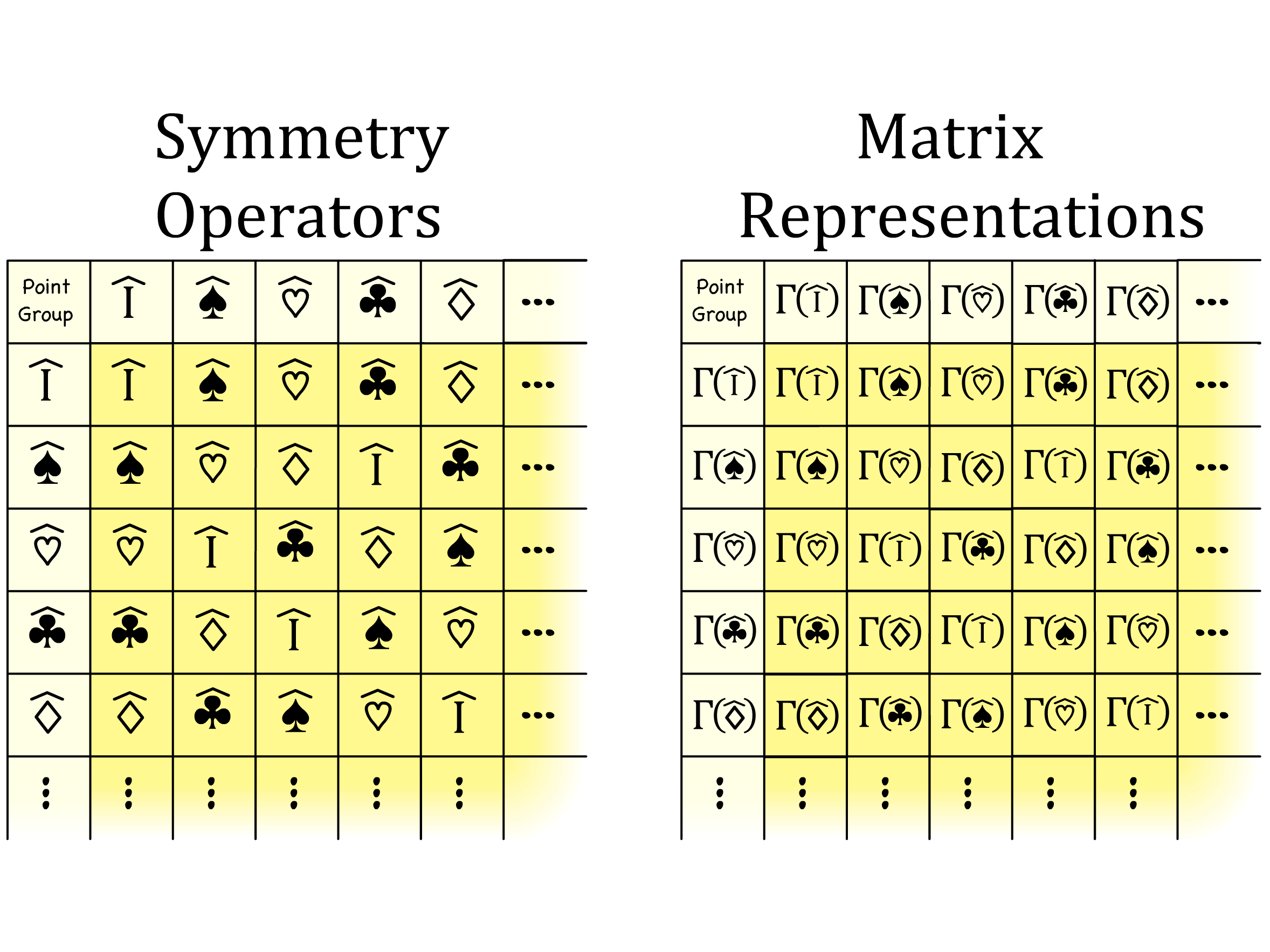
This mapping is formally called a group homomorphism. For our purposes in quantum mechanics, we are interested in operators acting on the Hilbert space of states. A crucial insight, known as Wigner's theorem, tells us that any symmetry transformation that preserves the physical content of quantum mechanics (specifically, transition probabilities between states) must be represented by either a unitary or anti-unitary operator on the Hilbert space.
Symmetries and quantum mechanics: basics, Wigner's theorem, linear representations of groups
The same lecture by Tobias Osborne provides an excellent, non-technical overview of Wigner's theorem and its profound implications.
Watch the segment from Wigner's theorem. The key takeaway is that the physical requirement of preserving probabilities drastically constrains the mathematical form of symmetry operators, forcing them to be linear (unitary) or anti-linear (anti-unitary). This is the bridge that connects the abstract group to the concrete operators acting on our Hilbert space.
For the remainder of this lesson, we will focus on the more common case of unitary representations.
3. Classifying Quantum States with Irreducible Representations
The connection between symmetries and unitary representations has a profound consequence: it allows us to classify the states of a quantum system.
Consider a system described by a Hamiltonian . Let be the symmetry group of the Hamiltonian, meaning for any group element , its corresponding unitary operator commutes with the Hamiltonian: .
Now, if is an eigenstate of with energy , then so is :
This means that all states obtained by acting on with symmetry operators from the group are also eigenstates with the same energy . The set of all such degenerate eigenstates forms a subspace of the total Hilbert space. This subspace is special: it is an invariant subspace under the action of the symmetry group, meaning that any state within this subspace remains within it after any symmetry operation is applied.
This invariant subspace "carries" a representation of the symmetry group. The crucial idea is that this representation can be either reducible or irreducible.
- A reducible representation means the invariant subspace can be broken down into smaller, independent invariant subspaces. If you start with a state in one of these smaller subspaces, the symmetry operations will never move you into another one.
- An irreducible representation (IR or irrep) means the subspace cannot be broken down any further. The symmetry operations mix all the states within this subspace.
The degeneracy of an energy level is "explained" or "protected" by the symmetry. The states of a degenerate energy level form a basis for an irreducible representation of the Hamiltonian's symmetry group. The dimension of the irreducible representation is equal to the degeneracy of the energy level.
Therefore, we can classify energy eigenstates not just by their energy, but by the irreducible representation of the symmetry group they belong to.
[PDF] Introduction to Group Theory
The Winkler PDF provides the formal definitions for these concepts.
First, read the definitions of Reducible and Irreducible Representations. This is the fundamental distinction. Next, see how this is applied in quantum mechanics by reading about Invariant Subspaces and the connection between IRs and invariant subspaces. Finally, read the section Symmetry of Observables. This explicitly states the key conclusion: the set of degenerate eigenstates forms an invariant subspace that carries a representation of the symmetry group, and we typically assume this representation is irreducible.
4. A Glimpse at Classifying Operators
Just as states can be grouped into sets that transform according to IRs, so can operators. For instance, under the group of 3D rotations, SO(3), a scalar operator (like the Hamiltonian of a spherically symmetric system) is unchanged. It transforms according to the one-dimensional "trivial" IR. The three components of the position operator, , transform into each other. They form a set of operators that transforms according to the three-dimensional "vector" IR of SO(3). This classification of operators is the foundation for powerful tools like the Wigner-Eckart theorem, which governs selection rules in spectroscopy and is a cornerstone of many calculations in quantum mechanics. We will delve deeper into this in a later module.
5. A Grand Unifying Example: Wigner's Classification of Particles
This method of classification is so fundamental that it can be used to answer the question: "What is a particle?". Your current studies in QFT and General Relativity are grounded in this idea. The modern perspective, pioneered by Eugene Wigner, re-frames the problem of "quantization" itself.
Symmetries and quantum mechanics: Linear representations
In this follow-up video, Tobias Osborne argues that we can think of quantization as the search for unitary representations of the symmetries of a given spacetime.
Please watch the segment from this new perspective. The central idea is that instead of quantizing classical variables, we should identify the symmetry group of our spacetime and then find all the ways it can be represented by unitary operators on a Hilbert space.
This profound idea leads to Wigner's classification of elementary particles.
- Symmetry Group: The fundamental symmetry of our universe, according to Special Relativity, is the Poincaré group, which includes translations, rotations, and boosts.
- Representation: An elementary particle is defined as an irreducible unitary representation of the Poincaré group.
- Classification: How do we label these different irreps? We use the eigenvalues of the group's Casimir operators—operators constructed from the group's generators that commute with all other generators. For the Poincaré group, there are two Casimir operators.
- The Result: The eigenvalues of these two Casimirs correspond to fundamental physical properties: mass () and spin ().
Thus, from first principles of symmetry, we find that a particle is fundamentally characterized by its mass and its spin. This is not an assumption, but a direct consequence of the symmetries of spacetime. The specific values spin can take () arise from classifying the IRs of the relevant "little group" (SO(3) for massive particles, ISO(2) for massless ones).
Wigner's classification — Grokipedia
This article provides a good summary of Wigner's classification.
Read the introductory paragraphs in the first section to get an overview of the program. Then, focus on the section Casimir Operators and Invariants. This explains how the invariant labels of mass and spin emerge directly from the group structure of spacetime.
Conclusion
In this lesson, we have seen how the abstract mathematical concept of a group and its representations becomes a powerful organizational principle in physics.
- Groups are the natural language to describe the symmetries of a physical system.
- Unitary representations are how these symmetries are realized on the Hilbert space of quantum states.
- Irreducible representations (IRs) are the fundamental, unbreakable units of these representations.
- By identifying the symmetry group of a Hamiltonian, we can classify its degenerate energy eigenstates according to the IRs they transform under.
- This principle is so fundamental that it provides a definition for what an elementary particle is: an irreducible unitary representation of the Poincaré group, classified by mass and spin.
This is our first major tool. Symmetries allow us to classify and simplify problems, often revealing deep truths about a system before we even write down a detailed Hamiltonian.
In the next lesson, we will explore our second mathematical tool: topology. While group theory often deals with discrete or continuous symmetries, topology will allow us to classify systems based on robust, global properties that are insensitive to smooth deformations. This will lead us to modern concepts like topological phases of matter, a very active area of research in condensed matter physics.