Welcome to the first lesson of our new module on the physics of collective behavior. In the previous modules, we developed a powerful set of tools for approximating the behavior of systems with a few degrees of freedom, culminating in our exploration of asymptotic series and resurgence. We saw how even divergent series can encode profound physical truths. Now, we pivot our attention from the few to the many. How can we describe systems with Avogadro's number of interacting particles, like a magnet, a crystal, or a superconductor?
A direct description of every particle's state is not just computationally impossible, it's conceptually misguided. The interesting phenomena in these systems—like the spontaneous appearance of magnetism when a material is cooled—are collective and emergent. They are marked by phase transitions, where the macroscopic properties of the system change abruptly and qualitatively. Our first task, and the focus of this lesson, is to learn how to distill the complexity of degrees of freedom into a single, potent descriptor: the order parameter. Identifying a suitable order parameter is the foundational step in the craft of modeling phase transitions, a bridge between microscopic chaos and macroscopic order.
1. The Puzzle of Broken Symmetry
The central conceptual puzzle of phase transitions is this: the microscopic laws of physics governing the particles (e.g., the Hamiltonian) are often highly symmetric, yet the states of matter we observe can have much lower symmetry. A classic example is a ferromagnet. The interaction between any two magnetic spins depends only on their relative orientation, not on any absolute direction in space—the Hamiltonian is rotationally invariant. Yet, below a critical temperature (the Curie temperature), the material spontaneously develops a net magnetization pointing in a specific direction, breaking the rotational symmetry. How does a symmetric cause produce an asymmetric effect?
This phenomenon is called spontaneous symmetry breaking (SSB). It is the conceptual key to understanding phase transitions and defining order parameters.
Let's begin by watching a video that sets up this puzzle and introduces the qualitative picture of how an order parameter emerges from the system's thermodynamics.
Quantum phase transitions, spontaneous symmetry breaking, mean field theory
This video, from Dr Mitchell's physics channel, introduces the core ideas of spontaneous symmetry breaking and the role of the free energy in driving phase transitions.
First, watch the segment from 1:43 to 6:13, which articulates the puzzle of how a symmetric Hamiltonian can describe phases with different symmetries. Then, jump to the section from 23:51 to 27:17. This is the crucial part. It explains spontaneous symmetry breaking visually using the free energy landscape and provides a clear, formal definition of the order parameter. Pay close attention to the shape of the free energy potential above and below the critical temperature.
The video establishes the essential definition: An order parameter is a macroscopic thermodynamic observable that is zero in the disordered, high-symmetry phase and non-zero in the ordered, low-symmetry phase.
The shape of the free energy, , as a function of the order parameter, , tells the whole story.
- High Temperature (Symmetric Phase): has a single minimum at . The system is disordered.
- Low Temperature (Broken-Symmetry Phase): develops a "Mexican hat" or double-well shape, with a local maximum at and a set of degenerate global minima at non-zero values of . The system must "choose" one of these minima, spontaneously breaking the symmetry and acquiring a non-zero order parameter.

This framework is elegant, but it hinges on one crucial step: how do we choose the right quantity for ?
2. Finding the Order Parameter: A Symmetry Detective Story
The choice of order parameter is not arbitrary; it is dictated by the physics of the system, and specifically by the symmetry that is being broken. The order parameter is the quantity that "detects" the symmetry breaking. A robust method for identifying an order parameter is to find a macroscopic quantity that is invariant under the symmetries of the disordered phase but transforms non-trivially under the symmetry operation that is broken in the ordered phase.
Let's make this concrete with a series of examples, drawing from the excellent lecture notes by Peter Olmsted. Your background in condensed matter and QFT will allow you to appreciate the increasing sophistication of these examples.
Lectures on Landau Theory of Phase Transitions
This text provides a comprehensive physicist's guide to constructing order parameters for various systems. We will focus on the examples.
First, read the examples in section 2.1, "Examples" (p. 2-3). This will give you a quick survey of different phase transitions and their associated order parameters. Then, we'll dive into the details of a few key cases. Read the following subsections from Section 4, "Examples": Ising Magnet (p. 7): Read the paragraphs on "Order Parameter" and "Symmetries". This is the simplest case, a scalar order parameter for a discrete symmetry. Heisenberg Ferromagnet (p. 8-9): Read "Order Parameter" and "Symmetries". This introduces a vector order parameter for a continuous symmetry. Nematic Liquid Crystals (p. 10): This is the most instructive example. Read the entire paragraph on "Order Parameter". It shows why physical considerations can force us to use a more complex, tensor order parameter.
Let's systematize the reasoning demonstrated in these examples.
Example 1: Ising Ferromagnet (Scalar Order Parameter)
- System: A lattice of spins that can only point up () or down ().
- Hamiltonian: .
- Symmetry of H: The Hamiltonian is invariant under a global spin flip, for all . This is a discrete symmetry.
- Phases:
- High T (Paramagnetic): Thermal fluctuations overwhelm the interaction. Spins are randomly oriented. . The state is symmetric under the transformation.
- Low T (Ferromagnetic): The system minimizes energy by aligning spins. The ground state is either all spins up or all spins down. This state is not symmetric under the transformation (flipping all-up gives all-down). The symmetry is spontaneously broken.
- Order Parameter: The average magnetization, .
- Justification: In the symmetric phase, . In the broken-symmetry phase, . transforms as under the symmetry, perfectly capturing the choice between the two degenerate ground states.
Example 2: Heisenberg Ferromagnet (Vector Order Parameter)
- System: A lattice of spins which are 3D vectors, .
- Hamiltonian: .
- Symmetry of H: The dot product is invariant under global rotations of all spins. The Hamiltonian has continuous rotational symmetry.
- Phases:
- High T (Paramagnetic): Spins are randomly oriented. . The state is rotationally symmetric.
- Low T (Ferromagnetic): All spins align along a single, spontaneously chosen direction . The state is no longer invariant under all rotations, only under rotations around the axis . The symmetry is broken to .
- Order Parameter: The vector magnetization, .
- Justification: In the symmetric phase, . In the broken phase, points along the direction of spontaneous magnetization, so . transforms as a vector under rotations, correctly describing the orientation of the ordered state.
Example 3: Nematic Liquid Crystal (Tensor Order Parameter)
This is a masterclass in using physical constraints to define an order parameter.
- System: A fluid of rod-like molecules.
- Physical Constraint: The molecules have head-tail symmetry. A molecule pointing along a direction is indistinguishable from one pointing along . Any physical observable must respect this symmetry.
- Symmetry of H: Like a normal fluid, the high-temperature (isotropic) phase is homogeneous and isotropic, possessing full translational and rotational symmetry.
- Phases:
- High T (Isotropic): Molecular axes are randomly oriented.
- Low T (Nematic): The molecules spontaneously align along a common axis, called the director , but with no head-tail preference. Rotational symmetry is broken.
- Why a vector parameter fails: If we tried to use an average orientation , the head-tail symmetry ensures that for every molecule contributing , another contributes on average. Thus, would be zero in both the disordered and ordered phases, making it a useless order parameter.
- Order Parameter: We need a quantity that is non-zero for an aligned state but is insensitive to the flip. The answer is a second-rank tensor. The standard choice is the traceless quadrupole tensor:
- Justification: In the isotropic phase, the orientations are random, so by symmetry , which makes . In the nematic phase, the molecules align along , creating anisotropy. For example, if is along the z-axis, making . This quantity is quadratic in , so it is manifestly invariant under .
These examples show a clear pattern: the tensorial nature of the order parameter—scalar, vector, or tensor—is determined by the symmetry being broken and any additional microscopic constraints.
3. The Order Parameter Space
Once a system enters a broken-symmetry phase, the order parameter takes on a specific non-zero value. However, because the symmetry breaking is spontaneous, there is typically a continuous family of equally valid, degenerate ground states. The set of all possible values for the order parameter in the broken-symmetry phase forms a mathematical space, known as the order parameter space or the manifold of degenerate ground states.
Given your background in mathematics, you can appreciate that the topology of this space is deeply connected to the types of defects (like vortices or domain walls) the ordered phase can support.
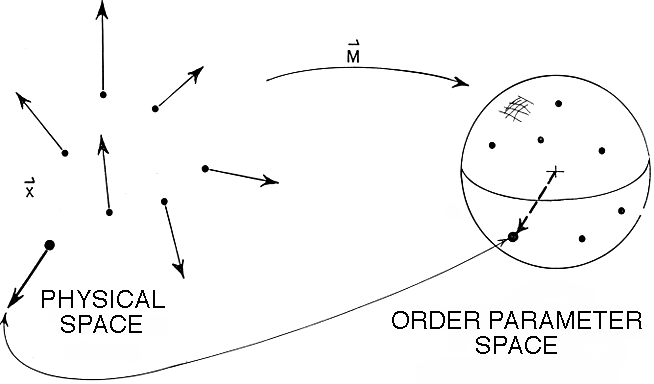
Let's characterize the order parameter spaces for our examples:
- Ising Model: The system chooses between and . The order parameter space is the discrete set of two points, .
- Heisenberg Model: At low temperatures, the spins align, giving a magnetization vector of fixed length but arbitrary direction. The order parameter space is the set of all possible directions, which is the surface of a sphere, .
- Nematic Liquid Crystal: The order parameter is the director . Since and describe the same physical state, the order parameter space is the sphere with antipodal points identified. This is the real projective plane, .
- 1D Crystal (Smectic-A Liquid Crystal): The order parameter can be written as . The magnitude is fixed at a given temperature, but the phase , which represents the overall position of the crystal layers, can be anything. The order parameter space is the circle, .
The structure of the order parameter space encodes the nature of the broken symmetry. A continuous order parameter space (like or ) arises from breaking a continuous symmetry and is associated with the existence of low-energy excitations called Goldstone modes (e.g., spin waves in a magnet), a topic we will explore later.
Conclusion
In this lesson, we have established the concept of the order parameter as the fundamental tool for describing phase transitions. We've moved beyond a simple definition to develop a systematic methodology for identifying a suitable order parameter based on the physical and symmetric properties of a system.
Key Takeaways:
- Phase transitions are characterized by spontaneous symmetry breaking, where a low-temperature, ordered state possesses less symmetry than the underlying Hamiltonian.
- An order parameter is a macroscopic observable chosen to be zero in the high-temperature, symmetric phase and non-zero in the low-temperature, broken-symmetry phase.
- The nature of the order parameter (scalar, vector, tensor, complex) is determined by the symmetry group being broken and any additional physical constraints (like the head-tail symmetry of liquid crystals).
- The set of all possible ground states in the ordered phase forms an order parameter space, whose topological properties are physically significant.
We have now completed the first, crucial step in modeling collective phenomena: creating a simplified macroscopic description. The next question is, how do we model the transition itself? How can we predict the behavior of the order parameter as we change the temperature? This leads directly to the topic of our next lesson, where you will learn to construct a Landau free energy expansion based on symmetry and analyticity arguments, turning the qualitative picture of the "Mexican hat" potential into a powerful quantitative theory.