In our last lesson, we explored how to validate a model by testing its predictions in simple, well-understood limiting cases. This process serves as a crucial "sanity check" to ensure our theoretical construction is sound. Now, we advance to a more subtle and equally important question: assuming our model is correctly constructed, under what conditions can we trust its predictions?
This lesson delves into the concept of a model's domain of validity. Every model in physics is an approximation, built on a set of assumptions that neglect certain complexities of the real world. Its domain of validity is the region of parameter space—of energy, length, temperature, etc.—where those assumptions hold true. The edge of this domain is where the model begins to "break down." Crucially, this breakdown is not a failure. Instead, it is a signal, a signpost pointing toward the new physics that our initial assumptions left out. Understanding these boundaries is essential for knowing when to apply a model and how to interpret its predictions, or lack thereof.
1. Signals of Breakdown: When Models Go Wrong
A model's breakdown can manifest in various ways, ranging from stark qualitative absurdities to subtle quantitative divergences. The key is to learn how to recognize these signals.
Qualitative Breakdown: The Failure of Intuition
Sometimes, a simple model makes a prediction that is dramatically contradicted by observation. These moments are invaluable, as they force us to identify the missing physical ingredient. The physicist and mathematician Tadashi Tokieda has created a brilliant collection of "toys" that demonstrate this principle.
-
Granular Matter vs. Solid Body: A simple model of a hollow cylinder rolling down a ramp, based on introductory mechanics, predicts its descent speed. This model works perfectly. But what if we partially fill the cylinder with rice? The simple model breaks down spectacularly. Depending on the fill level, it might roll extremely slowly or stop completely. The original model is invalid because it lacks the necessary degrees of freedom to describe the internal motion of the rice, which is governed by principles like the angle of repose. The fill fraction and the properties of the granular medium define the domain of validity for the simple rigid-body model.
-
The Tippy Top: A common intuitive model is that physical systems tend to a state of minimum potential energy. An egg-shaped object's lowest energy state is lying on its side. Yet, if you spin a "tippy top" (or a hard-boiled egg) fast enough, it flips over to spin on its stem, raising its center of gravity. The simple minimum-energy model breaks down because it neglects the effects of spin and friction. The dominant physics is the complex interplay of angular momentum, contact forces, and energy dissipation. The model's validity depends on the angular velocity of the object.
These examples show that a model breaks down when a physical effect it ignores (internal degrees of freedom, friction, spin) becomes dominant. The art of the theorist is to identify which neglected effect is the culprit.
For a fascinating look at more of these phenomena, including some that are still open problems in physics, I highly recommend this lecture by Tadashi Tokieda.
Toy models, Tadashi Tokieda | LMS Popular Lectures 2008
This lecture from the London Mathematical Society, titled "Toy models" by Tadashi Tokieda, is a masterclass in using simple physical systems to reveal deep and often counter-intuitive principles.
You don't need to watch the entire lecture, but I encourage you to look at these specific examples of model breakdown: The rolling rice jars demonstrate how introducing internal degrees of freedom invalidates a simple rigid-body model. The tippy top shows a case where the simple principle of "minimizing potential energy" is overturned by the dynamics of spin and friction. Finally, the chiral tippy top presents an open problem—a system whose behavior is not yet fully explained by any simple model, representing the frontier of research.
Quantitative Breakdown: The Failure of Approximations
In more formal theories, particularly in your areas of interest like condensed matter and quantum field theory, breakdown often appears as a mathematical pathology.
-
Divergence of Perturbative Series: In many models, we calculate physical quantities using a perturbative expansion in some small parameter , of the form . The model is valid as long as the series converges, meaning each term is smaller than the last. The model breaks down when the correction terms become as large as or larger than the leading-order term . This tells you that is no longer a "small parameter" and the physics is non-perturbative.
-
Emergence of Infinities: When performing calculations (e.g., loop integrals in QFT), we might encounter infinities. An ultraviolet (UV) divergence signals that the model is invalid at very high energies (short distances). An infrared (IR) divergence signals a failure at low energies (long distances). These divergences are not mistakes; they are symptoms that the model is being pushed outside its domain of validity and is missing crucial physics at those scales.
Let's now make this concrete with two powerful frameworks for analyzing a model's domain of validity.
2. Case Study 1: Mean-Field Theory and the Ginzburg Criterion
A classic example from condensed matter physics is the use of mean-field theory (MFT) to describe phase transitions. MFT simplifies a complex interacting system by assuming each particle feels only the average effect of all its neighbors, thereby neglecting fluctuations. This is a powerful approximation, but when is it valid?
The Ginzburg-Landau theory provides the framework to answer this. It describes a system near a phase transition in terms of a coarse-grained order parameter field, .
[PDF] Chapter 2 Ginzburg-Landau Phenomenology
This chapter provides a clear introduction to Ginzburg-Landau theory and the assessment of its mean-field approximation.
Please read the following sections: Section 2.1, "Ginzburg-Landau Theory": Focus on how the Hamiltonian, Eq. (2.1), is constructed from symmetry principles and coarse-graining. This establishes our "toy model." Section 2.2, "Landau Mean-Field Theory": Understand how the mean-field approximation simplifies the problem by ignoring spatial variations (fluctuations) and leads to predictions for critical exponents like \beta=1/2 and \gamma=1. Section 2.7, "Fluctuation Corrections to the Saddle-Point": This is the crucial part. See how calculating the first correction to the mean-field result from fluctuations leads to Eq. (2.17). Notice that the integral in this correction behaves differently depending on the spatial dimension d. It diverges for d \le 4, signaling a breakdown of the mean-field approximation. This leads to the concept of the upper critical dimension, d_u=4, above which mean-field theory is exact. Section 2.8, "Ginzburg Criterion": This section synthesizes the previous point into a practical tool. The Ginzburg criterion, derived by comparing the size of the fluctuation correction to the mean-field result, defines a temperature range |t| \ll t_G where fluctuations dominate and MFT breaks down.
The Ginzburg criterion is a powerful, quantitative tool for determining the domain of validity of mean-field theory. It explains why MFT works so well for conventional superconductors (where the underlying length scale is very large, making experimentally inaccessible) but fails for liquid-gas transitions or magnets (where is of atomic size, making accessible). The breakdown of MFT within the "Ginzburg region" tells us that we need a more sophisticated theory that correctly handles fluctuations—this need is what motivates the development of the Renormalization Group, a topic for a future lesson.
3. Case Study 2: The Philosophy of Effective Field Theory (EFT)
The concept of a domain of validity is not just a tool for checking models; it is the foundational philosophy of one of the most powerful frameworks in modern physics: Effective Field Theory (EFT). Your QFT course will likely formalize these ideas.
The core idea of EFT is to accept from the outset that we are describing physics at a specific energy scale . We don't need to know the full, ultimate theory of everything to make precise predictions. We only need to identify:
- The relevant degrees of freedom at scale .
- The symmetries governing their interactions.
- An expansion parameter, typically , where is the "cutoff" scale of new, unknown physics.
All physics at energies much higher than is "integrated out" and its effects are systematically encoded in the coefficients of the EFT Lagrangian.
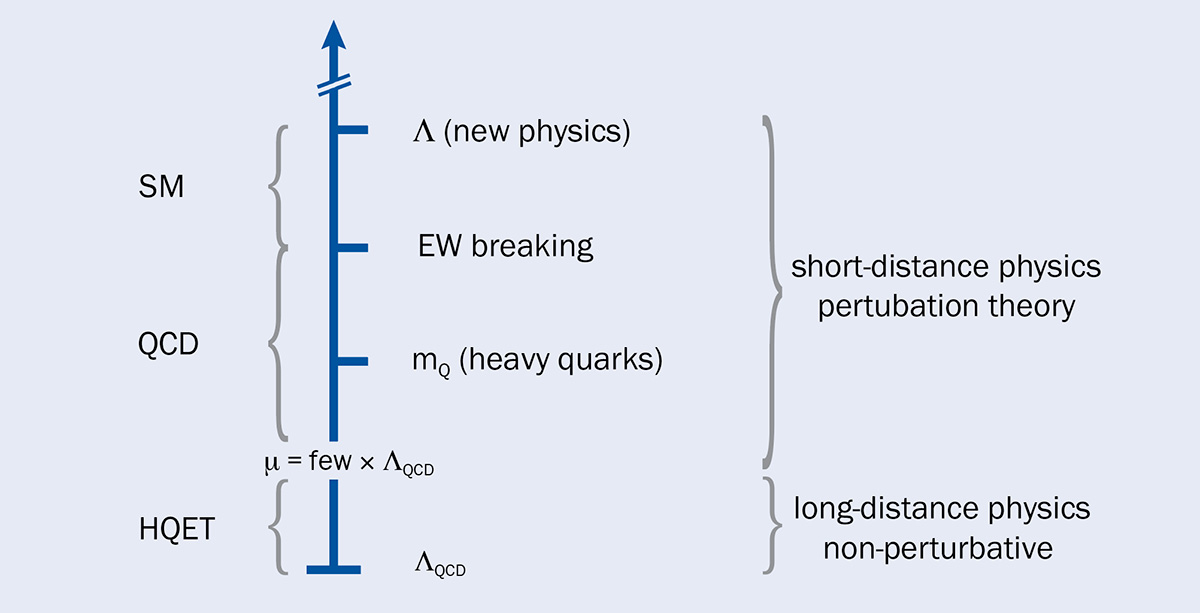
The following video from an MIT OCW course on EFT provides an excellent conceptual overview.
1. Introduction to Effective Field Theory (EFT)
This introductory lecture on Effective Field Theory by Prof. Iain Stewart provides the essential philosophy and motivation.
Please watch these segments: The Big Picture: This contrasts the "bottom-up" way we learn physics with the "top-down" approach of EFT, which focuses on a specific scale of interest to make calculations tractable. Key Principle of Insensitivity: This explains the core assumption of EFT—that low-energy physics is insensitive to the details of high-energy physics, except for their influence on the low-energy coupling constants. The expansion is not just in mass ratios, but can be in any small dimensionless parameter, like velocity. Hydrogen Atom Example: This is a fantastic, concrete illustration. The description of the hydrogen atom is a series of EFTs. At the lowest energy, it's just non-relativistic quantum mechanics. As you increase the energy of your probe, this model breaks down, and you start to see effects from the proton's finite mass, then its finite size (form factors), then its internal quark structure, and so on. Each breakdown signals the need for a more detailed theory. Top-Down vs. Bottom-Up: This distinguishes two ways EFTs are used. In a top-down approach, we know the high-energy theory (like QCD) and construct a simpler EFT for a specific, low-energy problem (like HQET). Here, the domain of validity is known by construction. In a bottom-up approach (like the Standard Model EFT), we don't know the high-energy theory. We write down the most general EFT consistent with symmetries. Its breakdown, observed through precision measurements, provides clues about the unknown physics at the high-energy scale \Lambda.
In the bottom-up approach, identifying the domain of validity is the entire game. The goal is to find experimental results that deviate from the Standard Model's predictions. Such a deviation would signal a breakdown of the SM as a complete theory and would give us a measurement of the scale of new physics. This is precisely what experiments at the LHC are trying to do.
The construction of an EFT formalizes this process.
Effective Field Theory - Indico Global
These slides provide a more formal summary of the principles of EFT construction.
Focus on two key slides: Slide 8, "Basic principles". This slide lists the three ingredients for building an EFT: degrees of freedom, symmetries, and a power counting scheme. The power counting parameter (the "small" thing) explicitly defines the expansion and thus the domain of validity. Slide 23, "Basic principles of the SMEFT". This shows the application to the Standard Model itself. The degrees of freedom and symmetries are those of the SM, and the power counting is in inverse powers of an unknown heavy scale \Lambda. Any measurement that constrains the coefficients of these higher-dimension operators is a probe of physics beyond the Standard Model.
Conclusion
You have now moved beyond simply checking if a model is "correct" to asking the more sophisticated question, "Where is this model useful?" The domain of validity is not a flaw; it is a feature that defines a model's purpose. Recognizing the signals of a model's breakdown—whether through counter-intuitive toy experiments, divergent mathematical expressions, or precision measurements that disagree with predictions—is one of the most fundamental skills in a theoretical physicist's toolkit. It is the primary engine of discovery, telling us where our knowledge ends and where new theories are needed.
Key Takeaways:
- A model's domain of validity is the set of conditions under which its underlying assumptions are justified.
- Model breakdown occurs when neglected physical effects become dominant. This is a source of insight, not an error.
- Breakdown can be qualitative (predicting physically absurd behavior) or quantitative (perturbative corrections become large, or calculations diverge).
- The Ginzburg criterion provides a quantitative estimate for the domain of validity of mean-field theory by comparing the strength of fluctuations to the condensation energy.
- Effective Field Theory (EFT) is a framework that elevates the concept of a domain of validity to its central organizing principle, providing a systematic way to create low-energy approximations and use their breakdown to probe for high-energy physics.
In our next lesson, we will consider situations where multiple models might be proposed to describe the same phenomenon. We will learn how to evaluate and compare these competing models based on principles like parsimony, elegance, and predictive power, allowing us to select the most compelling theoretical description.