In our previous lesson, we established that every physical model has a domain of validity, and understanding its boundaries is key to knowing when to trust its predictions. This naturally leads to a new question: what happens when we have multiple, distinct models that all claim to describe the same physical system? How do we choose between these competing theories? This is a central activity in theoretical physics, moving beyond mere validation to the nuanced art of model selection.
This lesson will equip you with the two primary criteria for this task: parsimony and predictive power. We will explore how these principles, rooted in a philosophy that stretches back centuries, are given concrete, quantitative meaning in modern physics. You'll see how the choice between models is rarely a simple matter of "right" versus "wrong," but rather a dynamic trade-off that drives scientific progress. We will draw our examples from the frontiers of cosmology and particle theory, touching on concepts from your concurrent QFT course.
1. The Principle of Parsimony: Occam's Razor in Physics
The principle of parsimony, often encapsulated in Occam's Razor, suggests that among competing hypotheses, the one with the fewest assumptions should be selected. In physics, this isn't just a preference for aesthetic simplicity; it's a powerful heuristic that helps us avoid overfitting our models to existing data and guides us toward theories that are more generalizable and interpretable.
To begin, let's explore a broader perspective on what parsimony and its mathematical cousin, sparsity, mean in the context of building models from data.
Sparsity and Parsimonious Models: Everything should be made as simple as possible, but no simpler
This video from Steve Brunton's "Data Driven Science and Engineering" series, titled "Sparsity and Parsimonious Models," provides an excellent introduction to these concepts.
Please watch the following segments to build a strong conceptual foundation for parsimony: What is parsimony?: This part defines parsimony as the desire for the most economical description of a phenomenon and introduces sparsity as its mathematical implementation. Historical context: The lecturer connects parsimony to famous ideas from Einstein ("as simple as possible, but not simpler"), Occam's Razor, Aristotle, and the Pareto principle. This shows the deep historical roots of the idea. Ptolemaic system example: This is a key historical case study. The Ptolemaic model of the cosmos persisted for centuries because it was a parsimonious (though incorrect) model that fit the available data. It was only supplanted when an even simpler explanation (the Copernican model) emerged. Why it matters today: This section summarizes the modern benefits of parsimonious models in machine learning and data-driven modeling: they prevent overfitting, are more interpretable, and tend to be more robust. These advantages are just as relevant in theoretical physics.
As the video highlights, physicists strive for parsimonious models. But how is this principle applied in the context of advanced theories like QFT? It takes on several, more technical forms:
-
Fewer Free Parameters: A model with fewer arbitrary constants that need to be fixed by experiment is generally preferred. A model with too many parameters can be "tuned" to fit almost any data, but this reduces its predictive power.
-
Fewer Degrees of Freedom: A model that explains observations without inventing new entities (particles, fields, etc.) is considered more parsimonious.
-
Technical Naturalness: This is a more subtle, but crucial, concept in QFT. A model is considered "natural" if its parameters do not require extreme fine-tuning to match observations. A small parameter is considered natural if setting it to zero would increase the symmetry of the theory. This "symmetry protection" makes its smallness stable against quantum corrections. An "unnatural" theory, by contrast, requires a delicate cancellation between large, unrelated numbers, which many physicists find un-parsimonious.
To see this in action, we will look at a toy model from an Effective Field Theory (EFT) perspective.
[PDF] An Introduction to Effective Field Theories - ICTP – SAIFR
This document by Riccardo Rattazzi provides a clear introduction to EFTs. We will focus on the section discussing naturalness.
Please read Section 2.6, "Naturalness," which starts on page 20. Focus on the contrast between the fermion mass correction and the scalar mass correction. Pay close attention to: The argument that the fermion mass correction is proportional to the fermion mass itself (m), making a small mass "natural." The argument that the scalar mass correction is proportional to the heavy UV scale (m), not the scalar mass itself (M). This means a light scalar is "unnatural" unless there's fine-tuning or a protective symmetry. The discussion of ’t Hooft naturalness, which formalizes the idea of symmetry protection.
The concept of naturalness provides a powerful, physics-based criterion for parsimony. It allows us to compare two theories not just by counting their parameters, but by assessing the quality of those parameters. A theory with a naturally small parameter is often considered superior to one that requires an unexplained, fine-tuned cancellation.
2. Predictive Power: The Ultimate Arbiter
While parsimony is a valuable guide, it is not the final word. A beautiful, simple theory is useless if it doesn't agree with experiment. The ultimate test of any model is its predictive power: its ability to make sharp, falsifiable predictions for phenomena that have not yet been observed.
A classic ongoing example of this is the debate between two competing models for explaining the anomalous rotation of galaxies: Dark Matter and Modified Newtonian Dynamics (MOND).
- Dark Matter Model: This model is more parsimonious in its laws—it preserves General Relativity and Newtonian gravity. However, it is less parsimonious in its ingredients, as it postulates a new, undiscovered type of matter ("dark matter") that makes up ~85% of the matter in the universe.
- MOND Model: This model is more parsimonious in its ingredients—it requires no new particles. However, it is less parsimonious in its laws, as it proposes a modification to gravity itself in the regime of very low accelerations.
How do we choose? By testing their predictions in different physical regimes.
Is Gravity Modified or is it Dark Matter after all?
In this video, "Is Gravity Modified or is it Dark Matter after all?", physicist Sabine Hossenfelder gives a concise overview of the current state of the MOND vs. Dark Matter debate.
Watch these key segments to understand how these models are being compared in practice: The problem and the two solutions: This section introduces the core observational anomaly (e.g., galaxy rotation curves) and the two competing explanations. Conflicting evidence from wide binaries: This part highlights the messiness of real-world science. Different research groups analyze the same data and reach opposite conclusions, depending on how they handle systematic uncertainties (in this case, hidden triple-star systems). This shows that testing predictive power is challenging. The cost of improving a model: MOND struggles to explain galaxy clusters. A new, generalized version of MOND has been proposed that can, but at the cost of adding another parameter. This is a direct example of a trade-off between predictive power and parsimony. The fundamental trade-off: Hossenfelder succinctly summarizes the core choice: "MOND adds parameters, dark matter adds particles."
The Dark Matter vs. MOND debate perfectly illustrates that model comparison is a dynamic process. Neither model is perfect. The community currently favors Dark Matter because it successfully predicts a wider range of phenomena, especially at cosmological scales (like the cosmic microwave background), even though the dark matter particle itself remains elusive. MOND, while remarkably successful for galaxy rotation curves, becomes less parsimonious and predictive when extended to other scales. The search for a "knockout blow"—a definitive prediction from one model that is falsified for the other—continues to drive research.
3. Synthesis: Effective Theories and the Geometry of Models
The principles of parsimony and predictive power are not in opposition; they are two sides of the same coin, beautifully synthesized in the framework of Effective Field Theory (EFT), which you encountered in the last lesson.
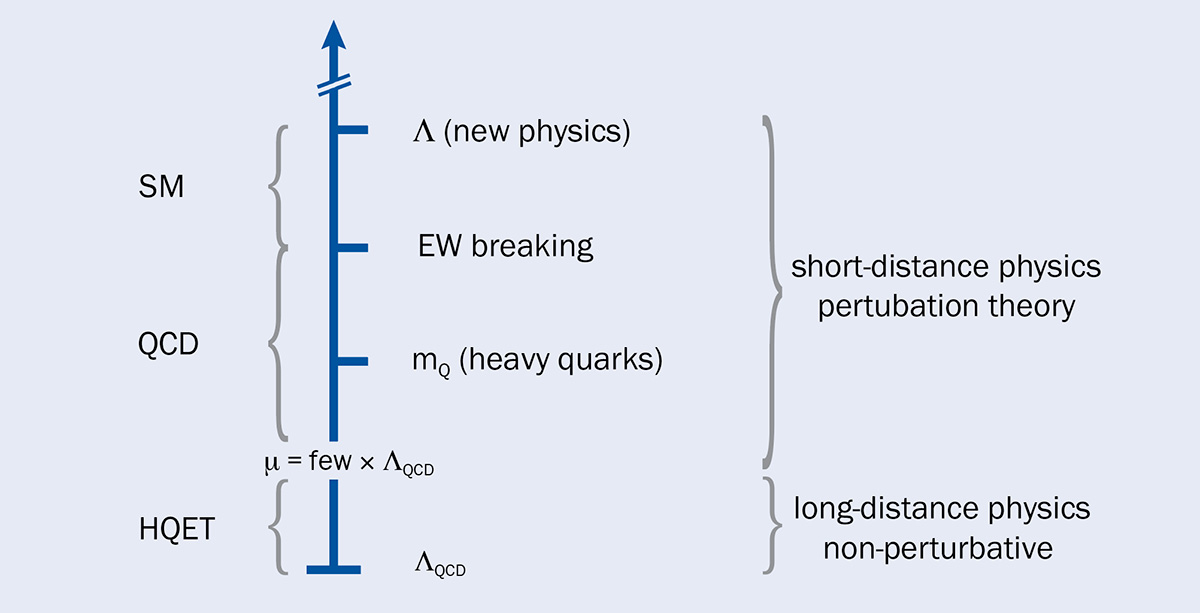
The EFT philosophy is to build the most parsimonious model possible that has predictive power at a specific energy scale. All the complexity of higher-energy physics is integrated out, its effects captured by a few parameters. This approach inherently balances parsimony (by including only the necessary terms for a given precision) and predictive power (by providing a systematic, computable framework).
This idea has a beautiful geometric interpretation. Modern research in statistical physics has shown that many complex, multi-parameter models are "sloppy": their predictions are only sensitive to a few "stiff" combinations of parameters, while being almost completely insensitive to many other "sloppy" combinations. The space of all possible model predictions forms a geometric object called a "model manifold," which is often shaped like a hyper-ribbon—extremely long in a few directions (the stiff, relevant parameters) and extremely thin in many others (the sloppy, irrelevant parameters).
This insight provides a deep justification for parsimony. A simpler, effective model can often be found by moving along the sloppy directions of the full model's manifold to a boundary or edge, where some parameters go to zero or infinity. This simpler model, despite being technically "wrong" in its microscopic details, makes nearly identical predictions to the full, complex model because the data cannot constrain the sloppy parameter combinations anyway.
[PDF] Information geometry for multiparameter models: new perspectives ...
This research review by Sethna et al. discusses the cutting-edge field of information geometry and its application to understanding why simple models work. As it's a dense paper, we will focus on the conceptual overview.
Please read the following sections to get a flavor of this modern perspective: Introduction (Section 1): Read the first three paragraphs. They introduce the central puzzle: why do complex models with many uncertain parameters still make accurate predictions? They introduce the concepts of "sloppiness" and the "hyperribbon" model manifold. Effective Theories as Manifold Boundaries (Section 4): Read this section. It makes a powerful analogy using the fundamental constants of physics (c, G, \hbar). Classical mechanics can be seen as living on the "boundary" of the manifold of relativistic theories (the c \to \infty limit). This formalizes the idea that simpler, effective theories are often limiting cases of more complex ones. Future Directions (Section 8.2): Read this short section. It speculates on a unified theory for the emergence of simplicity, connecting the coarse-graining of the renormalization group (a key topic in your condensed matter and QFT courses) with the structure of these model manifolds.
This geometric viewpoint shows that the success of parsimonious models is not an accident. It's a fundamental property of how information is structured in complex systems. We can often create a simpler model that is just as predictive because the vast majority of the complex model's parameters are irrelevant to the phenomena we are observing.
Conclusion
You now possess a more sophisticated framework for evaluating and comparing theoretical models. The process goes far beyond a simple binary of right and wrong. It involves a careful, ongoing evaluation based on two key principles:
- Parsimony: We prefer models that are simpler, not for aesthetics alone, but because they are less prone to overfitting and are often more robust and interpretable. This can mean fewer parameters, fewer entities, or the absence of "unnatural" fine-tuning.
- Predictive Power: The ultimate test is a model's ability to make novel, falsifiable predictions that are confirmed by experiment. A more parsimonious model must eventually cede to a more complex one if the latter demonstrates superior predictive power across a wider range of phenomena.
The interplay between these two principles is the engine of progress in theoretical physics. The EFT framework provides a systematic way to manage this trade-off, while the geometric language of model manifolds gives us a deeper reason why simple, effective theories can be so powerful.
In the next module, we will begin our deep dive into the primary mathematical tool used to extract predictions from these models: perturbation theory. You will learn how to systematically make calculations when a problem contains a "small parameter," which is the very foundation of the expansions that make parsimonious, effective theories work.