Welcome back. In our previous lesson, we established the core principles of an effective multi-channel follow-up cadence, describing it as the "blueprint" for turning initial interest into a booked call. We covered the importance of a strategic channel mix, purposeful timing, providing value, and maintaining a cohesive conversation.
Now, it's time to move from principles to practice. Your experience in DM setting is perfect for getting a prospect's initial attention and warming them up. But what happens when a warm lead—someone who showed clear interest in your DMs—suddenly goes silent before you can book the call? This is a common and frustrating scenario that a random "just checking in" message won't solve. Today, you'll learn how to handle this situation with a professional, systematic approach. Our learning outcome is to map a 7-day follow-up sequence for a non-responsive warm lead, specifying the channel and timing for each touchpoint.
A Visual Blueprint for the 7-Day Sequence
A well-designed cadence provides a path to follow when the conversation goes quiet. It removes the guesswork and ensures you are persistent and professional. Let's look at a visual example of what such a sequence can look like.
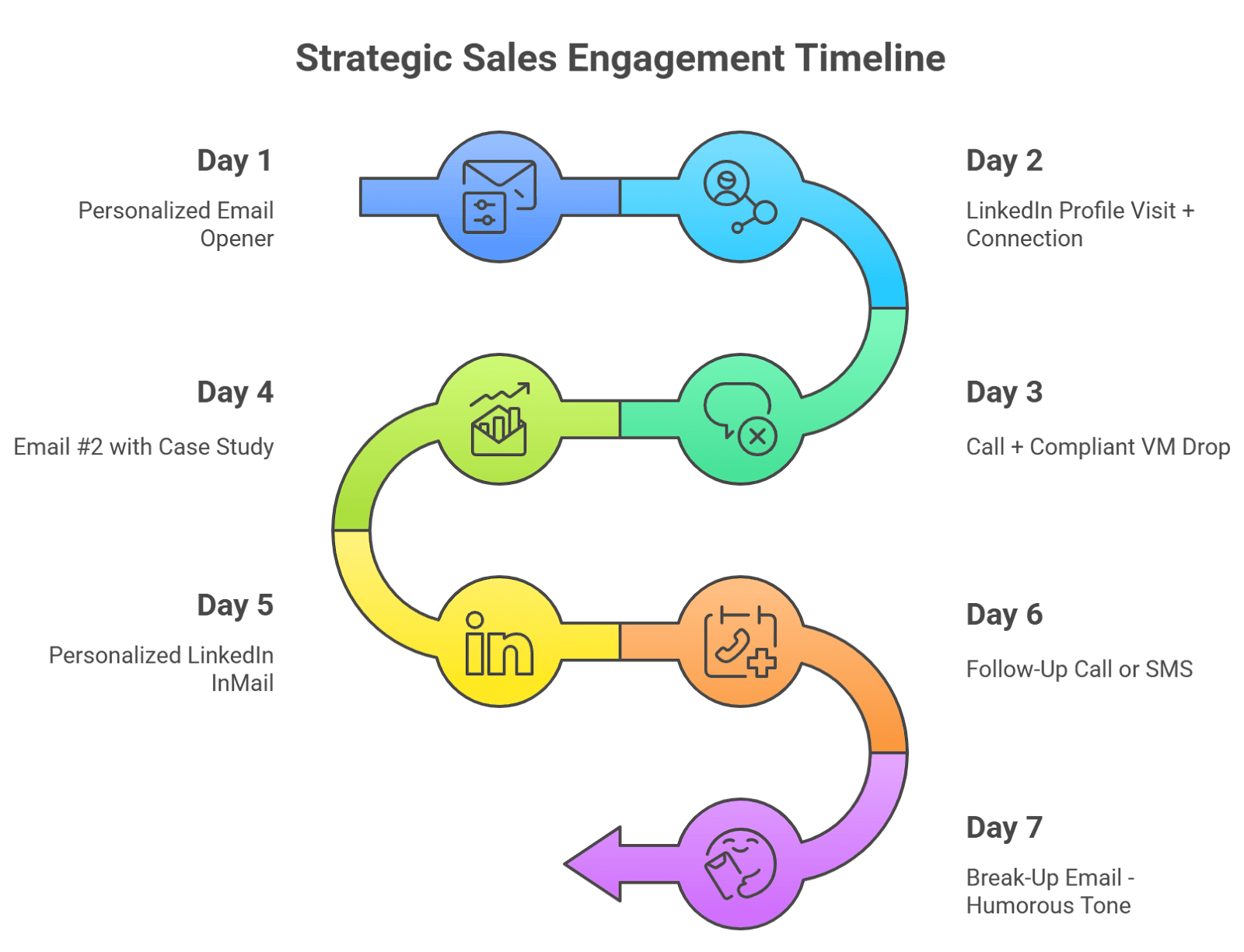
This timeline is a fantastic model. Let's break it down day-by-day to understand the strategy behind each step.
-
Day 1: Personalized Email Opener
This is your initial, primary touchpoint. Since this is a warm lead from your DM conversations, this email isn't cold. It should reference your prior chat, be highly personalized, and have a clear call-to-action (e.g., "When is a good time for a quick 15-minute call?"). -
Day 2: LinkedIn Profile Visit + Connection Request
This is a subtle, low-pressure touchpoint. A profile visit shows you're doing your research, and a connection request (if you're not already connected) is a natural next step. It keeps you top-of-mind without being demanding. -
Day 3: Call + Compliant VM Drop
This is your first attempt at a live conversation. Since your goal is to master phone setting, this step is crucial. If they don't pick up, you don't just hang up. You leave a "compliant VM drop"—a concise, professional voicemail. The goal isn't a long message; it's a verbal nudge. -
Day 4: Email #2 with Case Study
This is a classic value-add touch. Instead of just asking for their time again, you're providing something useful, like a case study relevant to their business. This reinforces your credibility and shifts the dynamic from you asking for something to you giving something. -
Day 5: Personalized LinkedIn InMail
If they haven't responded to email or the call, you try a different channel. A personalized InMail can sometimes cut through the noise of a crowded email inbox. Again, reference your previous touches to maintain a cohesive narrative (e.g., "Hi [Name], just following up on the case study I sent over..."). -
Day 6: Follow-Up Call or SMS
A second attempt at a call shows polite persistence. The option of an SMS is context-dependent; it's more common and accepted when selling to individuals or very small business owners, but use it with discretion. -
Day 7: Break-Up Email - Humorous Tone
If you've had no response after six attempts across multiple channels, it's time to gracefully exit. The "break-up email" is a well-known technique that often gets a surprisingly high response rate. It politely signals you're going to stop following up, which can trigger a prospect's "fear of missing out" and prompt a reply.
Expert Cadences for Warm Leads
The visual model above is one excellent template. To give you a broader perspective, let's examine how other experts structure their cadences for warm leads. You'll notice the core principles remain the same: speed, a multi-channel approach, and a defined number of touches within a specific timeframe.
First, let's establish the ideal length and intensity for a warm lead cadence.
Sales Cadence Timing and Frequency Guide 2025 | Sybill
This guide from Sybill provides a concise rule of thumb for different lead types.
Read the section from the beginning down to the first heading, focusing on the recommended structure for warm leads. Pay attention to the suggested number of touches and timeframe.
As the guide states, 4 to 7 touches within a week is the sweet spot for warm leads. Our 7-day model fits this perfectly. Now, let's look at two detailed examples of what this can look like in practice.
Sales Cadence Essentials: Proven Tips and Examples
This article from Tendril.us provides several example cadences. We will focus on the one designed specifically for warm leads.
Find the section titled "Quick-Win Cadence for Warm Leads (7 days)." Read through the day-by-day breakdown. Notice how it emphasizes speed and mixes calls, emails, and value-adds.
Sales Cadence Timing and Frequency Guide 2025 | Sybill
Now, let's look at a slightly different variation from the Sybill.ai guide.
Find the section titled "Inbound or hand raised sequence." Review the 6-touch, 7-day sequence. Note how it also front-loads the call and email, and includes a clear "forked" path for the final day depending on the outcome.
Comparing these two examples with the visual timeline, you can see a clear pattern:
- Immediate Action: All models advocate for an immediate or Day 1 touch.
- Mix of Channels: They all blend email, phone, and social media (LinkedIn).
- Value Provision: They include steps focused on sharing value (case studies, summaries, resources), not just asking for a meeting.
- Structured Persistence: They follow a clear, day-by-day schedule, ensuring persistence without being random.
- Defined End-Point: They all conclude within about a week, often with a final, decisive touchpoint.
Your Turn: Map Your Cadence in Notion
Now it's time to build your own sequence. Given your experience using Notion for lead tracking, this is the perfect place to house your follow-up blueprints.
- Open your Notion workspace.
- Create a new page titled "Follow-Up Cadence: Non-Responsive Warm Lead".
- Recreate the following template on your page.
- Fill in the "Action & Notes" for each day, using the examples we've reviewed as a guide. Customize it for the online coaches you work with. For example, what "value-add" could you provide on Day 4? A link to a relevant blog post by the coach? A short PDF guide?
| Day | Channel(s) | Action & Notes |
|---|---|---|
| 1 | Example: Personalized email referencing our DM chat and proposing 2 time slots. | |
| 2 | Example: Visit profile, send connection request with a short note. | |
| 3 | Phone + VM | Example: Call in the afternoon. If no answer, leave a 15-second voicemail. |
| 4 | *Example: * | |
| 5 | *Example: * | |
| 6 | Phone / SMS | *Example: * |
| 7 | *Example: * |
This exercise will give you a concrete, reusable asset that you can implement immediately.
Conclusion
You now have a powerful, structured alternative to improvisation when a warm lead goes quiet. By implementing a systematic 7-day follow-up cadence, you demonstrate professionalism, persistence, and value, significantly increasing your chances of re-engaging the prospect and booking the call.
Key Takeaways:
- A 7-day follow-up sequence for a non-responsive warm lead should consist of 4-7 touches.
- The sequence must be multi-channel, blending email, phone calls, and social media (like LinkedIn).
- Intersperse your "asks" (for a call) with "gives" (value-add content like case studies or helpful resources).
- The sequence should have a clear beginning (a prompt first touch) and a clear end (a graceful break-up email).
- Documenting your cadence in a tool like Notion makes it a repeatable and scalable process.
In our breakdown, we mentioned leaving a "compliant VM drop" on Day 3 and potentially another call on Day 6. But what should you actually say in that voicemail to maximize your chances of getting a callback or response? That is precisely what we will cover in our next lesson, where you will learn to formulate curiosity-inducing voicemails designed to increase callback rates.