Welcome back. In our last lesson, we focused on your vocal delivery—the "output" of your conversation. We broke down how to use tonality, pacing, and volume to project confidence and build rapport. Now that you have the tools to control how you send messages, it's time to master how you receive them.
This lesson is all about active listening. It's the other, arguably more important, side of the communication coin. In sales, the old saying holds true: we have two ears and one mouth so we can listen twice as much as we speak. For a phone setter transitioning from the world of DMs, active listening is the skill that allows you to truly understand a prospect's world in real-time, without the safety net of being able to re-read a text chain. You will learn to demonstrate active listening using techniques like paraphrasing and summarizing, with the ultimate goal of uncovering a prospect's deepest needs and motivations.
The Foundation: What is Active Listening?
First, let's be clear about what active listening is and isn't. It's not simply staying quiet while the other person talks. It's the practice of listening with the full intent to understand, not just to formulate your next response. It's about genuine curiosity and empathy.
In your DM setting work, you have the luxury of time. You can read a prospect's message, think about it, and even scroll up to re-read a previous point for context. On a live phone call, active listening is your real-time equivalent of that "scroll up" function. It's how you confirm, clarify, and comprehend on the fly.
Active Listening Exercises for Sales
This article provides a great starting point by defining active listening in a sales context and outlining the common pitfalls of failing to listen.
Read the introduction, which defines active listening as listening to understand and emphasizes showing genuine care. Then, review the sections on "The Biggest Mistakes Salespeople Make" and The Problems of Selling Without Listening to understand the negative consequences of poor listening habits.
When you fail to listen actively, prospects feel it. They perceive you as someone just trying to make a sale, not someone trying to solve their problem. This is especially damaging on a warm call, where a baseline of trust has already been established via DMs. Poor listening can erode that trust in seconds.
Your Active Listening Toolkit
To listen actively, you need a set of tools you can deploy during a conversation. These techniques not only help you understand better but also signal to the prospect that you are paying close attention.
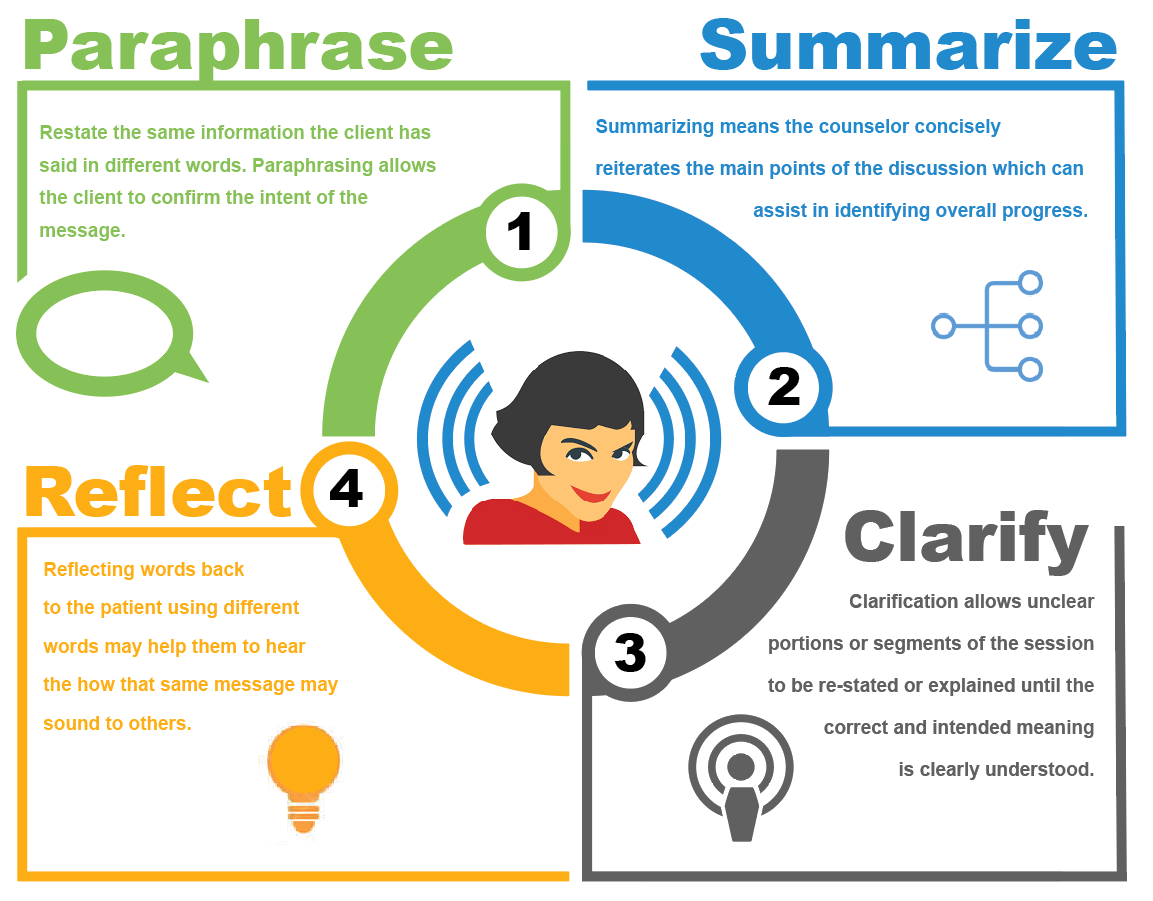
Let's break down each of these techniques:
-
1. Paraphrase: This involves restating the prospect's point in your own words. The goal is to confirm your understanding. It often starts with phrases like, "So, if I'm hearing you correctly..." or "In other words, you're saying that..." This shows you're processing what they've said, not just waiting for your turn to speak.
-
2. Summarize: A summary is like a condensed paraphrase. You're not restating one point; you're pulling together several points to capture the main themes of the conversation so far. This is perfect for transition points. For example: "Okay, so just to recap, it sounds like the main issues are the inconsistent lead flow and the amount of time it takes to manually follow up. Is that right?" This helps keep the call on track and confirms you've grasped the bigger picture.
-
3. Clarify: This is about removing ambiguity. When a prospect uses a vague term or makes a general statement, a clarifying question invites them to be more specific. It's your tool for digging deeper. If a prospect says, "Things are just too chaotic right now," a clarifying question would be, "When you say 'chaotic,' what does that look like on a day-to-day basis?"
-
4. Reflect: While paraphrasing deals with the content of what was said, reflecting deals with the emotion behind it. It's about identifying and acknowledging the feeling the prospect is expressing. For example: "It sounds like that whole situation was incredibly frustrating for you." This is a powerful way to build empathy and show you're listening on a human level.
The article below provides excellent examples and further explanation of these crucial skills.
How to Master Active Listening to Uncover Hidden Buyer Needs
This article dives into the practical application of active listening techniques for sales professionals.
Focus on the section Techniques to Improve Active Listening. Pay close attention to the subsections on Reflective Listening and especially Summarizing and Clarifying for practical ways to phrase these techniques.
From Techniques to Uncovering Core Needs
Mastering these techniques is the first step. The second, more crucial step is using them to uncover the prospect's true, underlying needs—the "business problems," not just the "process problems." This is where you transition from a setter to a trusted advisor.
A powerful way to structure this discovery process is the Situation, Problem, Impact (SPI) framework. You use your listening skills to guide the conversation from the surface level down to the core business pain.
How To Ask Discovery Questions To Uncover Business Problems (Sell Playbook)
The hosts of "30 Minutes to President’s Club" provide an exceptional breakdown of the Situation, Problem, Impact framework. This is a highly practical model for structuring a discovery call.
Watch the segment from the beginning of their explanation. They define SPI as: Situation: What's going on in the prospect's world? Problem: What isn't working well? What are the challenges? Impact: Why do those problems matter to the business? Listen to their example about compensation software to see how they connect a simple situation (using spreadsheets) to a major business impact (compensation inequities).
Your active listening toolkit is what allows you to navigate the SPI framework effectively.
- You use clarifying questions to move from Situation to Problem (e.g., "You mentioned you're using spreadsheets. How has that been working as the team grows?").
- You use probing questions and reflection to move from Problem to Impact (e.g., "That sounds time-consuming. Has that had an impact on anything else?").
To really pull out the deeper emotions and consequences, you can use specific probing questions.
What Questions To Ask Prospects During The Sales Discovery Process
Sales trainer Jeremy Miner demonstrates several powerful "Engaging Probing Questions" (EPQs) that get prospects to open up and reveal the true depth of their problems.
First, watch the introduction from the start to understand the purpose of these questions. Then, watch these specific examples: The Probing Statement: See how simply repeating back an emotional word can get a prospect to elaborate (this clip). Reliving the Pain: Notice how the question "How long has that been going on for?" makes the problem feel more tangible (this segment). The Power of "Trying": Learn to identify trigger words like "trying" as an opportunity to probe deeper (this example).
By combining the SPI framework with targeted probing questions, you move beyond just hearing the prospect's words. You start to understand their world, their frustrations, and the true cost of their problem. This information is invaluable for qualifying the lead and booking a call with a high chance of success.
Practice and Application
Active listening is a skill that requires deliberate practice. You can't just decide to be a better listener; you have to train the muscle.
Your Action Item:
-
Solo Drill: Use the "1 player variant" exercise suggested in the Active Listening Exercises for Sales article. Find a 5-10 minute TED Talk on a topic you know little about. Watch it, but pause the video every 60-90 seconds.
- Summarize what the speaker just said out loud. ("Okay, so the main point here was...")
- Formulate a clarifying question. ("They mentioned 'neural plasticity,' I'd want to ask what that means in this context.")
- Identify an emotion. ("They seem really passionate about this part.")
This drill trains you to listen for content, ambiguity, and emotion simultaneously.
-
Scenario Rehearsal: Record yourself on your phone. Read the following prospect statement aloud:
"Yeah, we've been trying to get more leads through our Instagram, but it's just been really inconsistent."
Now, record three different responses, one for each technique:
- A Paraphrase: "So if I'm hearing you right, the big goal is to make your Instagram a more reliable source for new leads."
- A Clarifying Question: "When you say 'inconsistent,' could you walk me through what that looks like?"
- A Probing Question (using Miner's technique): "You mentioned you've been 'trying' to get more leads... what have you attempted so far that hasn't quite worked?"
Listen back to your recordings. Do they sound natural? Do they invite more conversation? This is how you move from theory to practice.
Finally, remember your Notion tracking system. The information you gather through active listening—the prospect's specific problems, their emotional state, and the business impact of their challenges—is precisely the high-quality data you should be logging after every successful call.
Conclusion
Today, we've rounded out your foundational communication skills. You now have frameworks for both your output (vocal tonality) and your input (active listening).
Key Takeaways:
- Active listening is about understanding, not just replying. It's a crucial skill for building trust, especially when moving a relationship from DM to a live call.
- Your toolkit includes four key techniques: Paraphrasing, Summarizing, Clarifying, and Reflecting.
- The goal is to uncover core needs. Use the Situation-Problem-Impact (SPI) framework to guide your discovery and get to the heart of the prospect's business pain.
- Use probing questions to dig deeper. Simple questions like "How do you mean?" or "How long has that been an issue?" can unlock a wealth of information.
- Practice is essential. Use solo drills and recordings to build your active listening muscle.
You now have the core conversational tools needed for effective phone setting. However, knowing what to do is only half the battle. Doing it consistently, especially under pressure, requires the right mindset. In our next lesson, we will focus on just that, helping you develop a personalized pre-call routine to manage call reluctance and ensure you enter every conversation in a peak performance state.