Welcome to the first lesson of your journey into embedded systems and electronics. This course is designed to build your skills from the ground up, moving from foundational principles to complex, real-world system design. Our starting point is the very language of electronics.
In this lesson, you will learn to define voltage, current, resistance, and power, and describe their physical meaning in a circuit. These four concepts are the absolute bedrock of electronics. A deep, intuitive understanding of what they are and how they relate to each other is the most critical first step towards analyzing, designing, and debugging any hardware system. We will focus on building a strong mental model for each concept before we begin using them in calculations in our next lesson.
The Foundation: Electric Charge
At the heart of electricity is the concept of charge. You may recall from high school physics that atoms are composed of protons (positive charge), neutrons (no charge), and electrons (negative charge). In many materials, especially metals, the outermost electrons are not tightly bound to their atoms. They can move freely between atoms, and we call these free electrons. The entire field of electronics is essentially about controlling the movement of these free electrons.
To get a quick visual refresher on this atomic-level picture, please watch the beginning of the following video.
How ELECTRICITY works - working principle
Watch this segment from "How ELECTRICITY works" by The Engineering Mindset. It provides a clear animation of atomic structure and the difference between conductors and insulators.
Focus on the explanation of atoms, free electrons, and how materials are classified as conductors or insulators from this section.
Materials that allow free electrons to move easily are called conductors (e.g., copper, aluminum, gold). Materials that strongly resist the movement of electrons are called insulators (e.g., rubber, glass, plastic). This distinction is what allows us to build circuits: we use conductors to guide electricity where we want it to go, and insulators to prevent it from going where we don't.
Current: The Flow of Charge
When these free electrons are influenced to move in a coordinated, uniform direction, we have an electric current.
Current (I) is the rate of flow of electric charge through a conductor. Its unit is the Ampere (A), or amp. One ampere is defined as one coulomb of charge (approximately 6.24 x 10¹⁸ electrons) flowing past a point in one second.
Think of a copper wire as a pipe packed with marbles (the free electrons). If you push a new marble in one end, a marble is forced out the other end almost instantly, even though each individual marble only moved a short distance. This is an excellent analogy for electric current. The effect is near-instantaneous, but the individual electrons drift quite slowly.
This "flow" is the fundamental action in a circuit. To make it happen, we need two things: a complete, unbroken path for the electrons to travel—a circuit—and a "push" to get them moving.
BASIC CONCEPTS AND RELATIONSHIPS
This text from Applied Industrial Electricity provides a more detailed explanation of these core concepts. We'll start with the sections on conductors, electron flow, and circuits.
Please read the sections titled Conductors, Insulators, and Electron Flow and What Are Electric Circuits?. Focus on the following parts: The description of conductors and insulators. The definition of electric current and the marble-in-a-tube analogy. The concept of a circuit as a continuous loop.
Voltage: The "Push" Behind the Current
What provides the "push" that makes current flow? This force is called voltage.
Voltage (V) is the difference in electric potential energy between two points in a circuit. It is the "pressure" or "push" that drives the current. Its unit is the Volt (V). One volt is defined as the potential difference that will impart one joule of energy per coulomb of charge that passes through it.
Voltage is always a relative measurement; it only has meaning between two points. Think of it like gravitational potential energy. A rock on a cliff has potential energy relative to the ground below. The greater the height of the cliff, the greater the potential energy.
Similarly, a battery creates a chemical potential difference. The positive terminal has a high electric potential, and the negative terminal has a low electric potential. When you connect a wire between them, this voltage "pushes" the current from the high potential to the low potential.
This water analogy is a powerful tool for thinking about circuits.
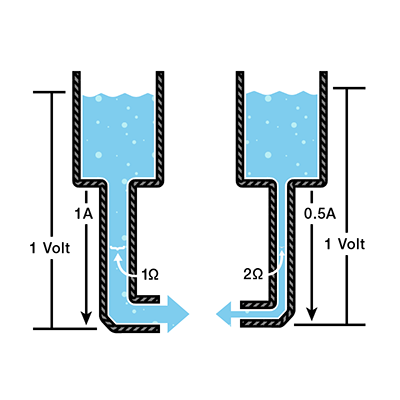
In this water analogy, the height of the water represents voltage (the pressure). The flow of water represents current. In the left tank, a wider pipe offers less opposition, so for the same voltage (water height), more current (water flow) is achieved. The right tank has a narrower pipe, restricting the flow.
BASIC CONCEPTS AND RELATIONSHIPS
Let's continue with the same document to formalize our understanding of voltage and its relationship to current.
Now, please read the section Voltage and Current. Pay close attention to: The explanation of voltage as potential energy. The water reservoir analogy for understanding voltage as a relative quantity. The definition of Direct Current (DC).
Resistance: The Opposition to Flow
If you connect a wire directly across a battery's terminals, you create a short circuit. The voltage will push a massive, uncontrolled amount of current, which can be very dangerous, draining the battery rapidly and generating a lot of heat. To control the current, we need resistance.
Resistance (R) is the measure of a material's opposition to the flow of electric current. Its unit is the Ohm (Ω).
Physically, resistance arises from electrons colliding with the atoms of the conductor as they are pushed through it. These collisions convert electrical energy into heat. A lamp filament, for example, is just a resistor designed to get so hot that it glows, producing light.
Every component in a circuit, including the wires themselves, has some resistance. Conductors have very low resistance, while insulators have extremely high resistance. Components called resistors are specifically designed to have a precise amount of resistance to control the current in a circuit.
BASIC CONCEPTS AND RELATIONSHIPS
This final reading from the same source introduces resistance as a practical element in a circuit.
Please read the section on Resistance. Focus on how resistance is introduced as a way to limit current and perform useful work, like in a lamp. Also note the definitions of an open and closed circuit.
Power: The Rate of Energy Use
We've seen that voltage is the energy-per-charge and current is the charge-per-second. When current flows due to a voltage, energy is being converted or consumed. The rate at which this energy conversion happens is power.
Power (P) is the rate at which electrical energy is transferred by an electric circuit. Its unit is the Watt (W). One watt is equal to one joule of energy per second.
Power is calculated as the product of voltage and current:
This makes intuitive sense: the rate of work done (power) depends on both the "pressure" (voltage) and the "flow rate" (current). A high-pressure, high-flow fire hose delivers far more power than a low-pressure garden hose.
A critical distinction for an engineer is between power and energy.
- Power (W) is instantaneous. It's the rate of energy use right now.
- Energy (Joules, or Watt-hours) is power accumulated over time. It's the total amount of work done.
A battery stores energy, not power. It can deliver power. Your electricity bill charges you for energy (in kilowatt-hours), not power. As an analytics engineer, you can think of power as an instantaneous metric (like requests/sec on a server) and energy as the total accumulated value over a period (like total requests in a day).
This distinction is often confused, but it's vital for understanding systems correctly. The following video provides one of the clearest explanations you'll find.
EEVblog #1009 - DC Fundamentals Part 1: Voltage vs Power vs Energy
Watch these key clips from "DC Fundamentals Part 1: Voltage vs Power vs Energy" on the EEVblog channel. This video is aimed at engineers and does an excellent job clarifying these terms.
Watch the definition of power as instantaneous. Watch the explanation of energy as power over time. Finally, watch the excellent dam analogy that elegantly summarizes the difference between voltage, power, and energy.
Summary and What's Next
Let's consolidate the key definitions from this lesson:
- Voltage (V, in Volts): The electrical potential difference or "pressure" that pushes charge. It exists between two points.
- Current (I, in Amps): The rate of flow of charge. It flows through a point.
- Resistance (R, in Ohms): The opposition to current flow, which converts electrical energy into heat.
- Power (P, in Watts): The rate at which energy is converted or used. It's the product of voltage and current.
These four quantities are interconnected. The relationship between Voltage, Current, and Resistance is described by one of the most fundamental laws in all of physics and engineering: Ohm's Law.
In the next lesson, we will dive into Ohm's Law. You will learn how to apply it to calculate any one of these three quantities if you know the other two, allowing us to move from conceptual understanding to quantitative analysis of circuits.