Hello! Welcome to your fifth lesson on ray optics.
In our last lesson, we completed our look at reflection by deriving the mirror formula and magnification formula. You are now equipped with the mathematical tools to quantitatively analyze any situation involving a spherical mirror.
Today, we shift our focus from light bouncing off surfaces (reflection) to light passing through them. This phenomenon, known as refraction, is responsible for how lenses work, why objects in water appear distorted, and how prisms create rainbows. Our learning outcome for this lesson is to state and apply Snell's law () for refraction at plane interfaces. This law is the cornerstone of refraction, just as the law of reflection was for mirrors.
1. The Phenomenon of Refraction
When a ray of light travels from one transparent medium to another (e.g., from air to water), it changes direction at the interface. This bending of light is called refraction. The reason for this change in direction is that the speed of light is different in different media.
A key concept for quantifying this is the index of refraction (or refractive index), denoted by . It's a dimensionless number that describes how fast light travels through a material. It is defined as:
where is the speed of light in a vacuum ( m/s) and is the speed of light in the medium.
- For a vacuum, , so .
- For any other medium, , so . For air, , which is usually approximated as 1. For water, , and for glass, .
- A medium with a lower is called optically rarer.
- A medium with a higher is called optically denser.
The relationship between the angles and refractive indices is given by Snell's Law. To get a clear introduction to these concepts and see how Snell's law is formulated, let's watch a video from Khan Academy.
Refraction and Snell's law | Geometric optics | Physics | Khan Academy
This video will introduce you to refraction, define the angles of incidence and refraction, and show how the familiar form of Snell's Law is derived from the definition of the refractive index.
Please watch from the beginning (around 00:29) until 12:39. Focus on: The definition of the angle of incidence and angle of refraction with respect to the normal. The initial form of Snell's Law relating velocities and angles. The definition of the index of refraction, n = c/v. The algebraic steps used to arrive at the final, more common form of Snell's Law: n₁sinθ₁ = n₂sinθ₂.
As you saw, Snell's Law is stated as:
Where:
- is the refractive index of the first medium (where the incident ray is).
- is the angle of incidence, measured between the incident ray and the normal.
- is the refractive index of the second medium (where the refracted ray is).
- is the angle of refraction, measured between the refracted ray and the normal.

A crucial consequence of Snell's Law is:
- When light enters an optically denser medium (), it must be that , so . The ray bends towards the normal.
- When light enters an optically rarer medium (), it must be that , so . The ray bends away from the normal.
2. A Calculus-Based Derivation: Fermat's Principle
While the algebraic derivation from the definition of is useful, there is a more fundamental principle at play. In the 17th century, Pierre de Fermat postulated that light travels between two points along the path that takes the least amount of time. This is known as Fermat's Principle of Least Time.
Given your background in calculus, you can appreciate that this is an optimization problem. We can derive Snell's Law by finding the path that minimizes the travel time. The derivation involves setting up a time function and finding its minimum by taking the derivative and setting it to zero.
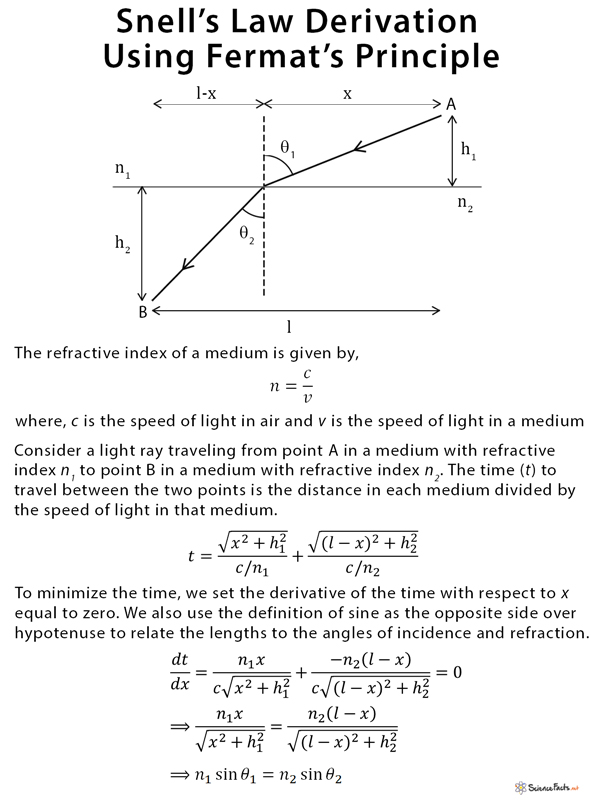
Let's walk through the logic shown in the image:
- Setup: A light ray travels from point A in medium 1 (refractive index , speed ) to point B in medium 2 (refractive index , speed ). The total horizontal distance is . The point where the ray crosses the interface is a variable distance from the point directly below A.
- Time Function: The total time is the sum of the time spent in each medium: .
- Using distance = speed × time, we get .
- The distances traveled in each medium, and , are found using the Pythagorean theorem: and .
- So, the total time as a function of is:
- Minimization: To find the path of least time, we must find the value of that minimizes . We do this by taking the derivative with respect to and setting it to zero: .
- Using the chain rule, , we get:
- Using the chain rule, , we get:
- Geometric Substitution: From the diagram, we can see that the trigonometric terms are:
- Substituting these into our derivative equation gives: , or .
- Final Step: Finally, we substitute the definition of refractive index, .
This simplifies to , which is Snell's Law.
This derivation is a beautiful example of how a fundamental physical principle, when expressed mathematically, yields a powerful, predictive law. It's also worth noting that another famous derivation uses Huygens' principle, which treats light as a wave. You will prove Snell's law using that method later in the course when we study wave optics.
3. Applying Snell's Law: Problem Solving
Knowing the formula is one thing; applying it correctly is another. The following video works through several numerical problems that will help solidify your understanding. The problems increase in complexity, requiring you to combine Snell's Law with geometric reasoning.
Snell's Law & Index of Refraction Practice Problems - Physics
This video from The Organic Chemistry Tutor demonstrates how to solve a variety of problems using Snell's Law, from a simple single-interface problem to more complex multi-layer and geometric scenarios.
Please watch the three examples presented between 05:05 and 17:58. First example (05:05 - 08:08): A straightforward calculation for light going from air to water. Second example (08:08 - 14:08): Light passing through three media (air -> glass -> diamond). Pay close attention to the shortcut mentioned: for parallel interfaces, the intermediate layer doesn't affect the final angle relative to the initial angle. Third example (14:08 - 17:58): A challenging problem where the interfaces are not parallel, requiring a combination of Snell's law and geometry within a right-angled triangle.
Test your understanding!
Consider the three-layer problem from the video (air -> glass -> air, if we imagine the light exiting the diamond back into air). If a ray of light enters a rectangular glass slab from air at an angle of incidence , it refracts, travels through the glass, and then emerges back into the air at an angle .
Question: What is the relationship between the initial angle of incidence and the final angle of emergence ? Prove your answer using Snell's Law.
Hint: Apply Snell's Law at both interfaces (air-to-glass and glass-to-air).
Show answer
Let's denote the refractive index of air as and glass as . The angle of refraction inside the glass is .
Interface 1 (Air to Glass):
Applying Snell's Law:
Interface 2 (Glass to Air):
Since the glass slab has parallel faces, the normal at the second interface is parallel to the normal at the first. Therefore, the angle of incidence at the second interface is also (alternate interior angles). The angle of emergence is .
Applying Snell's Law again:
Combining the equations:
From Equation 1 and Equation 2, we can see that the term is common to both. Therefore, we can equate the other sides:
Conclusion: The emergent ray is parallel to the incident ray. The glass slab does not change the direction of the light but displaces it laterally. This is a direct consequence of the reversibility of light paths and is consistent with the "shortcut" mentioned in the video.
Conclusion
In this lesson, you've been introduced to refraction, the second major phenomenon in geometric optics.
- Key Takeaways:
- Refraction is the bending of light due to a change in its speed as it crosses the boundary between two media.
- The index of refraction is defined as .
- The phenomenon is governed by Snell's Law: .
- Light bends towards the normal when entering a denser medium () and away from the normal when entering a rarer medium ().
- Snell's Law can be derived from the fundamental Fermat's Principle of Least Time using calculus.
Preview of the Next Lesson:
Now that you have mastered Snell's Law, we will use it to explain a common and interesting optical illusion. In the next lesson, you will derive the relationship between real depth, apparent depth, and refractive index. This will explain why a submerged object appears to be closer to the surface than it actually is.