Hello! Welcome to the fourth lesson in our study of ray optics.
In our last session, you mastered the art of constructing ray diagrams. This gave you a strong, intuitive feel for how concave and convex mirrors form images. You can now qualitatively predict an image's location, orientation, and relative size based on the object's position.
Today, we transition from qualitative sketches to quantitative precision. Your learning outcome is to derive the mirror formula and the magnification formula . These two equations are the mathematical bedrock of image formation by spherical mirrors. Given your strong background in calculus and coordinate geometry, you'll find that the derivation is a straightforward and elegant application of similar triangles.
1. Setting the Stage: From Geometry to Algebra
Let's begin with the familiar geometric setup from our ray tracing exercises. We'll consider a concave mirror forming a real, inverted image. The principles we derive, however, will be universally applicable to convex mirrors and virtual images, provided we use a consistent sign convention.
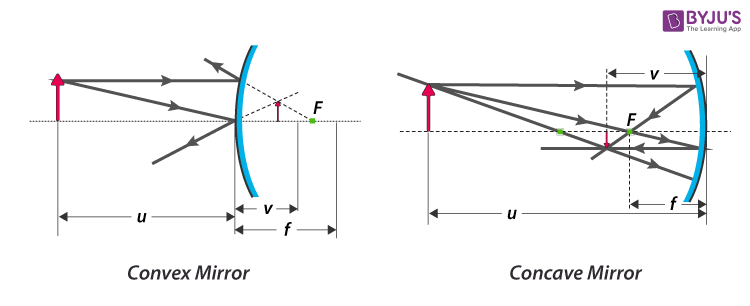
Our goal is to find a mathematical relationship between the object distance , the image distance , and the focal length . The derivation hinges on identifying pairs of similar triangles within the ray diagram.
2. Deriving the Mirror Formula
The most rigorous derivation starts by considering specific rays and applying geometric principles. We will use a derivation that formally identifies similar triangles based on the law of reflection.
Image Formation by Reflection—The Mirror Equation
The OpenStax 'University Physics' textbook provides an excellent, rigorous derivation of the mirror formula. It uses geometry to establish relationships which are then combined to produce the final equation. This approach will suit your preference for mathematical formalism.
Please read the section titled 'Image Formation by Reflection—The Mirror Equation'. Focus on the derivation starting from the figure showing object OP and its image. Follow the steps that use the tangent of angles θ and φ to establish two relationships, combine them, and arrive at the mirror equation. Note that they use 'dₒ' for object distance (our 'u') and 'dᵢ' for image distance (our 'v').
Let's break down the logic of that derivation to ensure every step is clear. The entire proof rests on finding two different expressions for the ratio of image height to object height () and then equating them.
Using the standard notation of , , and , and referring to a diagram similar to the one in the resource:
-
First Pair of Similar Triangles: Consider the ray that strikes the pole (vertex) P. The principal axis acts as the normal. By the law of reflection, the angle of incidence equals the angle of reflection. This creates two similar right-angled triangles, one with the object and one with the image.
- From these triangles, we get the relation: . If we account for the fact that the real image is inverted ( is negative), we write: , or .
-
Second Pair of Similar Triangles: Now consider the ray that passes through the center of curvature, C. This ray reflects back on itself. This creates another pair of similar right-angled triangles, this time with vertices at C.
- The base of the object triangle is .
- The base of the image triangle is .
- From these triangles, we get: .
-
Combining and Simplifying: We now have two expressions for the ratio of heights. Equating them gives:
Cross-multiplying gives:
Now, we divide the entire equation by :
-
The Small-Angle Approximation: Finally, we use the relationship you derived in a previous lesson, , which is based on the paraxial ray approximation (small angles). Substituting into our equation gives the celebrated Mirror Formula:
3. The Cartesian Sign Convention
The derivation above was for a specific case (concave mirror, real image). For the mirror formula to be universally applicable to all situations (including convex mirrors and virtual images), we must adhere to a strict set of rules known as the Cartesian Sign Convention.
- Origin: The pole (P) of the mirror is the origin (0,0).
- Principal Axis: The principal axis is the x-axis.
- Direction of Incident Light: Light is always assumed to travel from left to right.
- Distances:
- All distances measured along the direction of incident light (to the right of the pole) are positive.
- All distances measured opposite to the direction of incident light (to the left of the pole) are negative.
- Heights:
- Heights measured upwards and perpendicular to the principal axis are positive.
- Heights measured downwards and perpendicular to the principal axis are negative.
Applying this convention:
- Object distance (u): Since the object is always placed to the left of the mirror, is always negative.
- Focal length (f):
- For a concave mirror, the focus is on the left, so is negative.
- For a convex mirror, the focus is on the right, so is positive.
- Image distance (v):
- If the image is real (formed on the left), is negative.
- If the image is virtual (formed on the right), is positive.
Note: Your textbook and some resources may use a different convention. The Cartesian convention described here is standard in modern physics and is the most consistent. While the derivation was done using magnitudes, applying this sign convention allows the final formula to work for all cases. For example, if we substitute , , and (for a real image from a concave mirror) into our derived formula, we get , which is algebraically identical.
4. Deriving the Magnification Formula
Magnification tells us about the size and orientation of the image relative to the object.
Linear Magnification () is defined as the ratio of the height of the image () to the height of the object ():
Now, let's find a more useful expression for in terms of and .
The same OpenStax resource also provides a direct derivation for the magnification formula. It flows naturally from the first step of the mirror formula derivation.
Please read the short section titled 'Image Magnification'. It starts with the relation between heights and distances we found earlier and formally defines magnification, leading to the final formula m = -dᵢ/dₒ.
As you saw in the resource and our breakdown in step 2.1, the similar triangles formed by the ray striking the pole give us:
Here we explicitly include the negative sign for the inverted image height .
Rearranging this to match the definition of magnification:
Therefore, the Magnification Formula is:
The sign of tells you the image orientation:
- If , the image is real and inverted.
- If , the image is virtual and upright.
The magnitude of tells you the size:
- If , the image is magnified.
- If , the image is diminished.
- If , the image is the same size as the object.

Test your understanding!
The mirror formula relates , , and . The magnification formula relates , , and . Let's combine them.
Problem: Using the mirror formula and the magnification formula, derive an expression for magnification in terms of only the focal length and the object distance .
Hint: Start with the mirror formula and multiply the entire equation by . Then, rearrange to find an expression for .
Show answer
We start with the mirror formula:
Multiply the entire equation by :
Now, we want to isolate a term that looks like our magnification formula, . Let's rearrange the equation to solve for :
This is the reciprocal of . Let's invert both sides:
The magnification formula is . So, we multiply by -1:
Final Result:
This is a very useful formula for solving numerical problems quickly! For instance, what happens when ? The denominator becomes zero, and approaches infinity. This corresponds exactly to what we saw in the ray diagrams: when the object is at the focus, the image is formed at infinity.
Conclusion
In this lesson, we have moved from geometric constructions to algebraic formulas, providing you with powerful tools for quantitative analysis of spherical mirrors.
- Key Takeaways:
- The Mirror Formula, , relates the object distance, image distance, and focal length.
- The Magnification Formula, , relates magnification to the object and image distances.
- These formulas are universally applicable if you consistently use the Cartesian Sign Convention, where distances are measured from the pole and are negative to the left and positive to the right.
- The derived relationship shows how these fundamental equations can be manipulated to solve specific problems efficiently.
Preview of the Next Lesson:
You have now derived the necessary theoretical tools. The next step is to apply them. In our next lesson, we will focus on solving a variety of numerical problems involving spherical mirrors. This will solidify your understanding of the formulas and the crucial sign convention, preparing you for complex problem-solving scenarios.