Hello! Welcome to the final lesson of our first module on Ray Optics.
In the past lessons, we've built a solid theoretical foundation, deriving the mirror formula, Snell's law, and the conditions for total internal reflection. As you'll appreciate from your background in calculus-based physics, the real power of these principles lies in their application.
Today, we will focus exclusively on that application. Our goal is to solve a range of numerical problems involving spherical mirrors, refraction, and total internal reflection. This session is all about translating theory into practice, honing the problem-solving skills you'll need for your exams and for the topics ahead.
Let's quickly review the essential tools for today:
- Mirror Formula:
- Magnification (Mirrors):
- Snell's Law of Refraction:
- Apparent Depth:
- Critical Angle for TIR: (for light going from medium 1 to 2, where )
A systematic approach is key: always start by drawing a diagram, listing known and unknown variables, and being meticulous with sign conventions.
1. Problem Solving: Spherical Mirrors
The most common source of error in mirror problems is the sign convention. Let's start with a quick and clear review of the rules.
Concave Mirrors and Convex Mirrors Ray Diagram - Equations / Formulas & Practice Problems
This video by The Organic Chemistry Tutor provides a concise and clear explanation of the sign conventions used for spherical mirrors. Pay close attention to the conditions for positive and negative values of u, v, f, and m.
Watch the segment from the beginning until 04:26. This will establish the sign convention framework we will use for all mirror problems.
To summarize the key conventions (using the Cartesian system):
- Light is assumed to travel from left to right.
- The pole (P) is the origin (0,0).
- Distances measured in the direction of incident light are positive; those measured against it are negative.
- Heights measured upwards from the principal axis are positive; downwards are negative.
This leads to:
- u (object distance) is almost always negative.
- f (focal length) is negative for concave mirrors and positive for convex mirrors.
- v (image distance) is negative for real images (in front of the mirror) and positive for virtual images (behind the mirror).
- m (magnification) is negative for real, inverted images and positive for virtual, erect images.

Example 1: Concave Mirror and Magnification
Let's solve a problem where we need to work backward from the magnification to find the object position.
Problem: Calculate the distance of an object from a concave mirror with a focal length of 10 cm, so that a real image is formed with a magnification of 2.
Ray Optics And Optical Instruments - Important PYQs | Physics | Class 12th Boards 🔥
The following video from NCERT Wallah solves this exact type of problem. Watch how the information about the image being 'real' is used to determine the sign of the magnification, a crucial first step.
Watch the segment from 01:10:51 to 01:13:26. Follow the steps of using the magnification formula to relate v and u, and then substituting this into the mirror formula.
Let's outline the solution:
-
Given:
- Mirror type: Concave cm.
- Image type: Real magnification is negative.
- Magnification magnitude is 2. So, .
-
Relate and :
- Use the magnification formula: .
- .
-
Apply the Mirror Formula:
-
Solve for :
- cm.
The object must be placed 15 cm in front of the mirror.
Test your understanding!
An object is placed 30 cm in front of a convex mirror of focal length 20 cm. Find the position and nature of the image.
Show answer
-
Given:
- Mirror type: Convex cm.
- Object distance: cm.
-
Apply the Mirror Formula:
- cm.
-
Analyze the result:
- Since is positive, the image is formed 12 cm behind the mirror, meaning it is virtual.
- Let's find the magnification: .
- Since is positive and less than 1, the image is erect and diminished.
2. Problem Solving: Refraction
Problems involving refraction typically use Snell's Law or the concept of apparent depth.
Example 2: Calculating Refractive Index
Problem: A ray of light travels a distance of 12 m in a transparent sheet in nanoseconds. The speed of light in vacuum is m/s. What is the refractive index of the sheet?
Ray Optics And Optical Instruments - Important PYQs | Physics | Class 12th Boards 🔥
This problem is a direct application of the definition of absolute refractive index. Watch the solution in the following video.
Watch the clip from 00:53:51 to 00:56:32. The key is to first calculate the speed of light in the medium and then use the formula n = c/v.
Here is the breakdown:
-
Given:
- Distance in medium, m.
- Time in medium, s.
- Speed of light in vacuum, m/s.
-
Calculate Speed in Medium ():
- m/s.
-
Calculate Refractive Index ():
- .
The refractive index of the sheet is 1.5.
3. Problem Solving: Total Internal Reflection (TIR)
These problems test your understanding of the two conditions for TIR and the critical angle formula.
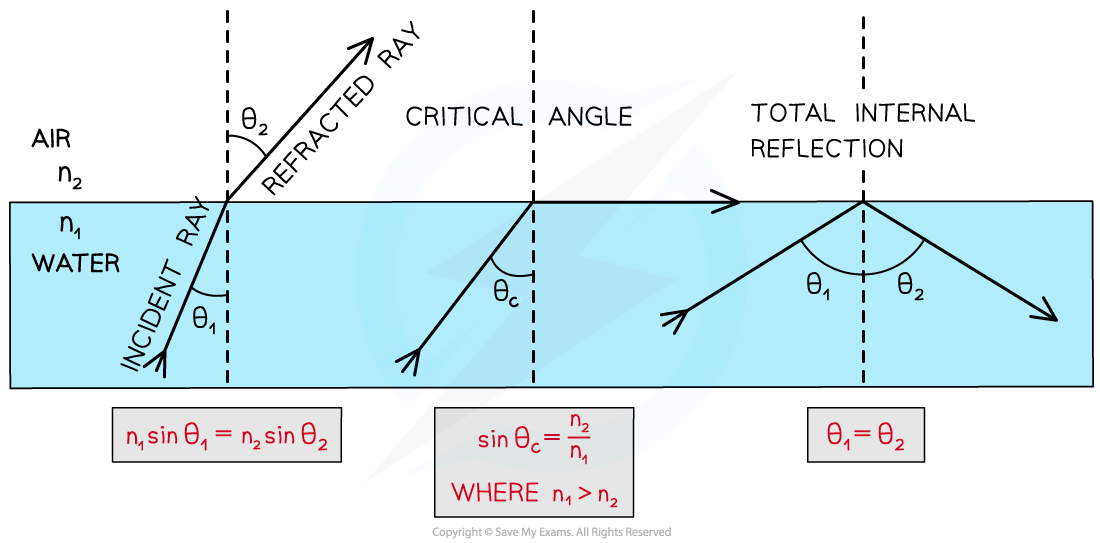
Example 3: Critical Angle and Speed of Light
Problem: The critical angle for light going from a certain medium into air is . Find the speed of light in the medium.
This problem connects the concept of critical angle back to the fundamental definition of refractive index.
Ray Optics And Optical Instruments - Important PYQs | Physics | Class 12th Boards 🔥
The following clip shows how to solve this two-step problem. First, find the refractive index from the critical angle. Second, find the speed of light from the refractive index.
Watch the solution from 00:37:25 to 00:40:17. Note that the medium is denser than air, which is why TIR is possible.
Let's walk through the steps:
-
Given:
- Light goes from medium to air, so , .
- Critical angle, .
-
Find the Refractive Index ():
- Using the critical angle formula: .
- .
-
Find the Speed of Light in the Medium ():
- Using the definition of refractive index: .
- m/s.
Example 4: A Challenging TIR Application (Snell's Window)
This final problem is a classic that beautifully integrates geometry with the physics of TIR.
Problem: A point source of light is placed at the bottom of a tank filled with water (refractive index ) to a depth of . Show that the area of the water surface through which light can emerge into the air is a circle of area .
Ray Optics And Optical Instruments - Important PYQs | Physics | Class 12th Boards 🔥
This problem, often called 'Snell's Window,' is a fantastic challenge problem. The video below provides a full derivation. Your strong math background will be very helpful here.
Watch the detailed walkthrough from 00:59:13 to 01:06:24. Focus on how the radius of the illuminated circle is determined by the ray that strikes the surface at the critical angle. Beyond this radius, all light undergoes TIR and does not emerge.
Let's derive it together:
-
Conceptual Setup: Light radiates from the source in all directions. Light rays striking the surface at an angle will refract out. The ray striking at exactly will graze the surface. Any ray striking at will be totally internally reflected. Therefore, the emerging light is confined to a circle on the surface, the radius of which is defined by the critical angle.
-
Geometric Relation:
- Let the radius of this circle be . Let the depth of the source be .
- Consider the right-angled triangle formed by the light source, the center of the circle on the surface, and the edge of the circle. The angle at the source is the critical angle, .
- From trigonometry, .
- So, the radius is .
-
Using the TIR Formula:
- We know .
- We need . We can use the identity .
- .
-
Find the Radius and Area:
- Substitute this expression for back into our equation for :
- The area of the circle is .
- This completes the proof.
- Substitute this expression for back into our equation for :
Conclusion
Today, we bridged the gap between theory and application by tackling a variety of numerical problems. You've seen how to systematically apply the core formulas of this module to find practical, quantitative answers.
- Key Takeaways:
- A structured approach (diagram, list variables, check signs) is essential for accuracy.
- Sign conventions are not arbitrary rules but a necessary framework for using the mirror and lens formulas correctly.
- The principles of refraction and TIR can be combined with geometry to solve complex and interesting problems, like Snell's Window.
Preview of the Next Lesson:
With this module on reflection and refraction at plane and spherical surfaces complete, we are ready to study a key optical component: the prism. In our next lesson, we will begin Module 2 by analyzing the path of light through a prism, deriving the famous prism formula, and seeing how TIR is applied within prisms. The concepts of refraction we've practiced today are the direct foundation for that analysis.