Hello! Welcome to your seventh lesson in the Ray Optics module.
In our last lesson, we explored how refraction at a plane surface leads to the phenomenon of apparent depth. We saw that when light travels from a denser to a rarer medium, it bends away from the normal. This naturally leads to a compelling question: what happens if we keep increasing the angle of incidence? Can the ray bend so much that it never leaves the first medium?
Today, we will answer that question by exploring the phenomenon of Total Internal Reflection (TIR). By the end of this lesson, you will be able to derive the condition for total internal reflection and the expression for the critical angle. This is a direct and powerful consequence of Snell's law with many important applications, from optical fibers to the sparkle of diamonds.
1. From Refraction to "Grazing Emergence"
Let's consider a ray of light traveling from a denser medium (refractive index ) to a rarer medium (refractive index ), where by definition .
As we established, the ray will bend away from the normal. As we increase the angle of incidence , the angle of refraction will also increase, staying governed by Snell's Law: . Since , it must be that .
There must be a specific angle of incidence for which the angle of refraction becomes . At this point, the refracted ray doesn't enter the rarer medium but instead travels, or "grazes," along the boundary surface. This specific angle of incidence is called the critical angle.
To visualize this progression, please watch the following video segment.
Critical Angle and Total Internal Reflection - Derivation | Class 12 Physics Chapter 9 | 2024-25
This video from Magnet Brains provides an excellent step-by-step conceptual illustration of how increasing the angle of incidence leads to the critical angle.
Watch from 03:15 to 08:56. Focus on the visual demonstration of how the refracted ray bends further away from the normal as the incident ray's angle increases, until it reaches the point of 'grazing emergence' where the angle of refraction is 90°.
The concept is summarized perfectly in the diagrams below.
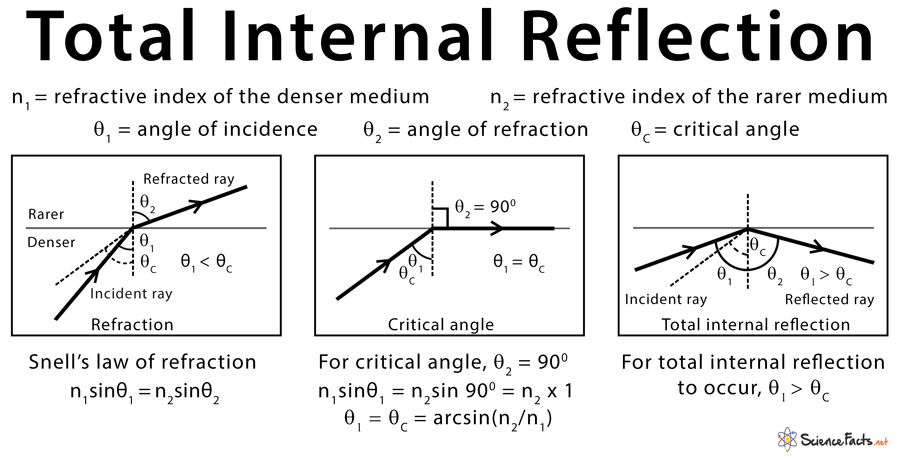
2. Derivation of the Critical Angle Formula
Now, let's derive the mathematical expression for the critical angle, which we'll denote as or . The derivation is a straightforward application of Snell's Law to the specific conditions of the critical angle.
The following resource provides a concise, text-based derivation that you can follow.
This article from Adda247 lays out the mathematical derivation of the critical angle formula clearly. Your background in calculus-based physics will make this derivation feel very direct.
Please read the section titled 'Derivation of Critical Angle'. It starts with Snell's law and applies the specific conditions that define the critical angle. Follow the steps that lead to the final formula.
Let's formalize the steps here:
-
Start with Snell's Law: For light traveling from medium 1 to medium 2, we have:
-
Apply the Definition of Critical Angle: The critical angle, , is the angle of incidence for which the angle of refraction is exactly . So, we substitute and :
-
Simplify and Solve for : Since , the equation becomes:
Solving for , we get:
Therefore, the critical angle is:
A crucial point arises from this formula. Since the sine function can only produce values between -1 and 1, for a real angle to exist, the ratio must be less than or equal to 1. This mathematically confirms our initial condition: a critical angle only exists when light travels from a denser medium to a rarer one ().
In the common scenario where light travels from a medium of refractive index into air (), the formula simplifies to:
3. Total Internal Reflection (TIR)
We've defined the critical angle. Now we must address what happens when the angle of incidence exceeds it.
If , then .
From our derivation, we know .
Substituting this into Snell's Law to find the angle of refraction :
Since , we have . Therefore:
The result, , is a mathematical impossibility for any real angle . This means that for angles of incidence greater than the critical angle, no light is refracted. Instead, 100% of the light is reflected from the boundary back into the denser medium, perfectly obeying the law of reflection (). This phenomenon is called Total Internal Reflection.
The term "total" is significant. While normal reflection from a surface like glass or water involves partial transmission, TIR is, in principle, perfectly efficient.
Critical Angle and Total Internal Reflection - Derivation | Class 12 Physics Chapter 9 | 2024-25
Let's return to the Magnet Brains video to see the visualization of what happens when the angle of incidence surpasses the critical angle.
Watch the segment from 15:26 to 19:29. This part shows the light ray being completely reflected back into the denser medium once the critical angle is exceeded, defining Total Internal Reflection.
4. The Conditions for Total Internal Reflection
Based on our analysis, we can state the two necessary and sufficient conditions for TIR to occur.
Conditions for Total Internal Reflection
The Physics Classroom website provides a very clear summary of these two essential conditions.
Read the two bullet points at the beginning of this article. They are the concise summary of everything we've derived.
To summarize, for Total Internal Reflection to take place, both of the following conditions must be met:
- The light ray must be traveling from a more optically dense medium to a less optically dense medium (i.e., from a higher refractive index to a lower one, ).
- The angle of incidence must be greater than the critical angle ().
If either of these conditions is not met, refraction will occur.
Test your understanding!
Light travels from a block of crown glass () into a pool of water ().
- Can total internal reflection occur at this interface? Why or why not?
- If so, calculate the critical angle for the glass-water interface.
- What would an observer see if a light ray strikes the interface from the glass side at an angle of incidence of 65°?
Show answer
-
Yes, TIR can occur. The first condition is met because light is traveling from a denser medium (glass, ) to a rarer medium (water, ).
-
We use the critical angle formula:
The critical angle for the glass-water interface is approximately 61.0°. -
The angle of incidence is given as . We compare this to the critical angle we just calculated: .
Since the angle of incidence is greater than the critical angle (), and the first condition is met, total internal reflection will occur. The observer would see the light ray being completely reflected from the interface back into the glass at an angle of reflection of 65°. No light would enter the water.
Conclusion
Today, we have fully explored the beautiful phenomenon of total internal reflection, deriving its conditions and the expression for the critical angle directly from Snell's Law.
- Key Takeaways:
- The critical angle () is the angle of incidence in a denser medium for which the angle of refraction in the rarer medium is .
- The formula for the critical angle is derived from Snell's Law: .
- Total Internal Reflection (TIR) occurs when light is completely reflected back into the denser medium.
- The two essential conditions for TIR are:
- Light must travel from a denser to a rarer medium ().
- The angle of incidence must be greater than the critical angle ().
Preview of the Next Lesson:
Now that you have a firm grasp of the theory behind TIR and refraction at plane surfaces, the next step is to apply these principles. In our next lesson, we will focus on solving a variety of numerical problems involving spherical mirrors, refraction, and total internal reflection, strengthening your problem-solving skills for this entire module.