Hello! Welcome to the first lesson in your course on ISC Class 12 Physics. We're kicking off with the fascinating world of optics, a field that combines elegant geometry with the physics of light.
This first module focuses on Ray Optics, beginning with reflection from spherical mirrors. Today's lesson is all about building a solid foundation. We will define the essential terminology used to describe concave and convex mirrors. Mastering this vocabulary is the first and most critical step before we can move on to deriving the mathematical relationships and constructing the ray diagrams that are central to this topic.
Let's begin by establishing the fundamental language of spherical mirrors.
1. The Geometry of Spherical Mirrors
A spherical mirror, as the name suggests, is a mirror whose reflecting surface is a part of a hollow sphere. Depending on which side of the sphere is polished for reflection, we get two types of mirrors:
- Concave Mirror: The reflecting surface is the inner side of the sphere, caved inwards.
- Convex Mirror: The reflecting surface is the outer side of the sphere, bulging outwards.
The following image provides a clear illustration of how these mirrors are conceptualized.

To describe the geometry and behavior of these mirrors, we use a standard set of terms. Let's define them one by one.
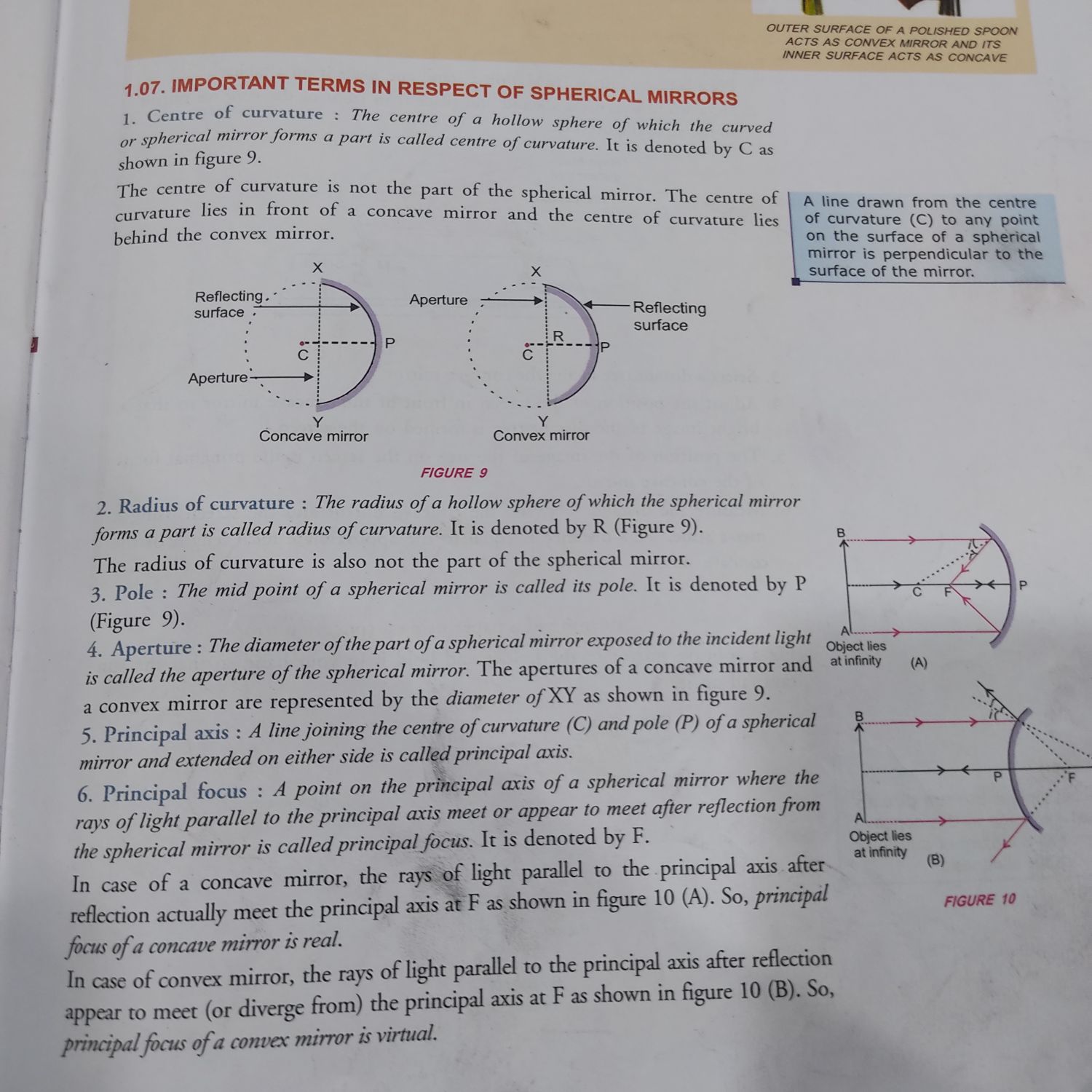
- Center of Curvature (C): This is the center of the hollow sphere of which the mirror is a part. Since the mirror is a section of a sphere, every point on its surface is equidistant from this center.
- Radius of Curvature (R): This is the radius of that same hollow sphere. It is the distance from the center of curvature (C) to any point on the mirror's surface.
- Pole (P) or Vertex (V): This is the geometric center of the spherical mirror's reflecting surface. We will primarily use the term Pole (P).
- Principal Axis: This is the imaginary straight line that passes through the Pole (P) and the Center of Curvature (C). It serves as the primary reference axis for the mirror system.
- Aperture: This refers to the effective diameter of the mirror's reflecting surface. It essentially determines how much light the mirror can collect.
To get a more dynamic and detailed explanation of these terms, please watch the following video from Khan Academy. It does an excellent job of clarifying the distinction between the physical size of the mirror and the geometric properties like the radius of curvature.
Spherical mirrors, radius of curvature & focal length
This video provides clear, intuitive definitions for the key geometric terms associated with spherical mirrors.
Please watch from 01:02 to 06:47. Focus on how Sal Khan defines the Pole, Radius of Curvature, Center of Curvature, Aperture, and Principal Axis. Pay close attention to the explanation around 04:00, which clarifies the difference between the 'radius of the mirror' and the 'radius of curvature'.
2. The Optical Properties: Focus and Focal Length
Now that we have the geometric framework, let's look at the most important optical property of a spherical mirror: its ability to focus light.
- Principal Focus (F): When a beam of light rays parallel to the principal axis strikes a mirror, they are reflected. The Principal Focus is the point on the principal axis where these reflected rays either:
- Converge (meet) for a concave mirror. This creates a real focus because the light rays actually pass through this point.
- Appear to diverge (spread out) from for a convex mirror. This creates a virtual focus because the rays do not actually pass through it; our brain just traces them back to this imaginary point behind the mirror.
- Focal Length (f): This is the distance between the Pole (P) and the Principal Focus (F), measured along the principal axis.
The image below provides a great summary of all the terms we've discussed and includes diagrams showing the Principal Focus for both types of mirrors.
A Note on Reality: Spherical Aberration
In our ideal model, all parallel rays converge perfectly to a single focal point. However, in reality, for a spherical mirror with a large aperture, rays hitting the edges of the mirror focus at a slightly different point than rays hitting the center. This defect is called spherical aberration, and it can lead to blurry images.
To ensure a sharp focus, we typically work with mirrors where the aperture is small compared to the radius of curvature. This is known as the paraxial approximation. Throughout our study, we will assume this condition holds, allowing us to use the simple geometric rules we are developing.
Test your understanding!
A concave mirror is created by cutting a section from a hollow glass sphere that has a diameter of 60 cm.
- What is the radius of curvature (R) of this mirror?
- Where is the center of curvature (C) located relative to the mirror's surface?
- If a beam of sunlight (which consists of parallel rays) is directed at the mirror parallel to its principal axis, where would the rays concentrate? What is this point called?
Show answer
- The radius of a sphere is half its diameter. So, the radius of curvature is 60 cm / 2 = 30 cm.
- The center of curvature (C) is located 30 cm in front of the center (Pole) of the concave mirror's reflecting surface, along the principal axis.
- The parallel rays of sunlight would concentrate at the principal focus (F). In the next lesson, we will prove that for paraxial rays, this point lies exactly halfway between the pole and the center of curvature, so it would be 15 cm from the mirror's pole.
3. A Framework for Calculation: The Cartesian Sign Convention
To solve problems numerically, we need a consistent sign convention for distances and heights. We will use the New Cartesian Sign Convention, which is standard in modern physics textbooks and will apply to lenses as well.
Here are the rules:
- The Origin: The Pole (P) of the mirror is treated as the origin (0, 0) of a Cartesian coordinate system.
- The Principal Axis: The principal axis is taken as the x-axis.
- Direction of Incident Light: Light is always assumed to travel from left to right.
- Measuring Distances: All distances are measured from the Pole (P).
- Distances measured in the same direction as incident light (to the right of the pole) are positive (+).
- Distances measured in the opposite direction to incident light (to the left of the pole) are negative (-).
- Measuring Heights: Heights are measured perpendicular to the principal axis.
- Heights measured upwards (above the x-axis) are positive (+).
- Heights measured downwards (below the x-axis) are negative (-).
Applying this convention to the focal length:
- For a concave mirror, the focus (F) is in front of the mirror (to the left of P). Therefore, its focal length is negative.
- For a convex mirror, the focus (F) is behind the mirror (to the right of P). Therefore, its focal length is positive.
This framework is absolutely essential for the formulas we will derive in the upcoming lessons.
Conclusion
In this lesson, we have established the fundamental vocabulary for our study of spherical mirrors. You should now be comfortable defining and identifying the following key terms:
- Concave & Convex Mirrors
- Pole (P)
- Center of Curvature (C) and Radius of Curvature (R)
- Principal Axis
- Principal Focus (F) and Focal Length (f)
We also differentiated between a real focus (concave) and a virtual focus (convex) and established the Cartesian Sign Convention that will be our guide for all future calculations.
In our next lesson, we will put these concepts into action. Using the law of reflection and some simple geometry, we will derive the important relationship between the radius of curvature and the focal length of a spherical mirror: . This will be our first major derivation in optics.