Welcome back. The previous lesson examined an Equal Protection claim that race predominated in the drawing of a particular district. This final lesson approaches a map from the other direction: can its boundaries unlawfully weaken minority voters’ opportunity to elect their preferred candidates under Section 2 of the Voting Rights Act?
Those questions can arise over the same map, but they are not interchangeable. Louisiana’s congressional map makes the distinction concrete. We will trace the competing claims, then examine how Louisiana v. Callais (2026) changed the Section 2 framework used to assess them.
Two claims, two starting points
A Section 2 racial vote-dilution claim begins with minority voters’ electoral opportunity. District lines might divide a community among several districts, leaving its voters unable to elect a preferred candidate where a reasonably configured alternative would provide that opportunity. Section 2 asks whether the electoral process is equally open to those voters—not whether their preferred candidates must win seats in proportion to the group’s share of the population.
An Equal Protection racial-gerrymandering claim begins instead with the government’s method of drawing a challenged district. As the previous lesson established, a challenger must show that race predominated in choosing its lines. If so, the state must justify that use of race under strict scrutiny. A claimant does not have to show that anyone’s voting strength was diluted.
The Congressional Research Service (CRS) sets out the statute and the earlier Gingles framework. Read this first to establish what a Section 2 claimant is trying to show before considering the 2026 changes.
Read the Congressional Research Service’s “Louisiana v. Callais” for its explanation of racial vote dilution and the original Section 2 framework.
In “Section 2 of the VRA and Legal Framework,” begin with the statutory purpose, ending just before the paragraph on Gingles. Then read the Gingles framework through the end of the paragraph on Equal Protection challenges. Focus on the three preconditions, the subsequent totality-of-circumstances inquiry, and why a map drawn in response to Section 2 can itself face a constitutional challenge.
Under the earlier Gingles framework, a vote-dilution challenger had to show that the minority group was large and geographically compact enough to form a majority in a reasonably configured district; that its voters were politically cohesive; and that majority-group voters usually voted as a bloc to defeat the minority group’s preferred candidate. The court then considered the totality of circumstances to assess whether the political process was equally open. These were conditions for evaluating a claim, not a rule requiring a majority-minority district wherever one could be drawn.
Hold onto the distinction between what a map does and how a state drew it. Cracking a minority community could be relevant to a dilution claim. Deliberately selecting voters by race to construct a district could be relevant to an Equal Protection claim. The same boundaries can generate both questions, but evidence supporting one does not automatically establish the other.
Why Louisiana produced both claims
The map below depicts Louisiana’s 2024 congressional plan. Blue marks districts whose Black voting-age population exceeded 50%. It is a snapshot of the map involved in the litigation, not a statement that the map satisfies the rule announced in 2026.
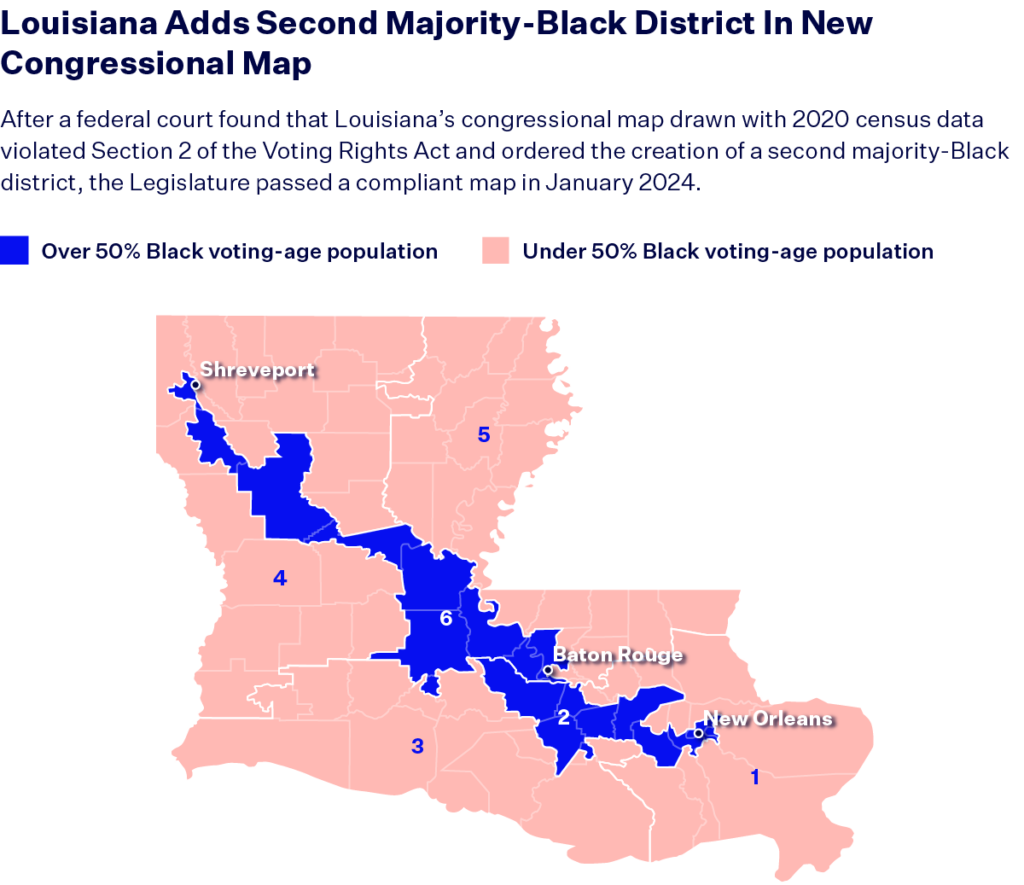
The sequence matters. Voters and civil-rights organizations challenged an earlier map with one majority-Black district, arguing that Section 2 required a second. Louisiana then enacted the depicted map with two. Other voters challenged the new district under Equal Protection, arguing that the state had relied predominantly on race in drawing it. Thus, the first claim said, in effect, the earlier map did too little to protect electoral opportunity; the second said the replacement map used race impermissibly in constructing a district.
Read the CRS account of that sequence. Its description of the lower court is a stage in the litigation, not the final Supreme Court rule.
Return to the CRS account to see how the Section 2 and Equal Protection claims came to concern successive versions of the same state’s congressional map.
In “Lower Court Litigation in Louisiana v. Callais,” start in the first paragraph at the description that introduces the two maps and claims. Continue through the lower court’s reasoning in the second paragraph, stopping before the account of the stay and appeal. Notice that the lower court assessed the new district’s use of race, rather than deciding the earlier vote-dilution claim merely by counting blue districts.
A district’s 50%-plus racial composition does not itself decide either claim. For Section 2, the issue is whether the applicable legal requirements establish that the earlier map denied equal electoral opportunity. For Equal Protection, the issue is whether race predominated in drawing the new district and, if it did, whether the state can justify that choice. The blue areas make the dispute visible; they cannot supply the missing evidence about voting patterns, permissible mapping goals, or mapmakers’ choices.
What Callais changed for Section 2
In Callais (2026), the Supreme Court affirmed the judgment against Louisiana’s second majority-Black district. Its reasoning also revised the framework for Section 2 redistricting claims. It is important to separate the Court’s rule from the law under which the Louisiana litigation began.
The Court said Section 2 liability now requires evidence supporting a strong inference that a state intentionally drew districts to give minority voters less opportunity because of race. That is more specific than observing that minority voters have less opportunity under the enacted map. At the same time, the majority said a court need not make a direct finding that the legislature, considered as an institution, had a proven discriminatory motive. The required strong inference must be supported by the circumstances. Those formulations should not be flattened into either “effects alone suffice” or “a confession of intent is necessary.”
The Court then updated the Gingles inquiries. In a redistricting claim, the challenger’s illustrative alternative map must contain the proposed majority-minority district without using race as a criterion to draw that map. It must also achieve the state’s legitimate objectives—including its specified political or incumbent-protection goals—alongside applicable districting criteria. This comparison is meant to test whether a different racial outcome was possible while preserving the state’s permissible aims. Under the revised second and third preconditions, evidence of cohesive minority voting and majority bloc voting must control for party affiliation: different outcomes for voters of different races are not enough if party preference explains the pattern. Finally, the totality-of-circumstances inquiry focuses on evidence bearing on present-day intentional racial discrimination in voting.
Read the majority’s formulation in the opinion itself. The short dissent passage afterward identifies a significant disagreement about what has happened to Section 2’s earlier, effects-focused approach. The dissent helps explain the debate; the majority supplies the governing rule described here.
24-109 Louisiana v. Callais (04/29/2026)
Read selected passages of the Supreme Court opinion to see the revised Gingles requirements in the majority’s own terms, then the dissent’s objection to the shift.
In the majority opinion, find “1. First Gingles Precondition” on printed pp. 29–30. Begin at the revised requirements, ending in “2. Second and Third Gingles Preconditions” on printed p. 31. Track separately what the alternative map must demonstrate and what the voting-pattern analysis must control for. Then, in Justice Kagan’s dissent on printed pp. 26–27, locate the paragraph contrasting Section 2 precedents with racial-gerrymandering cases. Read from the dissent’s contrast. Treat its account of prior precedent and its criticism of the majority as the dissent’s position, not as an exception to the new rule.
Consider why party affiliation matters without treating it as a universal answer. Suppose minority voters overwhelmingly support Party Q, while most other voters support Party P. A map that disadvantages Party Q may also disadvantage minority voters. Under the revised Section 2 framework, that overlap alone does not establish race-based vote dilution: the challenger must address the possibility that permissible partisan objectives account for the lines and the voting patterns. Conversely, evidence that race—not party—explains relevant line choices or voting differences remains important. Correlation identifies the problem to investigate; it does not settle which explanation is supported.
The dissent argues that this approach imports purpose-focused reasoning from Equal Protection racial-gerrymandering cases into a statute previously applied through an effects inquiry. That disagreement is consequential precisely because the claims remain distinct: the Equal Protection claimant challenges predominant racial sorting in the replacement district, while the Section 2 claimant alleges unequal electoral opportunity under the earlier map.
Applying the distinction to the 2024 map
The final step is to connect those standards without merging them. Read the CRS account of the Supreme Court’s application to Louisiana; the navigation goes directly to the case-specific paragraph rather than repeating its broader explanation of the new rule.
Finish the CRS account with the Court’s application of the revised framework to Louisiana’s second majority-minority district.
In “Supreme Court Ruling in Louisiana v. Callais,” go to the final paragraph beginning the Louisiana application. Read to the end of that paragraph. Focus on the two gaps the Court identified in the Section 2 showing—an alternative map meeting the state’s nonracial goals and voting evidence controlling for party—and on the resulting Equal Protection conclusion.
The Court found that the showing offered for a Section 2 obligation failed under its revised test. In particular, the challengers had not produced an illustrative map meeting Louisiana’s nonracial goals, including political goals and incumbent protection; their evidence of differing Black and white voting patterns did not control for partisan preference. The Court also found the totality-of-circumstances showing insufficient under its new approach.
That finding mattered to the Equal Protection defense. Because race predominated in creating the challenged district, the state needed a compelling justification for its use of race. The Court held that Section 2, properly construed, could supply such a justification when it actually required the race-conscious districting at issue. But because the Court found no Section 2 requirement for Louisiana’s second district, it concluded that the state lacked that compelling justification and affirmed the judgment against the map.
This does not mean that every majority-minority district violates Equal Protection, or that Section 2 can never require a different map. It means that claiming “Section 2 required this district” must be supported under the applicable Section 2 test; the label alone cannot defend predominant use of race.
Key takeaways
Keep the claims in separate columns when reading a redistricting case. Section 2 vote dilution concerns minority voters’ opportunity to elect preferred candidates; after Callais, a redistricting challenger must satisfy the revised Gingles framework and supply circumstances supporting a strong inference of present-day, intentional race-based disadvantage. Equal Protection racial gerrymandering concerns whether race predominated in drawing a challenged district; if it did, strict scrutiny applies even without proof of diluted votes.
Louisiana shows why the two questions can collide. A state may redraw a map in response to a Section 2 claim, only to face an Equal Protection challenge to the new district. The 2026 decision changed how the asserted Section 2 need is tested—and therefore how that need can justify race-conscious line drawing. This completes the course’s path from vote-to-seat mechanics through fairness measures and mapping institutions to the distinct legal questions raised by party and race.