Hello! Welcome to the first lesson of your course on AI Systems Performance Engineering.
Your goal is to build a "plug-and-play" observability product for AI systems. To do that effectively, we first need to understand the fundamental workloads your product will monitor. In the world of AI, nearly everything boils down to two distinct phases: training and inference.
This lesson is dedicated to explaining the difference between these two workloads. From a systems perspective, they have vastly different performance goals, resource requirements, and operational patterns. For someone with your background in HPC and distributed systems, you can think of them as two completely different types of computational jobs, much like a massive, long-running batch simulation differs from a high-transaction, low-latency web service.
Understanding this distinction is the cornerstone of AI performance engineering and will inform every aspect of the observability solution you aim to build.
The Core Idea: Learning vs. Doing
At its heart, the difference between training and inference is the difference between learning a skill and applying it.
- Training is the "learning" phase. It's like a student studying textbooks, reviewing thousands of practice problems, and learning from their mistakes to understand a subject deeply.
- Inference is the "doing" or "applying" phase. It's like that same student taking an exam, where they must quickly and accurately apply their knowledge to answer new questions they haven't seen before.
To see this in action, let's watch a short video from IBM Technology that uses a spam email detector to explain these two stages.
AI Inference: The Secret to AI's Superpowers
This video provides a great analogy for training and inference using a spam filter. Pay attention to how it describes the model 'learning' from a large dataset versus 'applying' that knowledge to new emails.
Starting around 30 seconds in, please watch the video covering AI model stages. The first part introduces the two stages, and the rest walks through the spam detector example for both training and inference.
As the video illustrates, training is a one-time (or periodic) process of building the model's "knowledge," while inference is the continuous, real-time application of that knowledge.
The Two Phases of the AI Lifecycle
Now, let's formalize these concepts. Every AI model goes through this two-phase lifecycle.
For a quick, high-level summary of these two phases, the following video provides a concise overview.
AI ML Training versus Inference
This video from New Machina gives a compact summary of the training and inference phases, highlighting the key characteristics of each.
Watch the entire video (it's about 3.5 minutes). It effectively recaps the purpose of each phase and introduces concepts like resource intensity and real-time vs. batch processing.
A Visual Summary
The core computational difference between training and inference lies in the operations performed. This diagram provides a simple but powerful visualization:
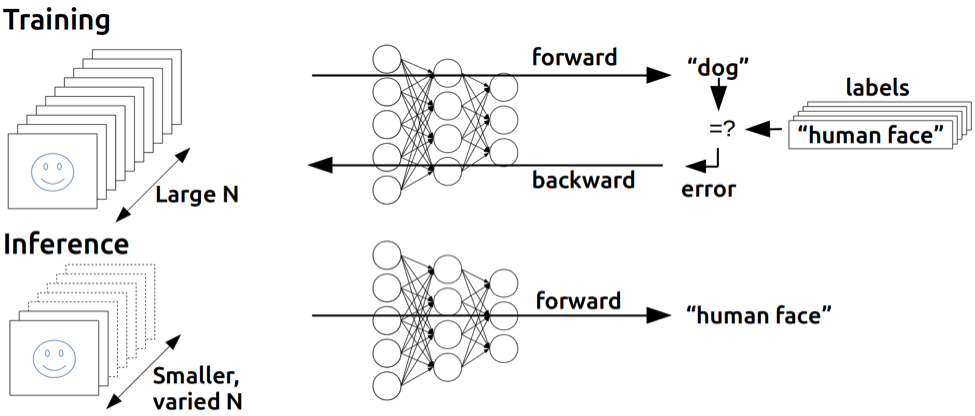
As the image shows:
- Training uses a large dataset and performs both a forward pass (to make a prediction) and a backward pass (to measure the error and adjust the model). This cycle is repeated millions of times.
- Inference uses a trained model (where the parameters are "frozen") and only performs a forward pass to generate a prediction for a new input.
We'll explore the forward and backward passes in detail in the next lesson. For now, the key takeaway is that training involves an extra, computationally expensive step (the backward pass) that is absent in inference.
A Systems Perspective: Contrasting Workload Characteristics
Given your background, the most useful way to think about training and inference is by comparing their infrastructure and performance profiles. They are fundamentally different engineering challenges.
To get a detailed breakdown, please read the following article from Clarifai. It does an excellent job of dissecting the infrastructure implications for each phase, which will be highly relevant to your goal of building an observability product.
AI Model Training vs Inference: Key Differences Explained
This article, 'AI Model Training vs Inference: Key Differences Explained', provides an in-depth comparison from an infrastructure perspective. It's one of the best resources for connecting AI workloads to the systems they run on.
Please read the sections titled 'Key Differences Between AI Training and Inference' and 'Infrastructure Implications of Model Training vs. Inference'. The second section, in particular, maps directly to your expertise in compute architecture, data pipelines, and networking.
Let's synthesize the key points from that article and others into a comparison table, framed from a performance engineering viewpoint.
| Characteristic | AI Training | AI Inference |
|---|---|---|
| Primary Goal | Throughput. Maximize the amount of data processed over time to train the model faster. | Latency. Minimize the time to get a single prediction for a responsive user experience. |
| HPC Analogy | A large-scale, tightly-coupled batch job (e.g., an MPI simulation). | A high-concurrency, low-latency transactional service (e.g., a web server). |
| Compute Pattern | Long-running, compute-intensive, parallel processing across many nodes. | Short-lived, bursty, high-concurrency requests. |
| Data Flow | Processes massive, static datasets (terabytes to petabytes) in large batches. | Processes single data points or small batches of new, unseen data. |
| Hardware | Clusters of high-end GPUs/accelerators with high-bandwidth interconnects (e.g., NVLink, InfiniBand). | A wide spectrum: CPUs, GPUs, specialized accelerators (NPUs), edge devices. |
| Cost Model | High, upfront capital expense (CapEx) or large, periodic cloud bills. | Continuous, accumulating operational expense (OpEx) that scales with usage. |
| Model State | Model parameters (weights) are constantly being updated. | Model parameters are fixed or "frozen." |
As you can see, optimizing for training is about maximizing resource utilization and parallel efficiency for a massive, single job. Optimizing for inference is about managing thousands of small, independent requests with minimal delay.
Test your understanding!
For each scenario below, identify whether it's primarily a training or inference workload. Justify your answer based on the system characteristics we've discussed (e.g., latency, throughput, data volume).
- A financial services company runs a process every night to analyze the entire day's market data to update its stock prediction model for the next day.
- An online retail website provides real-time product recommendations to a user as they click on different items.
- A research lab is creating a new foundational language model from scratch using a massive scrape of the public internet.
Show answer
- Training. The key clues are "update its stock prediction model" and analyzing a large set of "entire day's market data." The goal is to learn from historical data to create a new model version. This is a throughput-oriented batch job, not a real-time request.
- Inference. The key clues are "real-time" and responding to a single user's actions ("as they click"). This is a classic low-latency application. The system is using a pre-trained model to make a quick prediction for an individual user.
- Training. This is the most extreme example of a training workload. "Creating a new ... model from scratch" using a "massive scrape" of data implies a huge, compute-intensive process that could take weeks or months. The goal is pure throughput to finish the training process.
Conclusion
In this lesson, we've established the fundamental difference between AI training and inference. This is the most important concept to grasp as you begin your journey into AI performance engineering.
Here are the key takeaways:
- Training is the learning phase: It's a compute-heavy, throughput-sensitive process that uses large datasets to create a model. From a systems view, it resembles a large-scale HPC batch job.
- Inference is the application phase: It's a latency-sensitive process where a trained model makes predictions on new data. It resembles a transactional, high-concurrency service.
- They require different optimizations: Your observability tool will need to capture different metrics and expose different performance characteristics for each workload. For training, you'll care about things like GPU cluster utilization and data processing throughput. For inference, you'll focus on end-to-end latency and requests per second.
Now that you understand the high-level distinction between these two worlds, our next lesson will zoom in on the training process. We will break down the core components of a single training step: the forward pass, backward pass, and optimizer step. This will lay the groundwork for understanding what's actually happening on the CPU and GPU during training.