Welcome back. In our previous lessons, we explored the theory and practice of the Buteyko method, culminating in the "Steps Exercise" to build CO₂ tolerance during physical activity. You now have a practical foundation in the how of the technique. Today, as we planned, we pivot to a rigorous examination of the why and what, a deep dive into the clinical evidence that will be central to your goal of building a research-backed system.
This lesson is designed specifically for your background in statistics and clinical trial analysis. We will deconstruct two key randomized controlled trials (RCTs) on the Buteyko method for asthma, moving beyond summaries to dissect their study designs, statistical methods, and raw results. Our objective is to critically evaluate the quality and magnitude of the evidence, allowing you to form your own conclusions about the technique's efficacy.
The Gold Standard: A Modern Randomized Controlled Trial
The most robust way to assess an intervention is through a well-designed RCT. Let's begin by analyzing a recent and comprehensive study that investigated the Buteyko Breathing Technique (BBT) in adults with asthma.
Effect of Buteyko breathing technique on clinical and functional ...
This 2024 paper by Jörres et al., published in the European Journal of Medical Research, serves as an excellent case study in modern clinical research on breathwork. It is methodologically sound and provides the detailed data necessary for a critical appraisal.
I recommend you read the full paper, but pay particular attention to these sections in order: First, review the Abstract (0) and Background (1) to grasp the study's rationale and Buteyko's original hypothesis regarding CO₂ depletion. Next, thoroughly analyze the Methods section (2), focusing on the Study design, Intervention, Outcomes, Sample size, and Randomization. Then, examine the Statistical analysis section (3). Note the use of a linear mixed-effects model and procedures for handling missing data and multiple comparisons. Finally, delve into the Results (4) and Discussion (5). Concentrate on Tables 2, 3, and 4, which present the core findings for the primary and secondary outcomes.
As you read, let's structure our analysis around the key components of a clinical trial.
Study Design & Methodology
The Jörres et al. paper provides a clear blueprint of a parallel-group RCT.
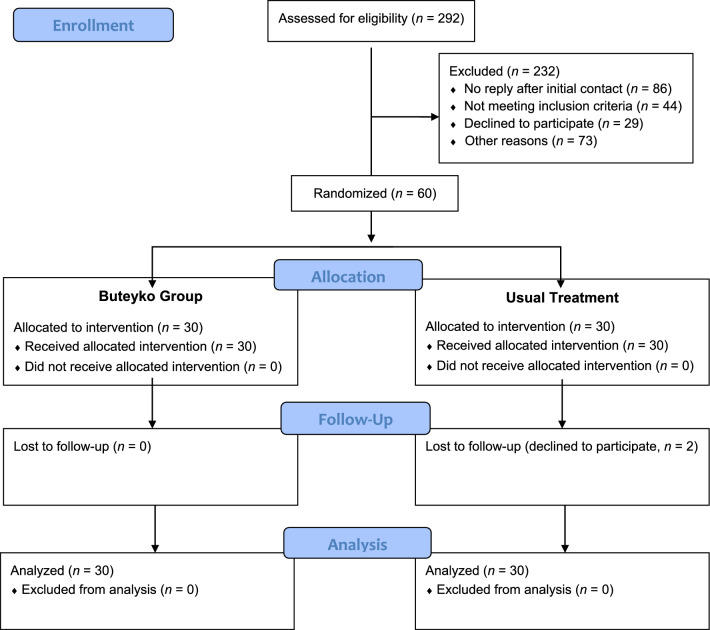
From the Methods section, we can extract several points that speak to the study's rigor:
- Randomization: The use of stratified randomization (by age and asthma control) is a strong choice. This helps ensure that these key prognostic factors are balanced between the Buteyko Group (BG) and the Usual Treatment (UT) control group, reducing the risk of confounding.
- Control Group: The control was "usual treatment." This design tests whether BBT adds benefit on top of standard care. However, it doesn't control for non-specific effects like patient attention and expectation. We will return to this crucial point later.
- Outcomes:
- Primary: Change in Control Pause (CP). This is a logical choice, as it's a direct, quantifiable measure of the technique's proposed physiological target (CO₂ tolerance).
- Secondary: The study included an excellent mix of measures:
- Functional: Spirometry (FEV1), capnovolumetry, exhaled nitric oxide (FeNO).
- Clinical/Subjective: Asthma Control Questionnaire (ACQ), Nijmegen Questionnaire (NQ), and daily medication use.
This multi-domain approach provides a more holistic picture of the intervention's impact.
- Blinding: The authors note that no further blinding was performed beyond the allocation concealment. This is a common limitation in behavioral interventions. The lack of blinding could introduce performance bias (participants in the BG might behave differently because they know they are in the intervention arm) or detection bias (assessors might be influenced by knowing the group allocation).
- Statistical Power: An a-priori power analysis was conducted, demonstrating that the study was designed with a sufficient sample size to detect a predefined effect size.
Results: Effect Sizes and Clinical Significance
Your expertise in statistics will make the results tables particularly informative. Let's focus on the key takeaways from Table 4 (Within-group differences) and Table 2 (Post-hoc comparison).
-
Primary Outcome (Control Pause): The effect on the primary outcome was unequivocal.
- The Buteyko group (BG) saw their CP increase by a mean of 8.67 seconds (95% CI [6.15, 11.19]). The Cohen's d effect size for this change is 1.49, which is considered very large.
- The Usual Treatment (UT) group had a negligible change of -1.03 seconds (95% CI [-3.73, 1.66]).
- The time-by-group interaction was highly significant (p < 0.001), confirming that the change over time was different between the groups. This provides strong evidence that the BBT intervention directly impacts CO₂ tolerance.
-
Symptom Control and Medication Use: The clinical impact was also significant.
- Asthma Control (ACQ): The BG group's ACQ score decreased by -0.56 (d = -0.54), a change that exceeds the minimal clinically important difference (MCID) of 0.5 points for this questionnaire. They subjectively felt better.
- Medication: This improvement occurred despite a statistically significant reduction in both short-acting β2-agonist use (d = -0.32) and inhaled corticosteroid (ICS) use (d = -0.19).
- In contrast, the UT group showed no significant changes in either symptoms or medication use. This is a powerful finding: the BBT group improved their asthma control while simultaneously reducing their reliance on medication.
-
Lung Function and Inflammation (FEV1 & FeNO):
- Neither group showed a significant change in FEV1 (a standard measure of airway obstruction). This is a common finding in Buteyko research and suggests the method improves symptom control and breathing efficiency rather than fundamentally altering the degree of fixed airway obstruction.
- The discussion notes that FeNO (a marker of eosinophilic airway inflammation) did not increase in the BBT group, even though they reduced their ICS dose. This supports the authors' conclusion about the "ICS-sparing potential" of BBT.
In summary, this trial provides high-quality evidence that, compared to usual care, the Buteyko method produces large physiological changes in CO₂ tolerance that are accompanied by clinically meaningful improvements in asthma control and reductions in medication use.
A Methodological Counterpoint: The Importance of the Control
The Jörres et al. study is compelling, but the choice of a "usual care" control group leaves an important question unanswered: how much of the effect is due to the specific breathing-retraining components of Buteyko, and how much is due to non-specific factors like patient expectation, therapeutic attention, and simply having a structured self-management practice?
To explore this, we'll analyze an older, but cleverly designed, study that used an active "sham" control.
Double blind randomised controlled trial of two different breathing ...
This 2006 study by Slader et al. is a classic in the field precisely because of its design. It pits a Buteyko-like intervention against a meticulously designed sham intervention to isolate the effects of the technique itself.
Please read the following sections: Review the Abstract (0) to get a quick overview of the design and surprising conclusion. Read the Methods (2), focusing on the Study design and the description of the two groups in Table 1 (3). Notice how carefully the interventions were matched. Examine the Results (5), particularly the section on Primary outcome measures and the graph of Reliever use reduction (Figure 3). Finally, read the Discussion (6), where the authors interpret their findings and propose alternative mechanisms.
Study Design & The "Sham" Intervention
The brilliance of the Slader et al. study lies in its control group.
- Group A (Buteyko-like): Taught hypoventilation, breath holds, and nasal breathing.
- Group B (Sham Control): Taught non-specific upper body exercises (shoulder rotations, curls) with controlled breathing, but with no specific instruction on hypo-ventilation or route.
- Blinding: The study was double-blind. Both groups received video-based instruction of the same duration and style, and were told to use their exercises for symptom relief before using their inhaler. This design masterfully controls for the "process" elements of the intervention.
The Surprising Results
The results present a fascinating puzzle for interpretation:
- No Between-Group Difference: The primary finding was that there were no clinically important differences between the Buteyko group and the sham group on primary outcomes like QoL or symptom scores at the end of the study.
- Massive Within-Group Improvements: However, both groups experienced dramatic and sustained improvements. Across both groups combined, reliever use decreased by 86% and the mean ICS dose was reduced by 50%.
Interpretation: Process vs. Physiology
The authors conclude that the specific physiological mechanism of Buteyko (i.e., correcting hyperventilation) was likely not the primary driver of the improvements. Instead, they attribute the results to the shared process elements:
- A Deferral Strategy: Both groups were given a structured activity to perform before reaching for their reliever inhaler. This likely broke patterns of habitual or pre-emptive medication use.
- Self-Efficacy: Being given a self-management tool empowered patients, potentially reducing anxiety and the perceived need for medication.
- The Hawthorne Effect: The act of participating in a trial and receiving attention from researchers can itself induce positive changes.
This study does not invalidate the Buteyko method; patients in both studies clearly got better. What it does is challenge the proposed mechanism of action and highlight the powerful psychological and behavioral components that accompany any structured breathing practice.
Conclusion: Synthesizing the Evidence for Your Cheat Sheet
From analyzing these two trials, we can draw a nuanced, evidence-based conclusion for your records.
Key Takeaways:
- Technique: Buteyko Breathing Technique (BBT).
- Proposed Mechanism: To normalize breathing patterns, correct chronic hidden hyperventilation, and increase the body's tolerance to carbon dioxide.
- Clinical Evidence for Asthma:
- Efficacy: Strong evidence from multiple RCTs demonstrates that BBT provides clinically meaningful benefits over usual care.
- Primary Benefits:
- Significant reduction in reliever medication use (up to 86%).
- Significant reduction in inhaled corticosteroid (ICS) dose (approx. 50%), indicating an "ICS-sparing" effect.
- Improved asthma-related quality of life and symptom control (e.g., ACQ change > 0.5 MCID).
- Physiological Effects: Very strong evidence for increasing CO₂ tolerance, as measured by a large increase in the Control Pause (Cohen's d ≈ 1.5). No significant effect on FEV1.
- Methodological Caveat: The specific physiological mechanism is debated. A significant portion of the clinical benefit may be attributable to non-specific behavioral and psychological factors (e.g., self-efficacy, having a deferral strategy for reliever use) rather than solely to changes in blood CO₂.
You have now moved from being a practitioner of the Buteyko method to a critical evaluator of its scientific foundation. This analytical lens is precisely what you need to build your own robust, evidence-informed breathwork protocols.
In our next lesson, we will begin a new module on modern techniques for autonomic regulation. We'll start with the highly quantitative practice of Heart Rate Variability (HRV) biofeedback and determine your personal resonance breathing frequency—a technique that pairs perfectly with your analytical skills.