Welcome to the next lesson in our exploration of respiratory physiology. In our previous session, we examined the oxyhemoglobin dissociation curve, a model that brilliantly illustrates how hemoglobin's affinity for oxygen allows for efficient O₂ loading in the lungs and unloading in the tissues. We concluded by noting that factors like increased CO₂ and acidity cause this curve to shift to the right, enhancing oxygen release.
Today, we will focus entirely on this phenomenon, known as the Bohr effect. Understanding this principle is not just an academic exercise; it is fundamental to grasping how your body responds to physical exertion and, crucially, how many breathwork techniques achieve their effects by manipulating blood gases. Your goal to "mix and match" breathing techniques to create personalized protocols starts with a deep comprehension of these underlying physiological levers.
The Bohr Effect: Unlocking Oxygen Delivery
The Bohr effect, named after Danish physiologist Christian Bohr, describes how hemoglobin's oxygen-binding affinity is inversely related to both acidity and the concentration of carbon dioxide. In simpler terms, when CO₂ levels rise and the blood becomes more acidic, hemoglobin's grip on oxygen loosens, causing more oxygen to be released to the surrounding tissues.
This is an elegant and powerful feedback mechanism. The very tissues that are most metabolically active—and thus have the greatest need for oxygen—are the ones producing the most CO₂ and acid. These metabolic byproducts act as a direct signal for hemoglobin to deliver its precious cargo.
The diagram below provides a clear visual summary of this process.
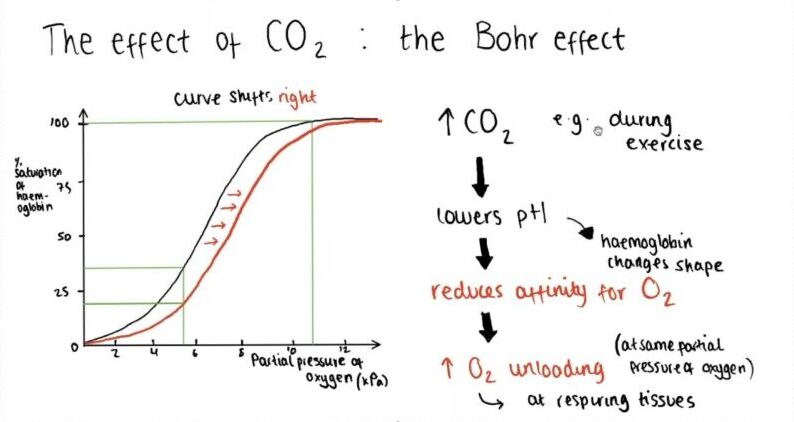
The biochemical basis for this effect lies in the structure of the hemoglobin molecule itself.
- An increase in protons (H⁺), which makes the blood more acidic, causes these protons to bind to specific amino acid residues on the hemoglobin protein.
- Additionally, some CO₂ molecules bind directly to hemoglobin, forming carbaminohemoglobin.
Both of these events induce a subtle change in hemoglobin's three-dimensional shape, stabilizing its low-affinity "Tense" or "T-state". This makes it more likely to release the oxygen molecules it is carrying.
To reinforce this concept, let's revisit a video from our last lesson. The presenter provides an excellent visualization of how this rightward shift impacts oxygen saturation at a given partial pressure.
Respiratory | Oxygen-Hemoglobin Dissociation Curve
This segment from the Ninja Nerd channel graphically demonstrates the Bohr effect by comparing the normal curve to a right-shifted curve.
Please watch the section explaining the Bohr effect. Focus on the comparison between the black (normal) and pink (right-shifted) curves. At the same tissue PO₂ of 40 mmHg, notice how the saturation on the right-shifted curve is significantly lower, representing a greater amount of oxygen unloaded to the tissues.
Quantifying the Bohr Effect in Action
During strenuous exercise, the partial pressure of CO₂ in your muscle capillaries can rise from a resting value of ~40 mmHg to 46 mmHg or even higher. This change, though seemingly small, has a significant impact on oxygen delivery.
Given your background in analyzing research, let's move beyond diagrams and examine how this effect is quantified in a laboratory setting. The following paper investigates the precise relationship between PCO₂ and the oxyhemoglobin dissociation curve.
In vitro characterization of hemoglobin oxygen dissociation curves ...
This research article from Frontiers in Medicine provides a robust, data-driven analysis of the Bohr effect in human blood.
First, review Figure 1 in the section titled "Oxygen–hemoglobin dissociation curve". The series of curves, shifting from blue (low PCO₂) to red (high PCO₂), provides a clear experimental visualization of the Bohr effect. You are seeing the direct result of systematically increasing CO₂ levels. Next, read the paragraph in the Discussion section that begins with this text. The authors use their model to perform a calculation that isolates the contribution of the Bohr effect. Their analysis concludes that the small arterio-venous increase in PCO₂ is responsible for releasing over 26 mL of O₂ per minute, accounting for about 10% of total oxygen consumption. This is a powerful quantification of the effect's physiological importance.
This research demonstrates that the Bohr effect is not a minor adjustment but a major contributor to matching oxygen supply with metabolic demand.
The Bohr Effect in Breathwork: The CO₂ "Paradox"
Now we arrive at a concept that is critical for understanding breathwork, and one that may seem counterintuitive. While we inhale to get oxygen, it is often our level of carbon dioxide that dictates how efficiently that oxygen can be used by our cells. This is what some call the "CO₂ paradox."
Many people assume that feelings of "air hunger" or the benefits of deep breathing are all about maximizing oxygen intake. However, chronically low levels of CO₂, often caused by habitual over-breathing (subtle hyperventilation), can impair oxygen delivery. By blowing off too much CO₂, you increase hemoglobin's affinity for oxygen (a leftward shift), causing it to hold on to oxygen more tightly, even as it passes through oxygen-starved tissues.
The following video from a breathing coach explains this concept from a practical perspective.
How to Naturally Increase Oxygen - 2 Breathing Exercises
This video from YOGABODY, "How to Naturally Increase Oxygen," directly addresses the common misconception about oxygen and highlights the importance of CO₂ for oxygen release.
Start by watching the explanation of the Bohr effect. The speaker clearly explains how, in the absence of sufficient CO₂, oxygen remains "trapped" by hemoglobin. Continue with the next segment from the discussion on oxygen saturation. He makes the excellent point that most healthy people already have 95-99% oxygen saturation. The problem isn't getting more oxygen into the blood; it's getting the oxygen out of the blood and into the cells, a process facilitated by CO₂.
This insight has profound implications for breathwork. Different techniques intentionally manipulate CO₂ levels to leverage the Bohr effect for different goals. A synthesis of research on various "Breath Tools" makes this connection explicit.
Breath Tools: A Synthesis of Evidence-Based Breathing Strategies ...
This review article published in Frontiers in Physiology connects physiological mechanisms like the Bohr effect directly to breathwork techniques.
First, read the paragraph discussing hyperventilation in the section "Respiration as a Limiting Factor". Focus on the sentence beginning with this passage. The authors note that inappropriate hyperventilation leads to hypocapnia (low CO₂), which can reduce peripheral muscle perfusion via the Bohr effect. This is the physiological downside of over-breathing. Now, read the paragraph on breath-holding techniques. Pay attention to the sentence here. This highlights the opposite strategy: deliberately holding the breath increases pCO₂ (hypercapnia), which in turn enhances O₂ transport to the tissues via the Bohr effect.
Techniques you will learn later in this course, such as those from the Buteyko method or freediving training, are explicitly designed to increase your tolerance to CO₂. The goal is to retrain your breathing patterns to maintain a higher baseline level of CO₂, thereby optimizing the Bohr effect for more efficient oxygen delivery throughout the day. Conversely, techniques involving controlled hyperventilation, like the Wim Hof Method, temporarily create a state of low CO₂, which has other distinct physiological effects we will explore later.
Conclusion
In this lesson, we have dissected the Bohr effect, moving from its definition to its physiological and practical implications. It is a cornerstone of respiratory science and a key lever manipulated by conscious breathing.
Here are the key takeaways:
- The Bohr effect is the decrease in hemoglobin's oxygen affinity in response to increased CO₂ and/or decreased blood pH.
- Graphically, this is represented by a rightward shift of the oxyhemoglobin dissociation curve.
- This mechanism is vital during physical exertion, as metabolic byproducts in active tissues trigger enhanced oxygen release precisely where it is needed.
- In the context of breathwork, the Bohr effect explains the "CO₂ paradox": maintaining adequate CO₂ levels is crucial for efficient oxygen delivery to cells. Techniques that increase CO₂ tolerance can enhance oxygenation, while chronic over-breathing can impair it.
We have established that CO₂ is the primary driver of the pH changes that underpin the Bohr effect. In our next lesson, we will examine the chemistry behind this relationship in detail by exploring the bicarbonate buffer system, the body's elegant solution for managing blood pH and transporting CO₂ out of the body.