Welcome to the first lesson in our module on complex breathwork systems. In our previous module, we analyzed a series of distinct pranayama techniques, culminating with Sitali and Sitkari, where we explored the difference between local sensory perception ("cooling") and systemic physiological effects. We will now shift our focus from isolated techniques to integrated practices where breath control is a central component of a broader meditative discipline.
Today, we begin this exploration with Zazen, the seated meditation at the heart of Zen Buddhism. Our objective is to learn how to perform the core physical and mental components of this practice, specifically the posture, the method of slow abdominal breathing known as tanden breathing, and the attentional technique of susokkan, or breath counting. This lesson will focus on the "what" and "how" of the practice, establishing a solid foundation for our next lesson, where we will rigorously analyze the clinical evidence for its effects.
The Foundation: Posture in Zazen
In Zazen, physical posture is not merely a preliminary step but an integral part of the meditation itself. A stable, aligned body is considered the container for a stable, focused mind. The aim is to create a physical structure that is both solid and relaxed, allowing for effortless breathing and prolonged stillness.
The ideal posture establishes a stable three-point base formed by your two knees and your posterior. This is typically achieved by sitting cross-legged on a firm cushion, or zafu, which elevates the hips and allows the knees to rest on the floor.

To understand the key elements of the posture, the following video provides a clear and detailed demonstration.
THE ZEN MEDITATION | How to Do Zazen Complete Guide
This video from the SOKO Zen Monk Q&A channel offers a complete guide to the physical setup for Zazen meditation.
Please watch the first section of the video, from the beginning to the posture instructions. Pay close attention to the following key points: Legs and Base: The different cross-legged options (Burmese, half-lotus, full-lotus) and the importance of the cushion for creating a stable three-point base. Note the alternative of sitting in a chair, which is also shown in the image above. Spine and Torso: The instruction to "push out our posterior" and "straighten our spine" creates a slight anterior pelvic tilt. This helps maintain the natural lumbar curve and allows the spine to stack vertically with minimal muscular effort. Hands: The formation of the cosmic mudra, with the left hand resting on the right, palms up, and the thumbs lightly touching. Head and Eyes: The head is balanced, the chin is slightly tucked, and the eyes remain partially open with a soft, downward gaze. This is a distinguishing feature of Zazen, intended to keep the practitioner present and aware, rather than retreating into an internal world.
The combination of these elements creates a posture that is balanced and self-supporting, minimizing the need for muscular tension and freeing up the body's resources for the work of breathing and attention.
The Engine: Slow Abdominal (Tanden) Breathing
With the physical structure established, the focus shifts to the breath. The style of breathing central to many Zen traditions is Tanden breathing. The tanden is a concept from East Asian medicine and martial arts, referring to a point in the lower abdomen, roughly two inches below the navel, considered a center of vital energy, or ki.
From a physiological perspective, tanden breathing is synonymous with deep, slow diaphragmatic breathing. Let's explore this concept further through the research literature.
History and Recent Advances of the Japanese Society of ... - PMC
This article from the journal Biofeedback provides excellent historical and physiological context for Tanden breathing.
Please read the section titled "Tanden Breathing (Abdominal Slow-paced Breathing)", from this definition to the end of the paragraph. This will introduce you to the historical significance of the concept, including its popularization by the Zen Master Hakuin Ekaku.
As the text explains, the practice involves drawing your energy and attention down into this lower abdominal region. Mechanically, this is accomplished by emphasizing the movement of the diaphragm.
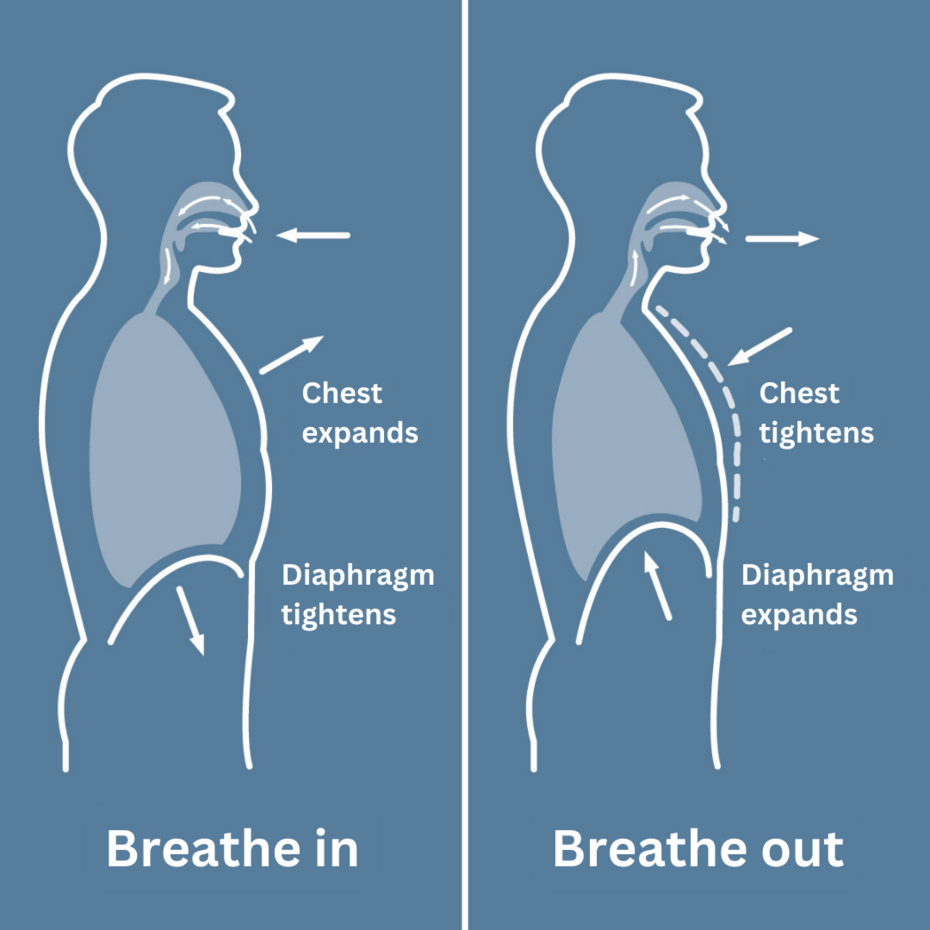
To perform tanden breathing:
- Assume your stable Zazen posture. The upright spine is crucial as it gives the diaphragm maximum room to move.
- Breathe in and out through your nose.
- As you inhale, allow the lower abdomen to expand gently, as if you are filling a balloon located at your tanden.
- As you exhale, allow the abdomen to fall back naturally toward the spine. The chest and shoulders should remain relatively still.
This form of breathing is highly efficient. In experienced Zen practitioners, it has been observed to produce remarkably slow respiration rates, sometimes as low as 2-4 breaths per minute. This slow, deep pattern has a profound effect on the autonomic nervous system, which we will analyze in detail in our next lesson.
The Anchor: Susokkan (Breath Counting)
Having established the posture and the breathing method, the final component is the training of attention. The mind will inevitably wander. In Zazen, the primary technique for anchoring the attention is susokkan, or breath counting. It is a simple, non-judgmental method for continually returning the focus to the present moment.
The study of susoku (an alternate term for the same practice) in novices has shown it can induce changes in brain activity associated with relaxation.
[PDF] Zen and Behavioral Health: A Review of the Evidence
This review article by Kushner discusses the scientific literature on Zazen. It provides a useful link between the practice of breath counting and its observed physiological correlates.
Please read the paragraph in the "Relaxation, Stress Reduction, and Anxiety" section that begins with "Subsequent studies...". Note the mention of Takahashi et al. (2005), who trained novices in susoku and found associated changes in brainwave activity.
The practical instructions for susokkan are straightforward. The video you watched earlier provides an excellent guide.
THE ZEN MEDITATION | How to Do Zazen Complete Guide
Let's return to the video from the SOKO Zen Monk for the practical instructions on breath counting.
Watch the section on breathing, from the instructions. The monk explains the process clearly: Keep the mouth closed, tongue resting on the roof of the mouth. As you exhale, silently count "one." On the next exhalation, count "two." Continue this process up to ten. If you find your mind has wandered and you've lost track of the count, or when you reach ten, simply and gently return your count to one.
The goal is not to achieve a perfect count to ten. The practice is the act of noticing that you are thinking and gently, without self-criticism, returning your attention to the anchor of the breath and the count. Each time you return from a thought, you are successfully practicing susokkan.
Conclusion
Today we have assembled the three core components of Zazen meditation. This practice is not a collection of separate parts but an integrated whole, where a stable posture enables deep abdominal breathing, and the breath itself becomes the anchor for focused attention.
Key Takeaways:
- Posture: The foundation of Zazen is a stable, upright posture (often on a cushion) that creates a three-point base, aligns the spine, and allows for free movement of the diaphragm.
- Tanden Breathing: This is slow, deep abdominal breathing focused on the tanden (lower abdomen). It is physiologically synonymous with efficient diaphragmatic breathing and can lead to very slow respiratory rates.
- Susokkan: This is the practice of counting exhalations from one to ten as an anchor for attention. The essential skill is not in reaching ten, but in gently returning to the count each time the mind wanders.
For your "cheat sheet," you can add this under a "Meditative/Calming" category.
- Technique: Zazen
- Components: Stable seated posture (e.g., on a zafu), tanden (slow abdominal) breathing, susokkan (counting exhalations 1-10).
- Primary Mechanism: Trains attention while using slow-paced breathing (~2-6 breaths per minute in advanced practitioners) to promote a state of low physiological arousal and high parasympathetic tone.
Now that we have established the practical "how-to" of Zazen, our next lesson will be dedicated to a rigorous analysis of the clinical research. We will act as peer reviewers, examining the study designs, statistical methodologies, and effect sizes reported in key papers to evaluate the scientific evidence for Zazen's impact on heart rate variability, brain activity, and psychological well-being.