In our last lesson, we distinguished between the "fight or flight" sympathetic system and the "rest and digest" parasympathetic system, establishing them as the two primary branches of your autonomic nervous system (ANS). We highlighted the vagus nerve as the main pathway for parasympathetic signals. This sets the stage for a crucial question for anyone interested in breathwork: How do we actually measure "rest and digest" activity?
This lesson provides the answer. We will introduce the concept of vagal tone and explore its most common and practical measurement: Heart Rate Variability (HRV). Your learning outcome for this lesson is to explain vagal tone and its measurement via heart rate variability (HRV). Understanding HRV is foundational, as it provides a quantitative window into your physiological state, allowing you to objectively track the impact of different breathing techniques.
Vagal Tone: The Body's Parasympathetic Brake
In the previous lesson, we saw that the parasympathetic nervous system (PNS) generally acts to slow things down and conserve energy. "Vagal tone" is a term used to describe the level of activity of the vagus nerve, which represents the primary output of the PNS.
A useful way to conceptualize this is to think of the heart's own internal pacemaker (the sinoatrial node), which, if left to its own devices, would beat at a rate of around 100 times per minute. Vagal tone is the constant, braking influence that the vagus nerve exerts on this pacemaker, slowing the heart rate down to a typical resting level (e.g., 60-70 bpm).
A higher vagal tone at rest means the vagus nerve has a stronger influence, indicating a dominant parasympathetic state. This is not simply about a slower heart rate; it's about a more agile and responsive system. The video from Dr. Matt & Dr. Mike you saw previously has an excellent segment that explains precisely why this vagal influence creates variability.
Heart Rate Variability (HRV) and Health
In this clip from "Heart Rate Variability (HRV) and Health," the presenters provide a brilliant mechanistic explanation for how the vagus nerve's activity generates variability.
Please watch the segment from this explanation. The key insight is the contrast between the parasympathetic system's ability to precisely "tweak" the heart rate on a beat-by-beat basis, versus the sympathetic system's more "all or nothing" global activation. This "tweaking" is the very origin of high heart rate variability in a relaxed state.
Heart Rate Variability (HRV): The Proxy for Vagal Tone
Since we cannot easily measure the electrical activity of the vagus nerve directly, we rely on a proxy. That proxy is Heart Rate Variability (HRV).
It is crucial to distinguish HRV from heart rate.
- Heart Rate is the number of times your heart beats per minute (bpm).
- Heart Rate Variability (HRV) is the measurement of the variation in time between each of those consecutive heartbeats. These time intervals are known as interbeat intervals (IBIs) or R-R intervals (named after the R-wave peak in an ECG signal).
A healthy heart operating under high vagal tone is not a metronome ticking at a perfectly steady pace. Instead, it subtly speeds up and slows down with each breath and in response to other inputs. Higher variability at rest is therefore generally associated with better health, resilience, and a well-regulated autonomic nervous system.
The following video provides a concise and clear introduction to this concept.
The Science of Heart Rate Variability (HRV): Health, Wellness & Performance
This segment from "The Science of Heart Rate Variability (HRV)" by Dr Cailbhe Doherty defines HRV and distinguishes it from heart rate.
Watch from the beginning to the introduction. Note the core idea: HRV is a practical, non-invasive way to measure the activity of the autonomic nervous system.
Quantifying Vagal Tone: A Guide to HRV Metrics
This is where your background in statistics becomes invaluable. HRV is not a single number but a collection of different metrics derived from the series of R-R intervals. These metrics can be grouped into three main categories: time-domain, frequency-domain, and non-linear. For the purpose of assessing vagal tone, a few specific metrics are of primary interest.
The research paper "Heart Rate Variability and Cardiac Vagal Tone" by Laborde et al. provides an excellent, methodologically rigorous overview. We will use it as a reference throughout this course.
Heart Rate Variability and Cardiac Vagal Tone in ... - PMC - NIH
This paper details the various HRV parameters and provides recommendations for their use in research, with a specific focus on assessing vagal tone.
First, read the section HRV Variables to Assess. Pay close attention to Table 1, which maps different HRV variables to their physiological origins. Identify which variables are listed as reflecting vagal tone. Next, jump to the section HRV Variables to Analyze. This section reinforces which metrics are most relevant for psychophysiological research based on current theories.
As you will have noted from the paper, the key metrics that serve as indices of vagal tone are:
- RMSSD (Root Mean Square of Successive Differences) - a time-domain measure.
- pNN50 (Percentage of successive intervals that differ by more than 50ms) - another time-domain measure, highly correlated with RMSSD.
- HF Power (High-Frequency Power) - a frequency-domain measure.
Let's dissect the time-domain metrics, as they are the most common in consumer wearables and clinical practice.
A Deeper Dive: Time-Domain Metrics
The Doherty video provides an excellent statistical comparison of the most common time-domain measures: SDNN, RMSSD, and pNN50.
The Science of Heart Rate Variability (HRV): Health, Wellness & Performance
This part of the video explains the mathematical and practical differences between the key time-domain metrics.
Watch the segment on time-domain analysis. Focus on why RMSSD is often preferred by researchers over SDNN (it better captures short-term, beat-to-beat changes reflecting parasympathetic activity) and pNN50 (it avoids an arbitrary 50ms threshold). Also, note the important distinction between raw R-R intervals and cleaned Normal-to-Normal (NN) intervals, which are used to remove artifacts before calculation.
The Statistician's Corner: Calculating RMSSD
Given your expertise, you'll appreciate seeing the calculation firsthand. RMSSD quantifies beat-to-beat variance. It is calculated by:
- Measuring the time difference between each successive pair of heartbeats.
- Squaring each of these differences.
- Averaging the squared differences.
- Taking the square root of that average.
The formula is:
where is the time of the i-th R-wave peak and N is the number of beats.
The following infographic illustrates this process visually.
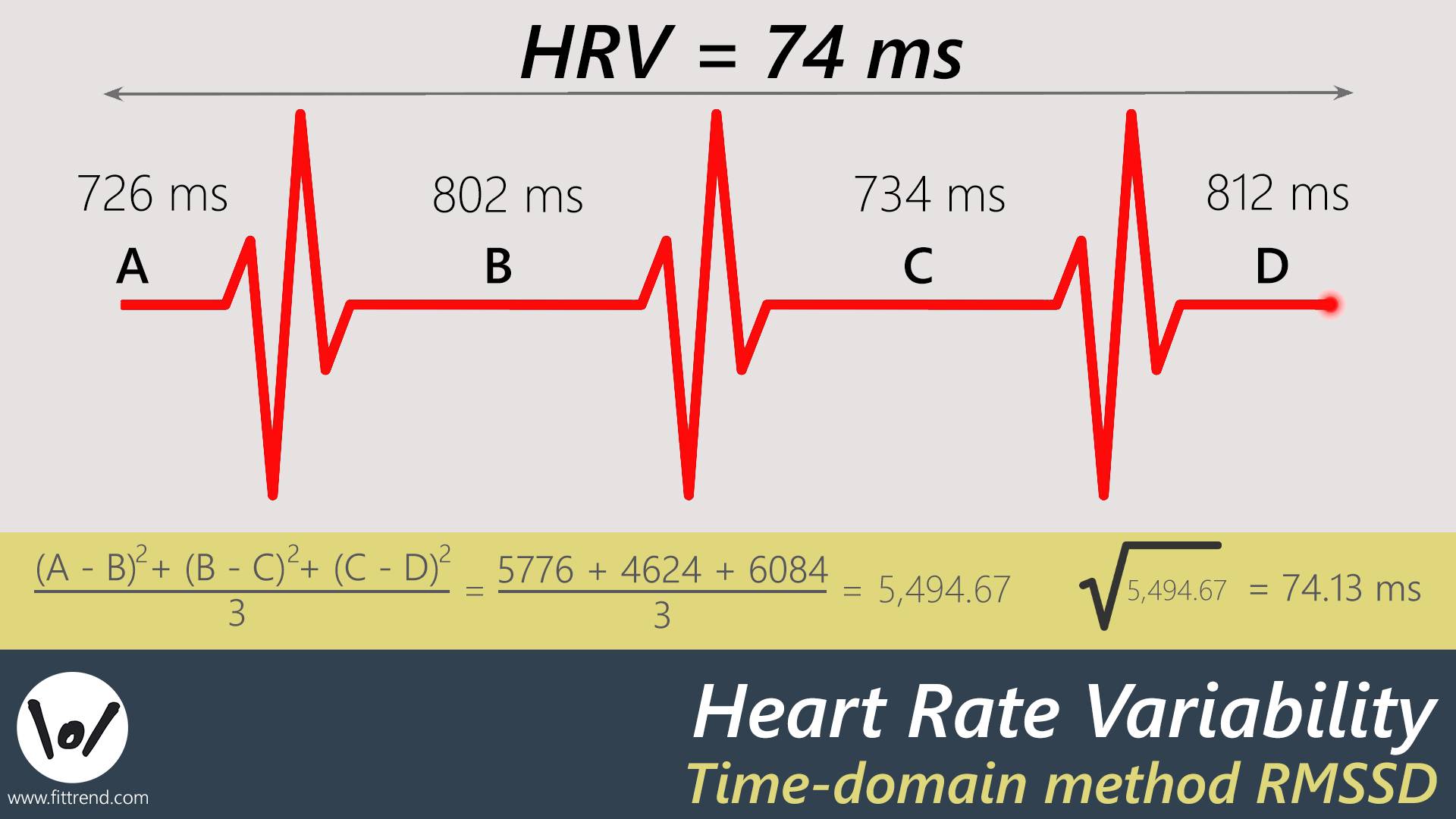
To see this calculation performed with concrete numbers, let's return to Dr. Matt & Dr. Mike.
Heart Rate Variability (HRV) and Health
This segment provides a clear, step-by-step numerical demonstration of how to calculate RMSSD from a series of R-R intervals.
Watch the walkthrough from the calculation example. This will solidify your understanding of how a single HRV number is derived from the raw time-series data.
Correlations and Critical Nuances
As a statistician, you'd expect these different measures of vagal activity to be highly correlated, and they are. The following correlation matrix shows the relationships between several common HRV metrics.
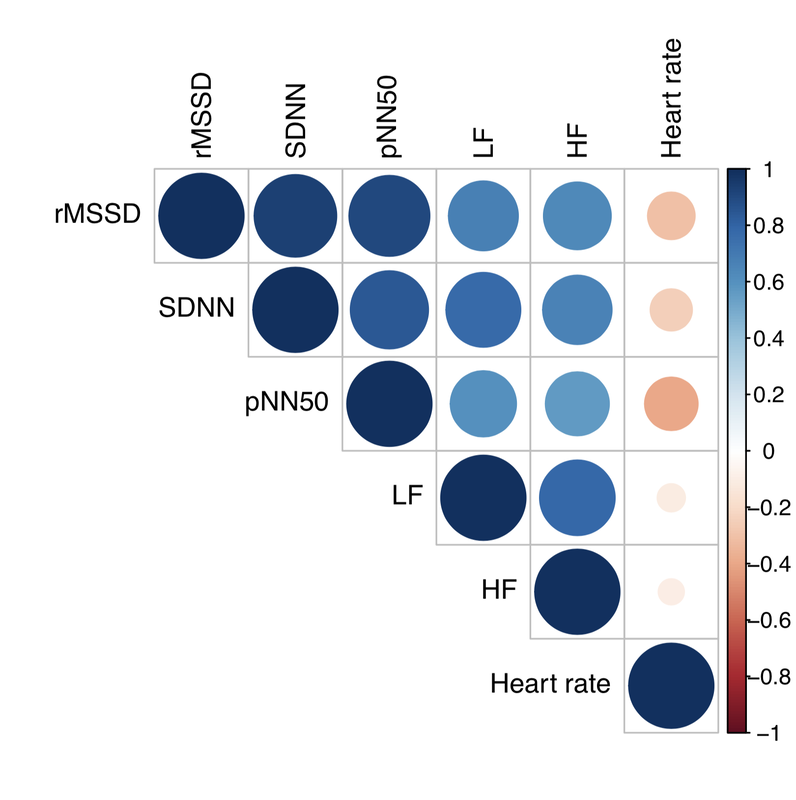
However, it is crucial to maintain a methodologically rigorous perspective. While we use HRV as a proxy for vagal tone, the two are not identical. The relationship can be influenced by confounding variables, most notably respiration. The paper "An Overview of Heart Rate Variability Metrics and Norms" by Shaffer & Ginsberg provides a critical discussion on this point.
An Overview of Heart Rate Variability Metrics and Norms - PMC
This review article provides a concise but deep look at HRV metrics, including a crucial section on the distinction between HRV measures and true vagal tone.
Please read the sections HF Band and, most importantly, HF Power and RSA do not Represent Vagal Tone. The key takeaway is that changes in breathing rate can significantly alter HRV metrics (like HF power and RMSSD) without necessarily changing the underlying mean vagal tone.
This is a vital point: HRV indexes vagal modulation of the heart, which is closely tied to breathing. A change in HRV doesn't always mean a change in baseline vagal tone. This is not a flaw in the measurement but rather the key to its utility for us: it shows that HRV is exquisitely sensitive to changes in breathing patterns.
Conclusion
You have now moved from the general concept of the parasympathetic nervous system to a specific, quantifiable metric that reflects its activity. This bridge between abstract physiology and concrete data is the cornerstone of a scientific approach to breathwork.
Key Takeaways:
- Vagal tone refers to the activity of the vagus nerve, which acts as the primary "brake" of the parasympathetic system on the heart's intrinsic rhythm.
- Heart Rate Variability (HRV) is the fluctuation in time intervals between adjacent heartbeats and serves as our best practical proxy for measuring vagal tone.
- At rest, higher HRV generally indicates greater parasympathetic dominance, reflecting a more resilient and adaptable autonomic nervous system.
- Key metrics for assessing vagal tone include the time-domain measure RMSSD and the frequency-domain measure HF power.
- RMSSD is a robust and widely used metric that captures the high-frequency, beat-to-beat changes in heart rhythm driven by the vagus nerve.
- The relationship between HRV and vagal tone is complex; HRV measures vagal modulation, which is heavily influenced by factors like respiration.
This last point provides a perfect segue to our next lesson. We will explore the direct link between breathing and HRV by examining a phenomenon called Respiratory Sinus Arrhythmia (RSA)—the physiological process responsible for generating the high-frequency component of your HRV. This will be our first deep dive into exactly how the simple act of breathing can immediately change your autonomic state.