Welcome to the next step in our journey into the science of breath. In our previous lesson, we completed the automatic respiratory control circuit by examining the central and peripheral chemoreceptors. We saw how these sophisticated sensors provide constant feedback to your brainstem about the chemical state of your body, primarily driven by CO₂, but with a critical override for low oxygen.
Now, we will explore the system that acts on this sensory information to produce widespread physiological changes. This lesson introduces the autonomic nervous system (ANS), the master regulator of your internal state. Your learning outcome is to distinguish between the sympathetic and parasympathetic branches of the autonomic nervous system and their physiological effects. This framework is the absolute foundation for understanding how breathwork techniques can shift you from a state of high alert to deep calm, and vice versa.
The Body's Automatic Pilot: The Autonomic Nervous System
The Autonomic Nervous System (ANS) is the division of your nervous system that controls all the functions you don't have to think about: your heartbeat, digestion, blood pressure, pupil dilation, and more. It operates automatically to maintain a stable internal environment, a state known as homeostasis. The ANS is broadly divided into two main branches that often, but not always, have opposing effects.
To begin, let's get a clear, high-level overview of these two branches. The following video from Dr. Matt & Dr. Mike provides an excellent introduction.
Autonomic Nervous System (Sympathetic & Parasympathetic) - Overview
This video, "Autonomic Nervous System (Sympathetic & Parasympathetic) - Overview," gives a concise breakdown of the ANS and its two primary divisions.
Please watch the segment from the introduction. Focus on how the ANS is categorized into the sympathetic ("fight or flight") and parasympathetic ("rest and digest") systems based on the body's needs during stress versus relaxation.
As the video explains, these two systems prepare the body for different, often opposite, situations. The sympathetic system mobilizes the body's resources for strenuous activity, while the parasympathetic system is dominant during periods of rest and recovery.
Fight or Flight vs. Rest and Digest: A Tale of Two Systems
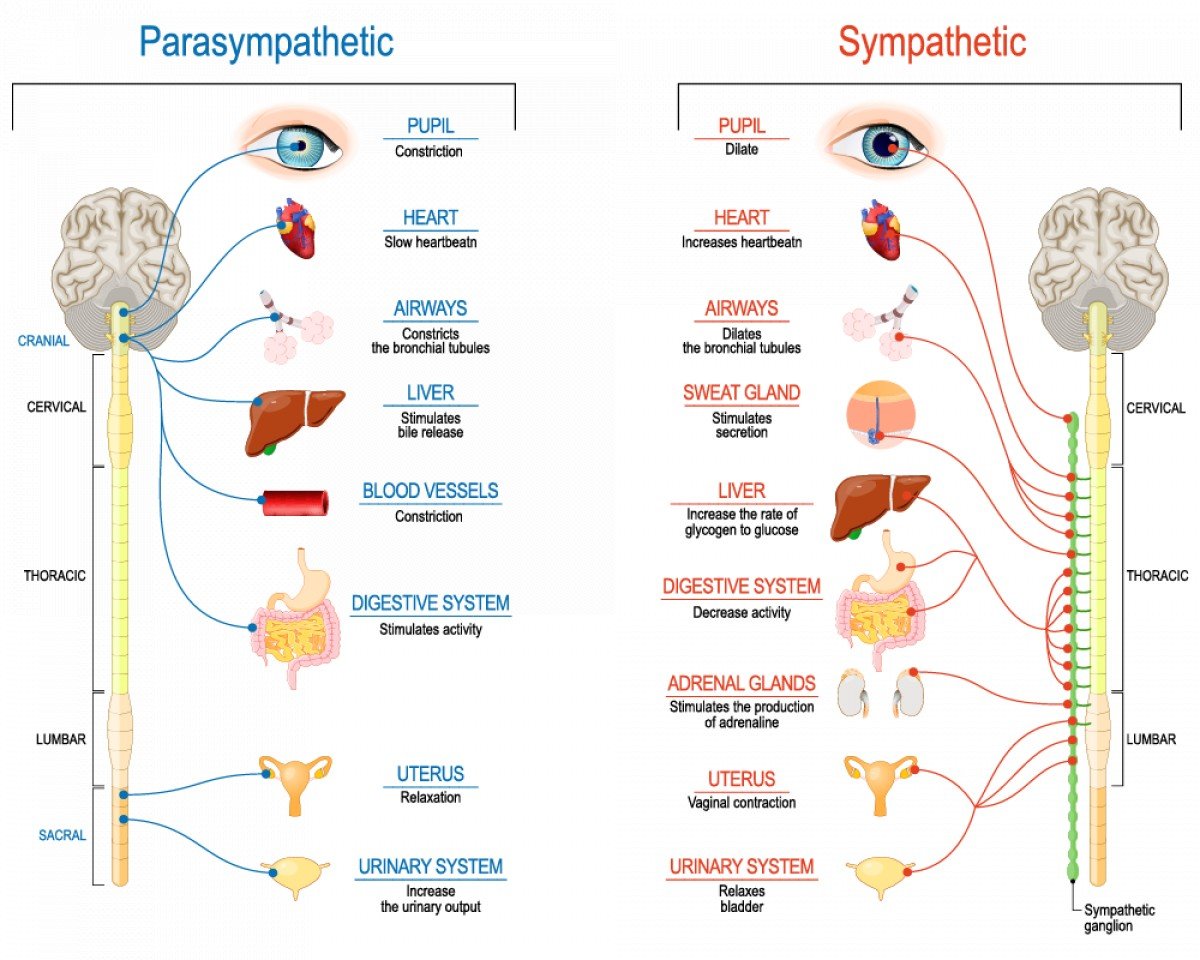
The nicknames "fight or flight" and "rest and digest" are useful heuristics for remembering the general functions of the two branches. Let's examine their specific physiological effects on key organs.
1. The Sympathetic Nervous System (SNS): The Mobilizer
When the SNS is activated, it prepares your body for immediate, intense physical action. Think of it as flooring the accelerator. It orchestrates a whole-body response to increase the delivery of oxygenated, nutrient-rich blood to the muscles and brain.
2. The Parasympathetic Nervous System (PNS): The Restorer
When the PNS is dominant, it shifts the body's focus toward housekeeping functions. It conserves energy and manages processes related to digestion, recovery, and repair. Think of this as the body's cruise control and recharging station.
The images below provide a clear visual map of these opposing effects.

To deepen your understanding of these specific effects, let's return to the Dr. Matt & Dr. Mike video, which walks through these changes organ by organ.
Autonomic Nervous System (Sympathetic & Parasympathetic) - Overview
This next portion of the video details the specific organ-level responses for each branch of the ANS.
First, watch the section on the sympathetic response. Pay attention to the physiological rationale for each change (e.g., why pupils dilate, why blood is shunted from the skin). Next, watch the corresponding section on the parasympathetic response. Note how these effects are generally the inverse of the sympathetic actions.
The Wiring and Chemistry of the ANS
To truly distinguish these two systems, we need to go beyond their effects and look at their underlying anatomy and neurochemistry. Both systems use a two-neuron chain to connect the central nervous system (CNS) to the target organ. This chain consists of:
- Preganglionic neuron: Its cell body is in the CNS (brainstem or spinal cord).
- Postganglionic neuron: It synapses with the preganglionic neuron in a cluster called a ganglion and then extends to the target organ.
The key distinctions lie in the location of their origins, the length of the neurons, and the neurotransmitters they use.
| Feature | Sympathetic Nervous System (SNS) | Parasympathetic Nervous System (PNS) |
|---|---|---|
| Origin | Thoracolumbar (Thoracic & Lumbar spine) | Craniosacral (Brainstem & Sacral spine) |
| Preganglionic Neuron | Short | Long |
| Postganglionic Neuron | Long | Short |
| Ganglia Location | Close to the spinal cord | Close to or within the target organ |
| Neurotransmitter (Postganglionic) | Norepinephrine (Adrenergic) | Acetylcholine (Cholinergic) |
| Effect | Diffuse, whole-body activation | Discrete, localized activation |
The primary pathway for the parasympathetic system is the vagus nerve (cranial nerve X), which originates in the brainstem and wanders through the body, innervating most of your thoracic and abdominal organs. You may have heard of the vagus nerve in the context of relaxation, and for good reason—it is the main actor in the "rest and digest" response.
Dr. Andrew Huberman provides a concise definition of the two systems and introduces the vagus nerve's role.
Control Your Vagus Nerve to Improve Mood, Alertness & Neuroplasticity
In this clip from a podcast on the vagus nerve, Dr. Huberman defines the ANS branches and positions the vagus nerve within this context.
Watch the segment from this timestamp. Note how he classifies the vagus nerve as parasympathetic but immediately adds a crucial caveat: its functions are more complex than simple calming, a point we will return to.
For a detailed walkthrough of the anatomical and neurochemical differences, the Dr. Matt & Dr. Mike video is once again an invaluable resource. Given your interest in mechanistic detail, this segment will be particularly useful.
Autonomic Nervous System (Sympathetic & Parasympathetic) - Overview
This comprehensive section explains the two-neuron chain, the craniosacral vs. thoracolumbar origins, and the specific neurotransmitters (acetylcholine, norepinephrine) and receptors (nicotinic, muscarinic, adrenergic) for both systems.
Please watch from this segment. This is a dense but crucial part of the lesson. Focus on: The anatomical layout (thoracolumbar vs. craniosacral). The difference in neurotransmitters at the target organ (norepinephrine for sympathetic, acetylcholine for parasympathetic). The role of the adrenal gland in releasing adrenaline for a systemic sympathetic response.
Beyond the Seesaw: The Autonomic Space Model
The simple "push-pull" or "seesaw" model of the SNS and PNS is a useful starting point, but the biological reality is more nuanced. The two systems are not always strictly reciprocal. They can be activated or inhibited independently, and in some cases, they can even be co-activated.
Your background in statistical modeling will make you appreciate this more complex, two-dimensional view known as the Autonomic Space Model. This model posits that the state of the ANS can be represented as a point in a 2D plane, with SNS activity on one axis and PNS activity on the other. This allows for four general states:
- Reciprocal SNS activation: High SNS, low PNS (classic fight or flight).
- Reciprocal PNS activation: Low SNS, high PNS (classic rest and digest).
- Co-activation: High SNS and high PNS.
- Co-inhibition: Low SNS and low PNS.
This flexibility allows for finer control over physiology. For instance, a state of attentive stillness might involve co-activation to keep the heart rate stable while priming the body for action.
This concept is explored in a research paper that analyzed SNS and PNS activity during a stress task. Given your expertise with clinical literature, you can go straight to the source.
Correlation of sympathetic and parasympathetic nervous ...
This research article models the concurrent relationship between the SNS and PNS during rest and a stress task.
Please read the Abstract and the Conclusion to get the main findings. Then, for the theoretical underpinning, read the introduction to the Autonomic Space Model. The key takeaway is that while the systems are often reciprocal, co-activation was observed during recovery from stress, demonstrating that the simple seesaw model is incomplete.
This nuanced understanding is critical for breathwork. While many techniques aim for simple reciprocal activation (e.g., slowing breath to increase PNS activity), others, especially more advanced or intense practices, may induce states of co-activation to achieve unique physiological and psychological outcomes. The activating potential of the vagus nerve, which Dr. Huberman hinted at, is a prime example of this complexity, which we will dissect in future lessons.
Conclusion
You have now established a clear framework for the two major branches of the autonomic nervous system. This is the control panel that breathwork directly manipulates.
Key Takeaways:
- The Autonomic Nervous System (ANS) regulates involuntary bodily functions and is split into two main branches: the Sympathetic (SNS) and Parasympathetic (PNS).
- The Sympathetic ("fight or flight") system originates in the thoracolumbar spine, uses norepinephrine, and orchestrates a diffuse, whole-body response to prepare for intense activity.
- The Parasympathetic ("rest and digest") system originates in the brainstem and sacral spine, uses acetylcholine, and produces more localized effects to promote recovery and conservation of energy. The vagus nerve is its primary pathway.
- The traditional model of a simple "seesaw" is an oversimplification. The SNS and PNS can be co-activated or co-inhibited, allowing for more complex physiological states, as described by the Autonomic Space Model.
In our next lesson, we will zoom in on the parasympathetic branch and its star player. We'll answer the question: how do we measure "rest and digest" activity? This will lead us to the concepts of vagal tone and its most common proxy, Heart Rate Variability (HRV), a metric that will become central to quantifying the effects of your future breathwork protocols.