In our previous lesson, we analyzed the 4-7-8 breathing technique, noting how its structured, extended "whooshing" exhale promotes a profound parasympathetic shift. That audible exhalation creates a subtle form of back-pressure in the airways. Today, we will explore the formal, clinical application of this principle with pursed-lip breathing (PLB).
This lesson will deconstruct PLB, a cornerstone of pulmonary rehabilitation. We will begin by examining the physiological mechanism—specifically, how it mechanically assists breathing. Then, you will learn the formal technique. Finally, true to your goal of understanding the science, we will perform a deep dive into a clinical trial to analyze the quantitative evidence for its effects on physiological parameters, particularly in managing dyspnea (shortness of breath).
The Mechanism of Pursed-Lip Breathing
Pursed-lip breathing is a technique designed to make your breaths more effective by slowing your breathing down and keeping airways open longer. The core principle is the creation of Positive End-Expiratory Pressure (PEEP).
To understand this, let's turn to a clear overview from StatPearls, a comprehensive medical reference.
Pursed-lip Breathing - StatPearls - NCBI Bookshelf - NIH
This resource provides a concise explanation of the physiological underpinnings of PLB.
Read the section under Definition/Introduction. Focus on the description of how PLB is performed (the technique) and the explanation of how it generates PEEP to prevent airway collapse (the PEEP mechanism).
As you've just read, exhaling against the resistance of pursed lips creates back-pressure that propagates from the mouth down into the smaller, non-cartilaginous airways (the bronchioles). In conditions like Chronic Obstructive Pulmonary Disease (COPD), these small airways are prone to collapsing during exhalation, which traps stale, CO2-rich air in the lungs. This trapped air prevents fresh, oxygenated air from entering on the next inhalation, leading to shortness of breath.
The PEEP generated by PLB acts as a pneumatic "splint," holding these floppy airways open during the entire exhalation phase. This has two critical benefits:
- Reduces Air Trapping: It allows for a more complete and efficient expulsion of carbon dioxide.
- Decreases the Work of Breathing: By preventing airway collapse, the body doesn't have to work as hard to force air out, which reduces respiratory muscle fatigue.
How to Perform Pursed-Lip Breathing
The technique itself is simple, but precision is key to its effectiveness. The goal is to establish a calm rhythm where the exhalation is significantly longer than the inhalation.
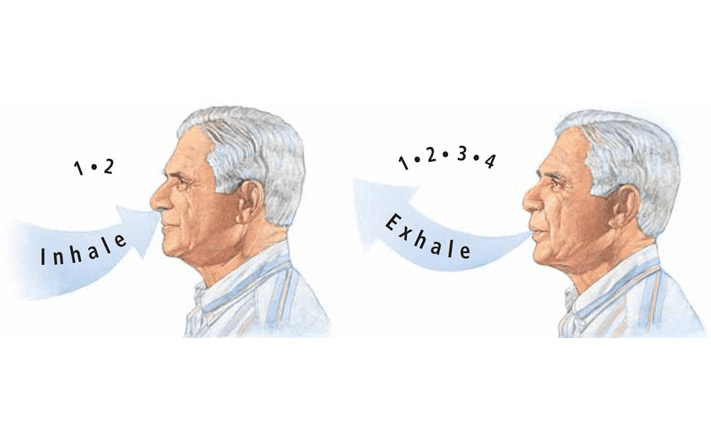
Here are the steps, based on the protocol used in clinical research:
- Sit or stand comfortably, relaxing your neck and shoulder muscles.
- Inhale slowly through your nose for a count of two seconds.
- Pucker or "purse" your lips as if you were about to whistle or gently blow out a candle.
- Exhale all the air from your lungs slowly and steadily through your pursed lips for a count of four to five seconds. The exhalation should be at least twice as long as the inhalation.
- Repeat the cycle.
Unlike the 4-7-8 breath, PLB is less about a rigid count and more about mastering the 1:2 (or greater) inhale-to-exhale ratio. It is often used "as needed" to control episodes of breathlessness, such as when climbing stairs or during other forms of exertion.
Analyzing the Clinical Evidence
Now, let's examine the data. Your background in statistics and clinical trials will be valuable as we dissect a study designed to measure the impact of PLB. We will focus on a 2018 study by Sakhaei et al. that investigated the effects of PLB on cardiac, respiratory, and oxygenation parameters in patients with COPD.
To start, let's visualize the structure of such a study. Below is a CONSORT (Consolidated Standards of Reporting Trials) flow diagram from a similar study. It illustrates the typical randomized controlled trial (RCT) design used to evaluate interventions like PLB, showing how participants are allocated to an experimental group (receiving PLB) or a control group.

Now, let's analyze the Sakhaei et al. paper.
The Impact of Pursed-lips Breathing Maneuver on Cardiac ... - PMC
This study provides the quantitative data we need to evaluate the physiological effects of PLB. We will walk through it as if we were peer-reviewing its findings.
First, read the Abstract (abstract here) for a high-level summary of the aim, methods, and results. Next, review the Introduction (the introduction) to grasp the clinical context of COPD and the existing uncertainty about PLB's efficacy that motivated the research. In the Material and Methods section, pay close attention to the precise instructions given to the participants for performing PLB (the technique). This is the exact intervention being tested. Now for the core data in the Results section. Focus your analysis on two key tables: Table 3: Examine the data for "Intervention (COPD)" and "Control (COPD)" across the three time points (Pre, Inter, Post). Note the changes in SPO2% (peripheral oxygen saturation) and RR min (respiratory rate). You can see the intervention group shows a more marked improvement in SPO2 and a decrease in RR compared to the control group. Table 4: This table isolates the COPD intervention group and uses a repeated measures test to assess within-group changes. This is where you can see the statistical significance of the intervention. Note the mean values for SPO2% increasing from 92.10 (Pre) to 94.15 (Inter), a change that is statistically significant (F(2) 4.47, P = 0.018). Also, observe the RR min decreasing from 20.15 to 19.50, which is also significant (P = 0.049). Finally, read the Discussion (the discussion). The authors interpret these findings, linking PLB directly to improved oxygenation, decreased respiratory rate, and a potential reduction in heart rate due to parasympathetic stimulation.
The analysis of this study provides clear, quantitative support for the benefits of PLB. For the intervention group with COPD, performing PLB led to a statistically significant:
- Increase in blood oxygen saturation (SPO2) by an average of 2.05 percentage points.
- Decrease in respiratory rate (RR) by an average of 0.65 breaths per minute.
These findings are not just statistically significant; they are clinically meaningful. An increase in SPO2 can alleviate symptoms of hypoxia, while a lower respiratory rate indicates a more efficient and less strained breathing pattern.
Synthesis and Place in Your Toolkit
While PLB is a cornerstone of clinical respiratory therapy, its principles are universally applicable for managing breath control.
- Classification: An asymmetrical, exhale-focused technique for improving respiratory efficiency and promoting calm.
- Primary Use Case:
- Clinical: Management of acute dyspnea in obstructive lung diseases (COPD, asthma).
- General Wellness: An excellent "spot treatment" to regain control of your breathing during physical exertion (e.g., walking uphill, climbing stairs) or to calm the feeling of being "winded" after exercise.
- Limitations: As noted in the StatPearls resource, the effectiveness of PLB can vary. It requires proper technique, can lead to muscle fatigue if overused, and may not be beneficial in restrictive lung diseases (like interstitial lung disease), where the problem is lung stiffness rather than airway collapse.
This technique is a powerful demonstration of how a simple mechanical adjustment—altering expiratory resistance—can produce immediate and measurable physiological benefits.
Conclusion
In this lesson, we have formally defined pursed-lip breathing and deconstructed its primary mechanism: the creation of Positive End-Expiratory Pressure to splint airways and improve gas exchange. Through a critical analysis of a clinical trial, we have validated its efficacy, observing statistically significant improvements in blood oxygenation and reductions in respiratory rate.
Key Takeaways:
- PLB works by creating PEEP, which prevents airway collapse, reduces air trapping, and decreases the work of breathing.
- The technique involves inhaling through the nose and exhaling slowly through pursed lips, with an exhale at least twice as long as the inhale.
- Clinical evidence robustly supports PLB as an effective, non-pharmacological method for improving oxygenation and reducing respiratory rate in patients with obstructive lung disease.
- It serves as a powerful on-demand tool for managing shortness of breath, both in clinical and general wellness contexts.
This lesson concludes our exploration of modern techniques for autonomic regulation. We have covered methods ranging from the rhythmic coherence of RF breathing to the acute interventions of the physiological sigh and the structured calm of 4-7-8 and PLB.
In our next module, we will dramatically shift gears to explore High-Intensity & Cathartic Breathwork. We will begin by dissecting the components of the Wim Hof Method, moving from the realm of gentle regulation to deliberate, intense physiological stimulation.