Welcome to the next lesson in our module on modern autonomic regulation techniques. In our last session, we established the strong physiological rationale for using extended exhalation to engage the parasympathetic nervous system, noting that its primary power lies in acute state regulation. We also saw that while the chronic benefits over symmetrical breathing were less clear in the specific trial we analyzed, the principle of elongating the exhale remains a fundamental tool.
Today, we will investigate a unique and particularly potent application of this principle: the physiological sigh, often practiced as cyclic sighing. You specifically mentioned an interest in the Stanford research on this topic, and this lesson is designed to give you a comprehensive analysis of both the technique and the evidence that supports it. We will deconstruct its mechanics and then, leveraging your expertise in statistics, perform a deep dive into the primary clinical trial that brought this technique to the forefront.
The Anatomy of a Sigh
The physiological sigh is not a modern invention but an innate biological reflex. You can observe it in sleeping infants and even in your own involuntary breathing patterns during moments of relief or prior to sleep. It consists of two distinct phases:
- A double inhalation through the nose: a full, primary inhale followed immediately by a shorter, secondary "top-up" inhale.
- A prolonged, relaxed exhalation, typically through the mouth.
When performed as a single event for immediate stress relief, it's called a physiological sigh. When repeated continuously for a period, typically five minutes, it's referred to as cyclic sighing. The 2023 Stanford study we will examine focused on the effects of this latter, sustained practice.
The core distinction is the use case:
- Physiological Sigh (1-3 repetitions): An acute intervention to rapidly quell a spike in stress or anxiety.
- Cyclic Sighing (e.g., 5 minutes): A daily practice intended to improve baseline mood and resilience to stress.
The Technique: How to Perform Cyclic Sighing
Before we analyze the data, it's important to understand the protocol the study participants followed. The technique is notable for its simplicity and lack of complex counting.
Physiological Sigh Breathing — Calm Down in 30 Seconds
This resource provides a clear, structured walkthrough of the technique. We will use this as our practical guide.
Please review the step-by-step section on how to practice. As you read, try performing 2-3 cycles yourself. Pay close attention to the sensation of the "top-up" inhale and the unforced nature of the long exhale.
The key elements are the sharp second inhale that feels like it's stretching the very top of your lungs, followed by a completely passive, extended sigh of relief.
The Mechanism: More Than Just a Long Exhale
The power of the physiological sigh comes from a unique synergy between its two phases.
-
The Double Inhale and Alveolar Recruitment: During normal, quiet breathing, some of the tiny air sacs in your lungs (alveoli) can slowly collapse due to surface tension. This reduces the surface area available for gas exchange, making your breathing less efficient. A single deep breath often isn't enough to reinflate the smallest of these collapsed sacs. The double inhale solves this mechanically.
- The first inhale fills the majority of your lung volume.
- The second, sharp "top-up" inhale, performed against already-inflated lungs, generates a higher peak airway pressure. This spike in pressure is what effectively "pops" open the previously collapsed alveoli.
-
The Extended Exhale and Vagal Activation: Once the lungs are fully reinflated, the extended exhale serves two purposes. First, as we covered in the last lesson, it maximizes vagal nerve stimulation, applying the parasympathetic "brake" to the heart. Second, it efficiently off-loads the carbon dioxide that was trapped in the newly re-opened alveoli. This combination provides both a mechanical reset of the lungs and a powerful neurological signal for calm.
Analysis of the Evidence: The Balban et al. (2023) Study
Now, let's turn to the research that quantified the effects of this practice. The 2023 study by Balban et al., published in Cell Reports Medicine, is the central piece of evidence.
Study Design
The researchers conducted a remote, randomized controlled trial with 108 healthy participants over 28 days. This design is crucial—it's not in a controlled lab but reflects real-world usage. Participants were assigned to one of four groups, each practicing for 5 minutes daily:
- Cyclic Sighing
- Box Breathing
- Cyclic Hyperventilation (similar to Wim Hof Method breathing)
- Mindfulness Meditation
The image below illustrates the study's flow and the breathing patterns for each intervention group. Note that your group of interest, cyclic sighing, is one of three active breathwork comparators, all being tested against an active meditation control.

The Primary Findings
The study's headline finding was that while all groups experienced benefits, breathwork practices, in general, were more effective than mindfulness meditation at improving mood. Among the breathing techniques, cyclic sighing demonstrated the largest increase in positive affect.
Let's examine the data directly.
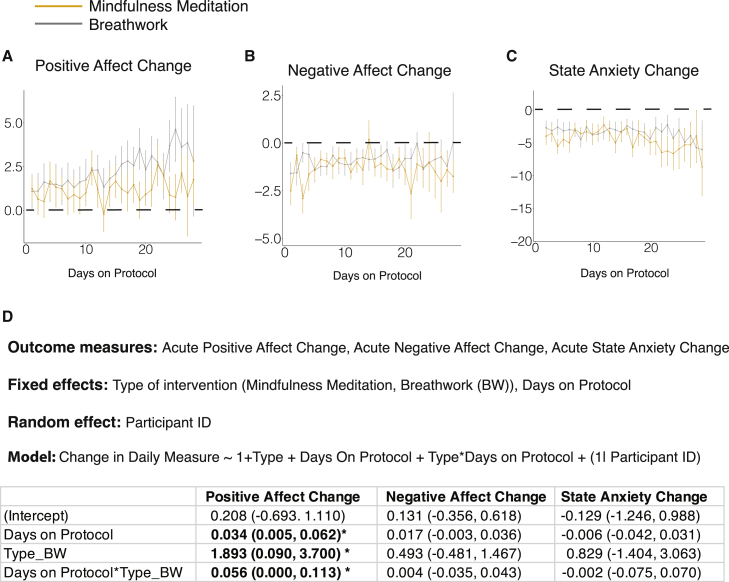
As a statistician, you will appreciate the detail provided in the model output table. Let's focus on the "Positive Affect Change" column:
- Intercept: The baseline starting point.
- Days on Protocol (0.034): This is the slope for the control group (Mindfulness). For each day, their positive affect score increased by an average of 0.034 points. This is statistically significant ().
- Type_BW (1.893): This is the main effect of being in a breathwork group. At Day 0, the breathwork groups started with a positive affect score that was, on average, 1.893 points higher than the mindfulness group. This is also significant.
- Days on Protocol*Type_BW (0.056): This is the interaction term, and it's the most interesting part. It means that the slope for the breathwork groups was 0.056 points steeper per day than the mindfulness group. Their total daily increase was . This significant interaction shows that the positive mood benefit of breathwork accelerated and diverged from meditation over the course of the month.
While the graphs group all three breathwork types together, the paper's text and supplementary data clarify that the cyclic sighing group drove the strongest effect on positive affect. Conversely, for "Negative Affect Change" and "State Anxiety Change," you can see from the table that the coefficients for Type_BW and the interaction term are not statistically significant. This reinforces that the standout benefit of this protocol was in improving positive mood, not just reducing anxiety.
To get a fuller picture and access the primary source, please review the following resources.
Cyclic Sighing: The Stanford-Studied Technique for Anxiety and ...
This article provides an excellent narrative summary of the study, highlighting details about the methodology that you'll appreciate.
Please read the section titled The Balban 2023 Study. Focus on the discussion of the study's design (active-controlled, real-world setting) and its acknowledged limitations (healthy volunteers, 4-week duration).
Physiological Sigh Breathing — Calm Down in 30 Seconds
This second resource is valuable as it provides direct links to the primary literature, fulfilling your request to access the source material.
In the "Research & safety" section, review the Study highlights. I encourage you to use the link provided for "Balban et al., 2023" to visit the PubMed abstract and confirm the findings for yourself.
Synthesis for Your Toolkit
Let's integrate cyclic sighing into your developing framework.
- Classification: It is an asymmetrical, exhale-focused calming technique. However, its unique double-inhale phase gives it an additional mechanical function of alveolar recruitment that distinguishes it from simple extended-exhale breathing.
- Primary Use Case: Based on the strongest available evidence, its primary indication is for the improvement of positive affect (mood) when practiced daily for just 5 minutes. It is also highly effective for acute stress reduction when used for 1-3 breaths.
- Comparison with Other Techniques:
- vs. Resonance Frequency Breathing: RF breathing aims for autonomic coherence and baroreflex optimization through a symmetrical rhythm. Cyclic sighing aims for a powerful, acute parasympathetic shift and mood elevation through an asymmetrical pattern.
- vs. Box Breathing: The Balban et al. study directly compared these. While both are calming, the data indicates cyclic sighing has a statistically superior effect on positive affect.
Conclusion
The physiological sigh is a powerful, evidence-backed tool that leverages both mechanical and neurological principles. You now have a clear understanding of not only how to perform it but also the statistical evidence that defines its primary benefit.
Key Takeaways:
- The physiological sigh consists of a double inhale to reinflate collapsed alveoli and an extended exhale to activate the vagus nerve.
- Practiced as cyclic sighing (e.g., for 5 minutes daily), it has been shown to be more effective than mindfulness meditation at improving positive affect over a 28-day period.
- The statistical evidence points to a significant main effect and an interaction effect, indicating that the mood benefit of breathwork, particularly cyclic sighing, grows over time compared to meditation.
- This makes it a first-line technique to consider for the goal of improving baseline mood.
In our next lesson, we will explore another famous application of the extended exhale principle: the 4-7-8 relaxation breath. We will analyze its structure and the evidence behind its common use as a tool to promote relaxation and aid sleep.