Hello! In our last lesson, we focused on Administrative Distance (AD) and how a router chooses the most trustworthy route when it receives information from multiple sources, like a static route versus a dynamic protocol.
Today, we're diving deeper into the world of dynamic routing. We'll explore the two primary families of Interior Gateway Protocols (IGPs): distance-vector and link-state. Understanding the fundamental differences in how these protocols see the network and share information is crucial. This knowledge will form the foundation for our upcoming lessons on specific protocols like OSPF, which is a key part of your CCNA studies and project.
By the end of this lesson, you will be able to clearly differentiate between distance-vector and link-state routing protocols based on their mechanism, resource usage, convergence speed, and overall behavior.
1. A Tale of Two Philosophies
Dynamic routing protocols automate the process of sharing route information, but they don't all do it the same way. The two main approaches, or "philosophies," are distance-vector and link-state.
First, let's look at where these categories fit into the overall picture of routing protocols.

- Interior Gateway Protocols (IGPs): Used for exchanging routing information within a single autonomous system (AS), which is essentially a network under a single administrative control (e.g., a corporate network). Examples include RIP, EIGRP, and OSPF.
- Exterior Gateway Protocols (EGPs): Used for exchanging routing information between different autonomous systems. The primary example is BGP, which runs the internet.
For your CCNA project, you'll be working exclusively with IGPs. Let's compare the two main IGP philosophies.
2. Distance-Vector: "Routing by Rumor"
A distance-vector protocol operates on a simple, localized principle. Imagine you're trying to find a post office in an unfamiliar town. You ask a local person for directions, and they point down the street and say, "Go that way, it's about two blocks." You trust their direction and distance without knowing the full city layout.
This is exactly how distance-vector routers work.
- Knowledge: They only know about networks from the perspective of their directly connected neighbors. They don't have a map of the entire network.
- Mechanism: They periodically send their entire routing table to their neighbors. This is often called "routing by rumor" because a router accepts the information from its neighbor without verifying the full path itself.
- Metric: The "distance" is a metric like hop count (how many routers away the destination is). The "vector" is the direction (which next-hop router to use).
3. Link-State: "Having the Full Map"
A link-state protocol takes a more comprehensive approach. Imagine that instead of asking for directions, you were given a complete, detailed map of the entire town. With this map, you can see all the streets, intersections, and your own location, and you can independently calculate the best route to the post office.
This is the link-state philosophy.
- Knowledge: Every router has a complete map, or database, of the entire network topology.
- Mechanism: Routers exchange information about the status of their direct connections (their "links"). These updates, called Link-State Advertisements (LSAs), are flooded throughout the network. Every router collects all the LSAs to build an identical Link-State Database (LSDB).
- Path Calculation: With the complete map (the LSDB), each router runs an algorithm, typically the Shortest Path First (SPF) algorithm, to calculate its own best paths to all destinations.
The following video from Practical Networking provides an excellent visual demonstration of this core difference.
EGP / IGP :: Distance Vector / Link State :: Dynamic Routing Protocols :: OSPF EIGRP BGP RIP IS-IS
This video uses a clear network diagram to illustrate how much each protocol type "knows" about the network.
Watch the section from Distance Vector vs. Link State. Pay close attention to the topology diagram and how the narrator explains what Router 5 knows in a link-state environment versus a distance-vector environment. This clearly illustrates the "full map" vs. "next hop only" difference.
4. Key Differences and Trade-offs
The philosophical difference between these two approaches leads to significant operational trade-offs.
A. Convergence
Convergence is the process by which all routers in a network agree on the best paths. Speed of convergence is critical for network stability.
- Link-State (Faster): When a link fails, the connected router sends out an LSA about the change. All routers receive this update, re-run the SPF algorithm on their existing map, and can almost immediately find a new best path.
- Distance-Vector (Slower): When a link fails, the information must propagate hop-by-hop. A router tells its neighbor, who tells its neighbor, and so on. This slow process can lead to periods of incorrect routing and potential routing loops.
B. Resource Utilization (CPU, RAM, Bandwidth)
- Link-State:
- CPU/RAM: Requires more processing power and memory to store the entire LSDB and run the complex SPF algorithm.
- Bandwidth: After the initial flooding of LSAs, they are very efficient, only sending small, triggered updates when a change occurs.
- Distance-Vector:
- CPU/RAM: Less demanding, as routers only store their routing table, not the entire topology.
- Bandwidth: Can be inefficient, as protocols like RIP periodically broadcast their entire routing table, even if no changes have occurred.
As the video you watched mentioned, the CPU and RAM argument against link-state protocols is largely historical. Modern routers can easily handle the demands of OSPF in most enterprise networks.
C. The Special Case: EIGRP
You may have noticed EIGRP in the protocol diagrams. Cisco developed EIGRP as an advanced distance-vector protocol. It operates on the principle of distance-vector but incorporates many features of link-state protocols, such as:
- Using triggered, partial updates instead of periodic full-table updates.
- Maintaining a topology table and forming neighbor relationships.
- Extremely fast convergence.
Because of these enhancements, it's sometimes called a "hybrid" protocol, though its underlying algorithm is based on distance-vector principles.
5. Summary Table
This table summarizes the core differences we've discussed. It's a useful reference for comparing the two protocol types.
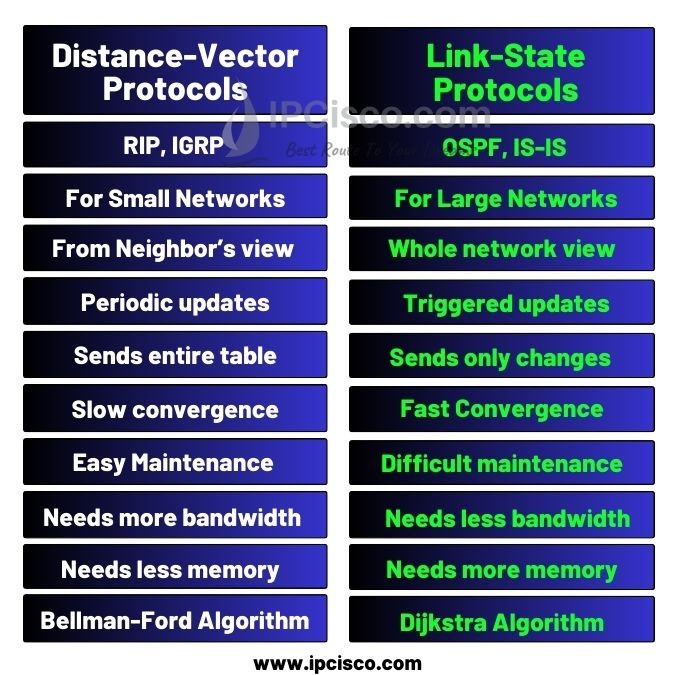
To solidify these concepts, let's review one final, concise resource.
Routing protocols - Study CCNA
This article from Study CCNA provides a straightforward textual summary of the two protocol types.
Please read the sections titled Distance vector protocols and Link state protocols. This will reinforce the concepts of how each protocol shares information, their relative complexity, and the algorithms they use (Bellman-Ford for distance-vector and Shortest Path First for link-state).
Conclusion
You now have a solid grasp of the fundamental division in the world of interior routing protocols. This distinction is not just academic; it directly influences network design, performance, and scalability.
Key Takeaways:
- Distance-Vector protocols operate on "routing by rumor," where each router only knows the distance and direction to destinations via its neighbors. They are simpler but converge slowly (e.g., RIP).
- Link-State protocols provide each router with a "full map" of the network, allowing each router to independently calculate the best path. They are more complex and resource-intensive but converge very quickly (e.g., OSPF).
- The primary trade-offs involve convergence speed, resource utilization (CPU/RAM vs. bandwidth), and scalability.
- EIGRP is an advanced distance-vector protocol that borrows beneficial features from link-state protocols, making it a high-performing outlier.
In our next lesson, we will begin our deep dive into OSPF. We will see firsthand how a link-state protocol discovers neighbors, builds its topology database (the "map"), and elects leaders, putting the concepts you've learned today into practical action.