Welcome to your second lesson. In our previous session, we established that the AdTech industry is consolidating around privacy-compliant, data-rich environments, creating a complex M&A landscape. Today, we will examine the mechanics of this consolidation within the core of the open internet: the programmatic ecosystem.
This lesson focuses on identifying the key consolidation themes, particularly the convergence of platforms on the buy-side and sell-side. For your role, understanding this trend is crucial. It helps you dissect the AdTech value chain, identify which functions are becoming commoditized or integrated, and pinpoint the specific types of companies that might be ripe for a "rationalization" acquisition—potentially aligning with your target valuation profile.
Deconstructing the Programmatic Trading Floor
Before we can analyze its consolidation, we must first clearly define the key players in the programmatic ecosystem. At its heart, programmatic advertising is the automated buying and selling of digital ad inventory. This process involves three core types of platforms.

As the diagram shows, the ecosystem connects advertisers who want to buy ad space with publishers who want to sell it. The key intermediaries are:
- Demand-Side Platform (DSP): Software used by advertisers and agencies to buy ad impressions from multiple sources in an automated fashion. A DSP allows buyers to manage their bids for the ad space and target their audience.
- Supply-Side Platform (SSP): Software used by publishers to sell their ad inventory in an automated way. An SSP helps publishers maximize their revenue by connecting to multiple ad exchanges and DSPs.
- Ad Exchange: A digital marketplace that enables advertisers and publishers to buy and sell advertising space through real-time auctions. It's the trading floor that connects DSPs and SSPs.
To see how these components evolved and interact, the following video provides a clear and comprehensive historical overview.
Programmatic Advertising. Clearly Explained
This video, "Programmatic Advertising. Clearly Explained" from the Senator We Run Ads channel, does an excellent job of explaining the origins and mechanics of the programmatic ecosystem. It will give you the foundational vocabulary for the rest of our course.
Please watch from the beginning up to the point where the ecosystem is fully laid out, around the first 17 minutes. Focus on how the industry moved from manual ad buys to a complex, automated system involving ad networks, exchanges, DSPs, and SSPs.
The video makes it clear that this system, while efficient, introduced many layers and intermediaries between the advertiser's dollar and the publisher's pocket. This complexity is the primary driver for the consolidation we see today.
The Great Squeeze: SSP & DSP Convergence
The central theme of programmatic consolidation is the convergence of buy-side (DSP) and sell-side (SSP) functionalities. The clear lines that once separated these platforms are blurring. Companies are increasingly looking to operate "full-stack" solutions that control more of the value chain.
There are three main drivers for this trend:
- Efficiency and Transparency (Supply Path Optimization - SPO): Every "hop" an ad request makes between platforms adds latency and costs (i.e., platform fees or "take rates"). By integrating DSP and SSP functions, a company can create a more direct, transparent, and efficient path between the buyer and seller, reducing waste.
- Data and Identity: As we discussed in the last lesson, the deprecation of third-party cookies makes first-party data paramount. A platform with visibility into both the buy-side (advertiser intent) and sell-side (publisher context and audience) has a significant data advantage in a privacy-first world. Vertical integration simplifies compliance and enables more effective targeting and measurement.
- Value Capture: By owning more of the stack, a consolidated entity captures a larger percentage of the ad spend that would otherwise be paid out to other intermediaries.
The following resource discusses this evolution and the challenges that are pushing the industry towards consolidation and simplification.
DSP vs. SSP vs. Ad Exchange: understanding the ...
This article from AI Digital provides a sharp analysis of the current pressures and future direction of the programmatic ecosystem.
First, read the section on "Challenges and considerations." Focus on the point about Market power and consolidation, which highlights the regulatory scrutiny on large, integrated players. Then, jump to the section "Future of DSPs, SSPs, and ad exchanges" and read the paragraph beginning "Here are the shifts to watch...". This directly addresses the convergence theme.
Consolidation in Action: The M&A Story
This trend toward consolidation isn't just theoretical; it's a major driver of M&A activity. After a slowdown, the AdTech M&A market has seen a rebound, often characterized by what LUMA Partners calls "rationalization" or "consolidation" transactions.
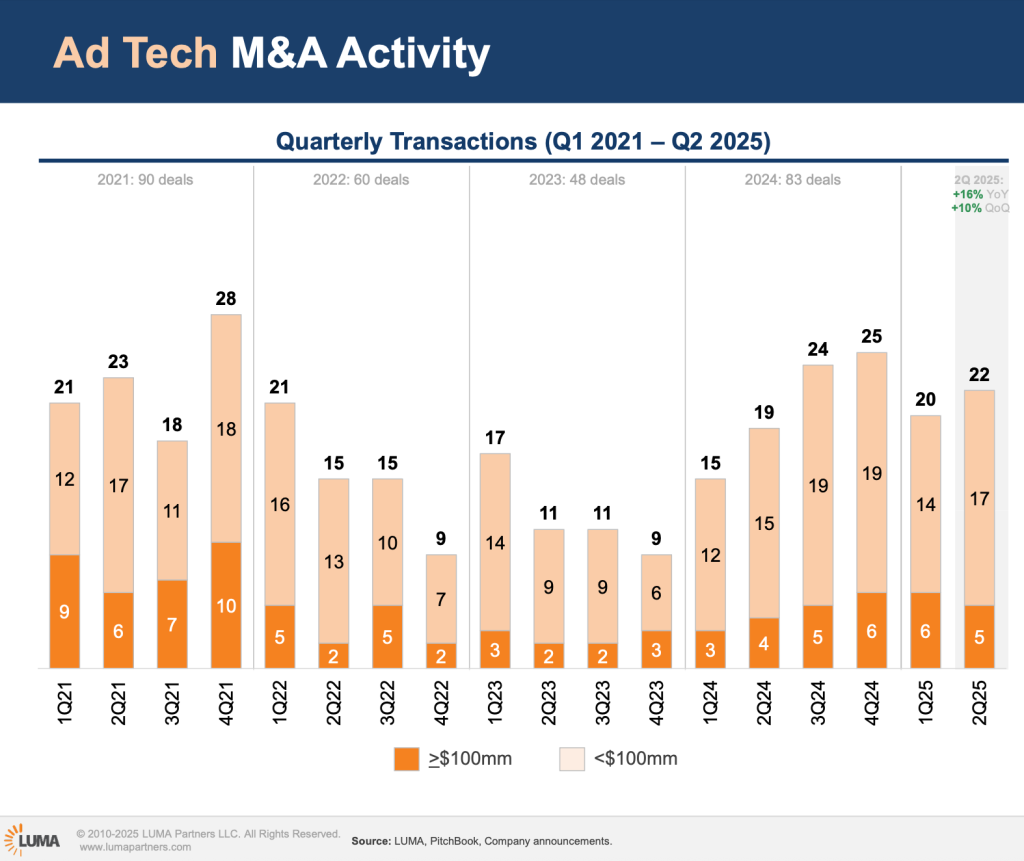
These deals are less about high-priced acquisitions of breakout stars and more about strategically combining companies to gain scale, enter a new geography, or add a critical technology component. Given your background in valuations and M&A, you'll recognize this as a classic industry maturation play.
The following LUMA report provides crucial context on this trend and its impact on valuations.
[PDF] 2024 Full Year - LUMA Partners
This investment banking report analyzes recent M&A activity and public market valuations in AdTech. It offers a direct window into the types of deals being done and the multiples they command.
Start on page 7, "Digital Media & Marketing M&A Activity by Sector." Read the commentary section, particularly the point that describes rationalization and consolidation transactions. Note the mention of "single-digit to low double-digit multiple of EBITDA." This is highly relevant to your goal. Turn to page 9, "Ad Tech M&A Activity." Read the bullet point that discusses the continued trend of these deals, reinforcing that this is a core theme. Finally, review the "LUMA.A – Summary Valuation Statistics" table on page 28. This table lists publicly traded AdTech companies and their valuation multiples. Scan the EV / Adj. EBITDA column for CY2024E.
Implications for Your Acquisition Strategy
The insights from the LUMA report are directly applicable to your mandate.
First, the report explicitly confirms that a significant portion of AdTech M&A consists of "rationalization" deals that command single-digit to low-double-digit EBITDA multiples. This provides market validation that targets within your 3-4x EBITDA range, while not common, are plausible, especially for companies that are sub-scale, facing competitive pressure, or offer a specific strategic fit rather than high standalone growth.
Second, the valuation table on page 28 provides real-world benchmarks. While many companies like The Trade Desk or AppLovin trade at very high multiples, notice the companies at the lower end. For example, Nexxen (NEXN) and Perion Network (PERI) show CY2024E adjusted EBITDA multiples of 4.9x and 0.8x, respectively. While these are public companies with their own unique circumstances, they demonstrate that lower multiples exist in the market. A private, sub-scale target facing the pressures of consolidation could very well be acquired in your desired range.
Your acquisition thesis could therefore focus on identifying these types of targets: a smaller, independent SSP in a specific geography you wish to enter, or a DSP with a unique algorithmic capability that would be more valuable when integrated into your company's broader platform.
Conclusion
Today, we've moved from the high-level industry shift to the granular mechanics of consolidation within the programmatic ecosystem.
Here are your key takeaways:
- The programmatic ecosystem is built on DSPs (buy-side), SSPs (sell-side), and Ad Exchanges (marketplaces).
- A primary consolidation theme is the convergence of DSP and SSP functions, driven by the need for efficiency, data control, and greater value capture.
- This trend fuels "rationalization M&A," where companies are acquired to build scale and integrate capabilities, often at single-digit EBITDA multiples.
- This creates a tangible opportunity for your acquisition strategy to target sub-scale but technologically sound companies that can be acquired at reasonable valuations to accelerate your global growth.
In our next lesson, we will build on this by evaluating the strategic M&A activity in the high-growth "hedged gardens" of Connected TV (CTV) and Retail Media, exploring how consolidation themes are playing out in these emerging battlegrounds.