Welcome to the final lesson of our first module. In our last discussion, we explored the strategic M&A activity surrounding Connected TV and Retail Media, noting that their rise is fueled by their foundation in first-party data. Today, we delve into the core driver of that shift: the deprecation of third-party cookies.
This lesson will assess the profound impact of this change on AdTech business models and, most importantly for your goals, on M&A drivers. Understanding this "paradigm shift" is essential for identifying which companies will thrive in the next era of digital advertising and which carry legacy risks. This knowledge will form the bedrock for the acquisition strategy we will begin to formulate in the next module.
The "Cookiepocalypse": A Fundamental Paradigm Shift
For decades, the third-party cookie has been the connective tissue of the open internet, enabling advertisers to track users across different websites for targeting, personalization, and measurement. The phasing out of these cookies by browsers like Chrome and Safari, combined with stringent privacy regulations like GDPR and CCPA, represents what many have called an "extinction level event" for the old way of doing business.
The following video provides an excellent overview of this industry-wide disruption.
The future of digital marketing in a cookie-less world
The video "The future of digital marketing in a cookie-less world" from AdAge sets the stage for why this is such a seismic event for the industry.
Watch the introduction from the beginning to understand why the combination of browser actions and privacy regulations is considered an "apocalypse" for an ecosystem built on third-party data. Next, listen to the explanation from this segment on how the elimination of identifiers like cookies and Apple's IDFA directly impacts the core functions of digital marketing: targeting and measurement.
This isn't just a technical adjustment; it's a fundamental change in the flow of data. The LUMA report on the State of Digital Marketing frames this perfectly as a move away from a world centered on third-party data.
[PDF] LUMA is pleased to present its 2023 State of Digital Marketing report.
This report from LUMA Partners, a leading strategic advisory firm in digital media, provides a high-level strategic perspective on the industry's evolution.
Please read the section titled "Evolving Privacy Landscape." Focus on the paragraph that describes the paradigm shift from a "3P-centric world" to a "1P data-collaboration world." Pay attention to how the strengths and weaknesses of each paradigm are inverted.
This shift from a third-party to a first-party data paradigm is the single most important trend shaping AdTech business models and M&A today.
From Cookies to Privacy-First Targeting
The image below provides a clear, high-level comparison between the old and new advertising models.
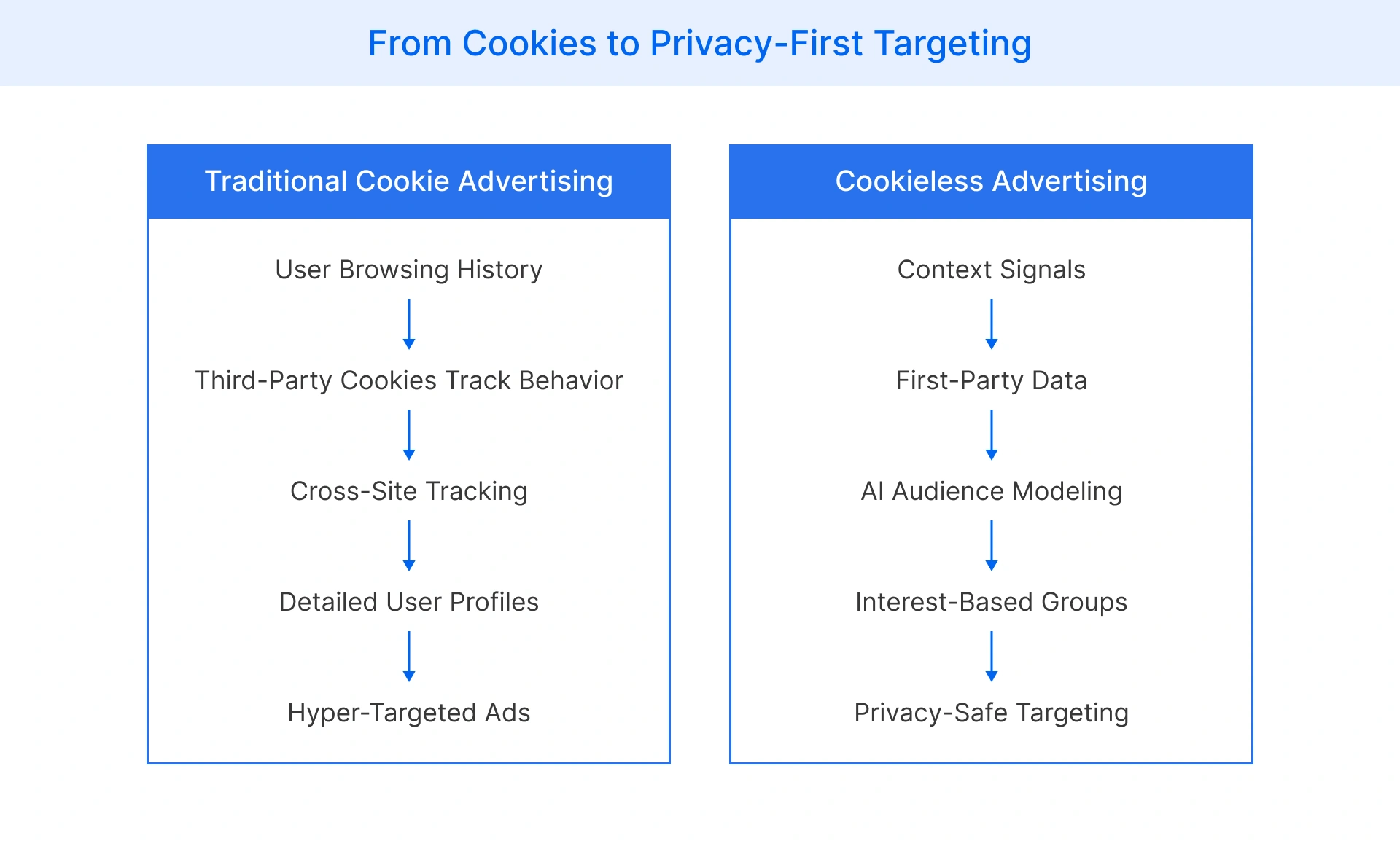
As you can see, the industry is moving away from tracking individuals via third-party cookies and toward models built on:
- First-Party Data: Data collected directly by a publisher or brand with user consent.
- AI Audience Modeling: Using machine learning to create interest-based groups or cohorts without relying on individual-level tracking.
- Context Signals: Targeting based on the content of a webpage rather than the identity of the user viewing it.
This has spawned a new generation of technologies and companies, creating a fresh landscape of M&A opportunities.
Industry Responses and New M&A Drivers
Companies are responding to cookie deprecation in several ways, each creating distinct M&A opportunities for a strategic buyer like your firm.
1. The Rise of Identity Solutions
One major response is the development of new "identity solutions" that create a persistent, privacy-compliant identifier to replace the third-party cookie. These solutions typically rely on authenticated user information, such as a hashed email address, provided with consent. One of the most prominent examples is Unified ID 2.0 (UID2), an open-source framework spearheaded by The Trade Desk.
The diagram below shows the complex data flow involved in making an identity solution like UID2 work.

For your M&A lens, the key takeaway is that an entire ecosystem of technology is needed to power these solutions. Companies that provide the infrastructure for identity resolution, consent management, and token exchange are valuable "picks and shovels" in this new gold rush.
2. Contextual and Probabilistic Alternatives
Not all solutions require a persistent user ID. Many companies are innovating in non-identifiable targeting methods.
- Next-Gen Contextual: This goes beyond simple keyword matching. Modern contextual advertising uses AI to understand the sentiment and nuance of content, allowing for more sophisticated placement.
- Probabilistic Targeting: Using AI and machine learning, this approach groups non-addressable users into audience cohorts based on aggregated signals (like browser type, time of day, and on-site behavior). This is where techniques like differential privacy become crucial, as they allow for analysis of group behavior without exposing individual data.
Let's return to the AdAge video, where the speakers discuss these alternatives.
The future of digital marketing in a cookie-less world
This video also explores the key alternatives to cookie-based targeting.
First, listen to the discussion on AI and ML techniques that rebuild audience targeting without identity. Next, watch the explanation of contextual targeting, which doesn't require user knowledge. Finally, listen to the segment on new data sources, including second-party data leveraged via "clean rooms" and differential privacy, as well as the use of aggregate data to solve problems without user-level information.
Acquiring a company with a sophisticated, AI-driven contextual engine or a proprietary probabilistic modeling technology could provide a significant competitive advantage in the cookieless world.
3. The Convergence of AdTech and MarTech
The LUMA report you reviewed earlier hinted at a crucial M&A driver. As first-party data becomes paramount, the line between AdTech (historically focused on media buying with third-party data) and MarTech (focused on managing customer relationships with first-party data) is blurring.
[PDF] LUMA is pleased to present its 2023 State of Digital Marketing report.
Let's revisit the LUMA report for this key insight.
Read the paragraph that begins "Note that within the parameters...". It explicitly states that because AdTech traditionally relied on 3P data and MarTech on 1P data, we are likely to see further convergence between the two.
This convergence means that a traditional AdTech company might acquire a MarTech company—like a Customer Data Platform (CDP), an email service provider, or a loyalty platform—to gain control over valuable first-party data assets and the tools to manage them. This is a critical new dimension for your M&A thesis.
The M&A Impact: Privacy as a Valuation Driver
Given your background in M&A and law, this is where the implications become most tangible. In this new era, a target's privacy practices are no longer a simple compliance check; they are a core component of enterprise value and a critical area of due diligence. Poor data governance creates what is known as "compliance debt"—a hidden liability that can dramatically affect valuation and deal certainty.
A recent workshop summary from the Network Advertising Initiative (NAI) and law firm Wilson Sonsini provides an excellent analysis of how privacy posture directly shapes deal outcomes.
This article translates privacy issues into the language of M&A, discussing their direct impact on deal value, terms, and timelines. It's highly relevant to the vetting aspect of your role.
First, read the section "In Ad Tech, Data Practices Shape Deal Value." Note the emphasis on the target's "data story" and how a coherent narrative contributes to deal speed and certainty. Next, review "Privacy Issues Have Real Impact on Deals." This part details the concrete consequences of privacy findings on reps and warranties, covenants, purchase-price adjustments, and indemnification. Finally, read the section "Good Privacy Programs Are a Tailwind to Deal Success." This introduces the concept of "compliance debt" and makes the crucial point that investing in privacy readiness before a deal is on the horizon is the most effective way to protect deal value.
For your acquisition mandate, this means that a target with a low EBITDA multiple might look attractive on the surface, but if it carries significant compliance debt, the cost of remediation and the associated legal risks could far outweigh the initial "bargain." Conversely, a company with a robust, well-documented privacy program may command a higher multiple but represents a de-risked asset.
Conclusion
This lesson concludes our survey of the major forces shaping the global AdTech landscape. The deprecation of the third-party cookie is not just another trend; it is the catalyst for a fundamental restructuring of the industry.
Your key takeaways are:
- A Paradigm Shift, Not a Patch: The move away from third-party cookies is forcing the industry toward models built on first-party data, consent, and privacy-enhancing technologies.
- New M&A Categories: This shift creates new acquisition targets, including identity solution providers, contextual advertising engines, and MarTech companies with rich first-party data assets.
- Privacy Diligence is Core to Valuation: A target's "data story" and "compliance debt" are no longer peripheral legal checks. They are central to valuation and must be a key component of your vetting process, directly influencing deal terms and price.
Having analyzed the macro consolidation themes—from the open web and walled gardens to CTV, RMNs, and the impact of privacy—you now have a comprehensive map of the strategic battlegrounds.
In our next module, we will pivot from market analysis to action. The first lesson will focus on translating these insights into a formal strategic M&A mandate for your company, providing a clear framework to guide your global acquisition search.