Hello. This first module begins beneath the visible surface of a pore. Before trying to decide whether a dark dot is a blackhead, it helps to understand what a blackhead actually is: a plug that develops inside a hair follicle, not dirt sitting on top of the skin.
This lesson follows that plug from its beginnings to two common forms, the open comedone (blackhead) and closed comedone (whitehead). It also explains why the exposed tip of a blackhead darkens. That foundation will make the look-alike comparisons in the next lesson more reliable.
A follicle normally carries oil to the surface
A visible “pore” is often the opening of a hair follicle. A hair may grow through it, while an attached sebaceous gland releases sebum, the oily substance that helps protect the skin. Cells lining the follicle also mature and shed. Ordinarily, sebum and shed cells can move toward the surface rather than accumulating in the canal.
The diagram shows these structures in cross-section. It is a simplified model: real follicles vary in size, and a clogged follicle does not necessarily progress through every panel.
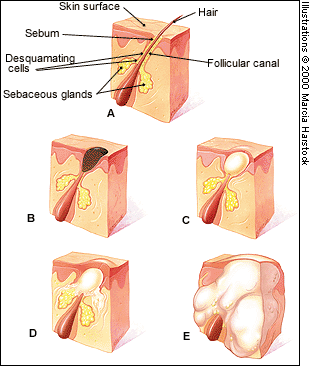
In panel A, notice where the gland joins the follicular canal. The canal is the important location for this lesson. A comedone forms when cells are retained within that canal and mix with sebum. It is not simply a coating that has collected on the outside of the face. Sebum itself is normal; having oil in a follicle does not automatically mean that the follicle is blocked.
DermNet’s Comedonal acne gives the underlying cell-and-oil explanation. Read its short definition and the first paragraph on causes; the subsequent list of possible contributing factors is beyond what you need for this lesson.
Read DermNet’s “Comedonal acne” to connect the visible bump with changes inside the follicle. Pay particular attention to its explanation of retained lining cells and sebum.
In “What are comedones?”, read from the definitions, including the open, closed, and microscopic forms. Then go to “What causes comedones?” and read its first paragraph. Stop before the list beginning “The development of comedones may involve the following factors.”
The key change is sometimes called abnormal follicular shedding or cornification: cells lining the follicle build up and remain together instead of clearing readily. Mixed with sebum, they form a small, initially invisible blockage—a microcomedo. As material accumulates, the blockage may become visible. Increased sebum can contribute, but the plug is not made of oil alone.
This explains why “clogged pore” is a useful shorthand but an incomplete picture. The process involves the follicle’s lining and its contents, not just a large opening that needs to be cleaned out. It also explains why the presence of a comedone says nothing by itself about someone’s cleanliness.
One kind of plug, two kinds of opening
What distinguishes a blackhead from a whitehead is chiefly the condition of the follicle’s opening above the plug.
In an open comedone, accumulated material widens the follicular opening, leaving the plug’s surface exposed to air. That exposed tip can appear dark: this is a blackhead, illustrated in panel B. “Open” does not mean the follicle is empty; there is still a plug beneath the visible surface.
In a closed comedone, a thin covering of skin remains over the plugged follicle. It often looks like a small, pale or skin-coloured bump, as in panel C. “Closed” describes the covered opening, not a different substance filling the follicle. The everyday name whitehead can be misleading: a closed comedone need not be distinctly white, and it is not the same thing as a pus-filled pimple.
The American Academy of Dermatology’s Acne: Signs and symptoms sets out this comparison in everyday terms. Its descriptions are useful here; interpreting photographs across skin tones comes in the next lesson.
Read the American Academy of Dermatology’s descriptions of whiteheads and blackheads to reinforce what “closed” and “open” refer to.
Under “Whiteheads”, begin with the comparison. Continue through “Blackheads” to the sentence explaining the colour change. Focus on what both lesions contain and what differs at their openings.
Both are types of comedonal acne. They are often described as non-inflammatory lesions because they need not show the conspicuous swelling of an inflamed pimple. That label does not mean inflammation plays no role at any stage: changes within a follicle can be more complicated than its surface appearance suggests. For now, the useful distinction is between a plug without an obvious swollen, tender lesion and the more visibly inflamed examples shown later in the diagram.
Why an exposed plug looks dark
The dark tip of a blackhead is not trapped dirt. When material at an open follicular opening is exposed to air, chemical changes—including oxidation—contribute to its dark appearance. Surface pigment, including melanin, also contributes. You may encounter explanations that emphasize one of these factors more than the other; neither explanation turns the dark colour into evidence of grime.
It helps to be precise about where the colour is seen. The exposed surface is dark; that does not mean every part of the plug has turned black. Nor does a dark-looking opening, by itself, prove there is a comedone inside it. Other normal or abnormal skin features can create small dark dots, which is why appearance and distribution matter in the next lesson.
This short video segment puts the colour change alongside a practical consequence: washing the surface more vigorously does not simply wash an established follicular plug away.
Blackheads on the Nose? Here’s What They Really Are | Derm Explains
Watch “Blackheads on the Nose? Here’s What They Really Are | Derm Explains” by dermatologist Dr Dray for its concise explanation of the exposed plug and why it is not dirt.
Watch the blackhead explanation, beginning where she defines an open comedone and ending after her point about cleansing. Focus on the distinction between removing surface material and clearing a plug inside the follicle.
Gentle cleansing still has a place in ordinary skin care. The point is narrower: more scrubbing is not a mechanical solution to a blackhead. If the visible darkness were dirt on the surface, washing harder would be an obvious response. Once you understand that it is the exposed end of material retained within a follicle, that response no longer follows—and harsh friction can irritate skin without addressing the process that formed the plug.
Keep the model useful, but not overconfident
The cross-section gives you a reliable account of how a comedone can form. It is less useful as a stand-alone diagnostic test for every dot you see in a mirror. A photograph or close-up usually cannot show whether a follicle contains an accumulated plug, and visible pores are a normal feature of skin.
For now, carry forward three linked ideas:
- Formation: retained follicular cells and sebum build up inside a hair follicle.
- Opening: an exposed plug is an open comedone; a plug beneath a covered opening is a closed comedone.
- Colour: a blackhead’s dark surface reflects changes to exposed material and surface pigment, not poor hygiene or trapped dirt.
The next lesson uses this model to compare likely comedones with normal sebaceous filaments in examples across skin tones, while keeping the limits of identification from images firmly in view.