Introduction
Welcome to the first lesson of our module on Artificial Intelligence. In the previous modules, we established a strong foundation in modern architecture and platform engineering, culminating in our last lesson on designing a communication strategy to drive platform adoption. Now, we shift our focus to the most significant technological force currently reshaping software development: AI.
As someone with extensive experience using coding assistants, you're already familiar with AI's ability to generate code. Our goal in this module is to move beyond that initial familiarity and develop a strategic, architectural perspective on AI integration. This first lesson is foundational. Your learning outcome is to categorize the current AI capabilities relevant to software development, including code generation, analysis, testing, documentation, and decision support. We will create a mental map of where AI can augment the entire software development lifecycle (SDLC), providing a structured framework that will guide our architectural discussions in the lessons to come.
The Architect's Mindset: From Coder to Orchestrator
Before we dive into a taxonomy of AI tools, it's crucial to frame the role of an experienced engineer in an AI-assisted world. The primary value shifts from the mechanical act of writing code to the more strategic activities of defining intent, setting constraints, and governing outcomes. Your role evolves from that of a creator to an orchestrator.
AI Coding Tools in Enterprise Software Delivery: An Architect’s Workflow | Keyhole Software
This article from Keyhole Software, written from a chief architect's perspective, perfectly captures this essential mindset shift.
First, read the section "The Mindset Shift in AI-Assisted Software Development," which describes how an engineer's role becomes a blend of product manager, architect, and team lead. Then, read the section "Why Experienced Teams Get Better Results With AI Coding Tools." This part emphasizes that AI doesn't replace engineering judgment but amplifies it, a key insight for leveraging these tools effectively.
This "orchestrator" mindset is the lens through which we will examine AI's capabilities. The goal isn't just to make a single developer faster, but to make the entire development system more effective, reliable, and intelligent.
A Map of AI in the Development Lifecycle
AI capabilities are not a monolith; they are a diverse set of tools that can be applied at nearly every stage of the software development lifecycle. The diagram below offers a high-level view, mapping different AI functionalities to the various loops of development work.
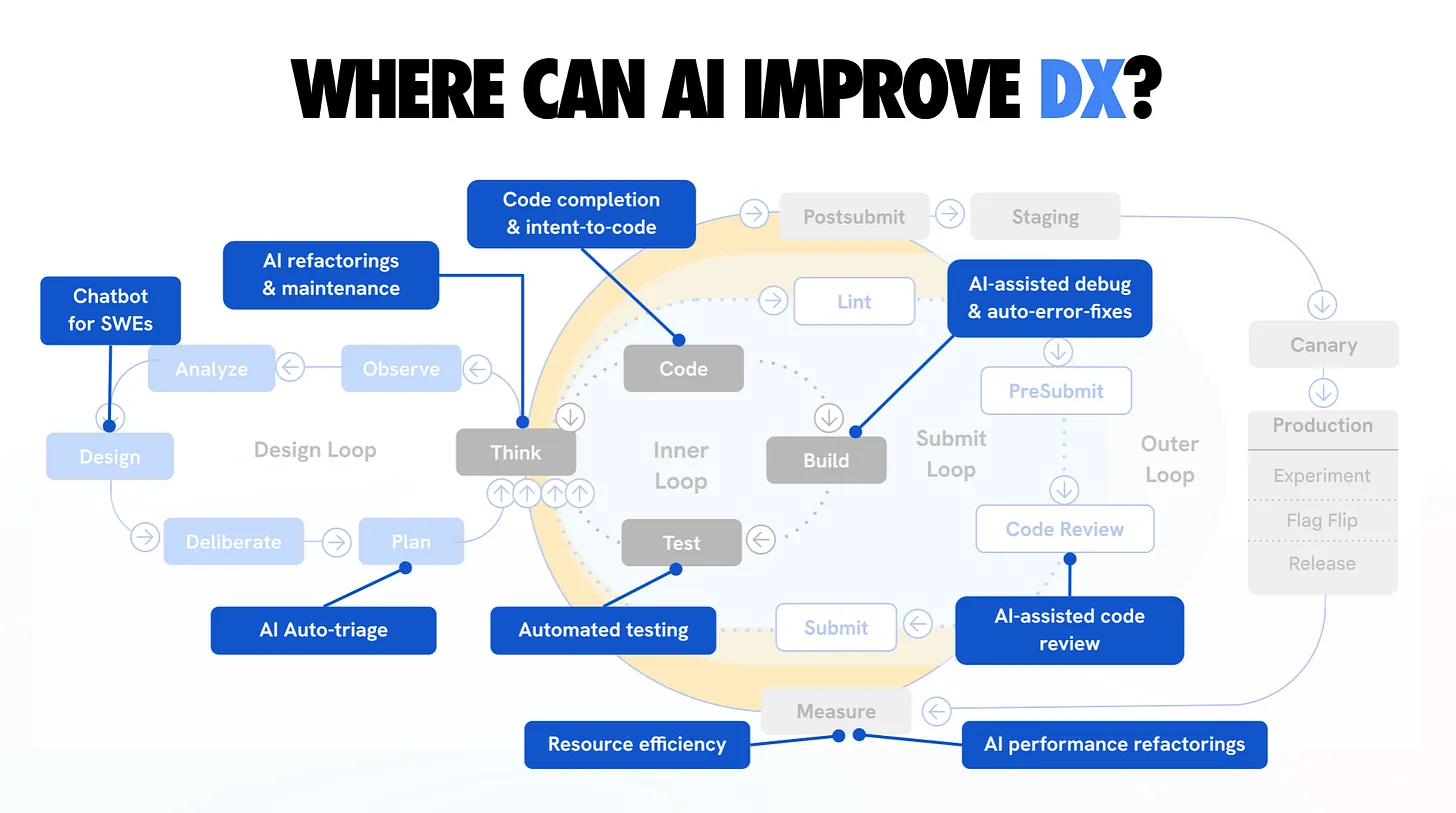
This visual provides an initial framework. We see AI assisting not just with coding but with thinking, testing, reviewing, and optimizing. Let's now build a more detailed categorization by walking through the SDLC phase by phase.
A Phase-by-Phase Categorization of AI Capabilities
To systematically categorize AI's role, we can break down the SDLC into six distinct phases and identify the specific capabilities that apply to each.
🤖 AI-Powered SDLC: Building an AI Framework for Developer Experience | Jonathan Gelin
This article provides a comprehensive and practical guide to integrating AI across the SDLC. It's one of the best structured overviews available.
Please read the entire section titled "Developer Experience Across the SDLC." It's a detailed walkthrough of six phases: Specify, Design, Develop, Validate, Release, and Maintain. As you read, focus on how the specific examples in each phase map to the broader categories of decision support, documentation, analysis, code generation, and testing.
Let's synthesize the key capabilities from that reading into our categories:
1. Specify & Design (Decision Support and Documentation)
This is the "pre-code" phase, where AI acts as a thinking partner for architects, product managers, and developers.
- Decision Support: AI can analyze backlogs to group related items, suggest priorities, and identify vague requirements. It can also act in an "interview mode," asking clarifying questions to help flesh out a technical specification.
- Documentation: From a high-level idea, AI can generate initial drafts of technical designs, component diagrams, API contracts (like OpenAPI specs), and even Architecture Decision Records (ADRs). This accelerates the design process and ensures that decisions are captured from the outset.
2. Develop (Code Generation and Analysis)
This is the most familiar area, but the capabilities go far beyond simple autocomplete.
- Code Generation: The key evolution here is from generic to contextualized generation. When provided with the right context (your organization's patterns, conventions, and existing utilities), AI can generate code that feels native to your codebase, rather than introducing new, redundant patterns.
- Analysis: AI tools can act as a guide to navigate large, unfamiliar codebases. You can ask questions like, "What is the purpose of this service?" or "Show me the call chain for this function." This analytical ability dramatically reduces the cognitive load of understanding complex systems.
3. Validate (Testing and Analysis)
Here, AI assists in ensuring the quality and correctness of the code being written.
- Analysis (Code Review): AI can perform a first-pass code review, automatically checking for common pattern violations, security vulnerabilities, or performance issues. This frees up human reviewers to focus on higher-level architectural and logical concerns. It can also automate the generation of pull request descriptions based on the code changes.
- Testing: AI is particularly effective at generating unit tests, component tests, and even end-to-end test scripts. It can also assist in "self-healing CI," where it analyzes build failures, correlates them with logs and recent code changes, and proposes a fix.
4. Release & Maintain (Documentation and Analysis)
After code is merged, AI continues to provide value through the deployment and operational phases.
- Documentation: AI can analyze a series of commits and PRs to automatically generate user-friendly changelogs, technical release notes, and breaking change summaries. This ensures that communication around releases is consistent and thorough.
- Analysis (and Refactoring): AI can perform large-scale, automated refactoring tasks, such as updating code to use a new API or removing a deprecated pattern across an entire monorepo. It can also analyze the codebase to identify and quantify technical debt, turning a vague feeling of "our code is messy" into a prioritized, actionable list.
Beyond Code Generation: Where's the Real Impact?
While code generation is the most visible application of AI, data on developer productivity suggests that the biggest time savings often come from other activities, particularly those involving analysis and debugging.
Measuring the impact of AI on software engineering – with Laura Tacho
In this segment from The Pragmatic Engineer, Laura Tacho from DX discusses a study on where developers save the most time with AI.
Please watch the section from the study results. Pay close attention to the top two time-saving use cases identified. This provides an important, data-driven perspective on what developers find most valuable in practice.
As the video highlights, stack trace analysis and refactoring existing code were found to be more significant time-savers than mid-loop code generation. This reinforces the importance of the analysis capabilities we've categorized. Pasting a complex error log into an AI chat and asking for an explanation or potential fixes can resolve in minutes an issue that might have taken hours of manual debugging.
Furthermore, AI proves invaluable for tasks that are both time-consuming and often disliked by developers, such as large-scale code migrations. Automating this "undifferentiated heavy lifting" is a powerful use case that falls squarely in the "Maintain" category.
Conclusion
This lesson provided a structured overview of where AI can be applied across the software development lifecycle. We've moved beyond a simple view of AI as a code generator and built a more comprehensive categorization.
Key Takeaways:
- Mindset Shift: The role of the experienced engineer is evolving from a code creator to an orchestrator who guides AI with clear intent and constraints.
- A Full-Spectrum Tool: AI capabilities are not limited to writing code. They span the entire SDLC, from initial specification to long-term maintenance.
- Key Capability Categories: We can group AI's contributions into five broad areas that appear throughout the lifecycle:
- Decision Support: Assisting with planning, prioritization, and architectural choices.
- Documentation: Generating and maintaining ADRs, API specs, changelogs, and guides.
- Code Generation: Creating contextualized code, from snippets to entire modules.
- Analysis: Understanding codebases, reviewing changes, debugging errors, and identifying tech debt.
- Testing: Generating tests and diagnosing CI/CD failures.
- Impact Beyond Generation: Data suggests the most significant productivity gains often come from AI's analytical capabilities, such as debugging complex errors and refactoring existing code.
Preview of the Next Lesson:
Now that we have a map of what AI can do, our next lesson will address the critical architectural question of how to integrate these capabilities safely and effectively. We will explore the fundamental challenge of combining deterministic and non-deterministic systems, identify the new non-functional requirements that AI introduces (like model versioning, inference latency, and cost), and describe common architectural patterns for integrating AI services into existing systems.