In our last lesson, you selected a strategic focus area—either enhancing platform engineering or architecting AI-native applications—and defined a set of high-level goals. This was the crucial "what" and "why" of your AI initiative. Now, we turn to the "how" and "when." A vision without a plan is merely a dream, and as an architect, your role is to bridge that gap between strategy and execution.
This lesson addresses exactly that challenge. We will focus on translating your strategic goals into a tangible, phased implementation plan. You will learn to structure a complex AI initiative into manageable stages, define clear milestones for each, and, critically, build in proactive risk mitigation. This process is the essence of architectural leadership: providing a clear, actionable roadmap that guides teams, manages stakeholder expectations, and navigates the inherent uncertainties of innovation.
From Strategy to a Phased Roadmap
Large-scale technology initiatives, especially those involving novel capabilities like AI agents, are rarely successful as "big bang" deployments. Your 15 years in software engineering have surely shown you the value of iterative development. A phased approach allows you to deliver value early, learn from real-world feedback, manage risk, and build momentum and organizational confidence.
This is often visualized as a strategic roadmap.
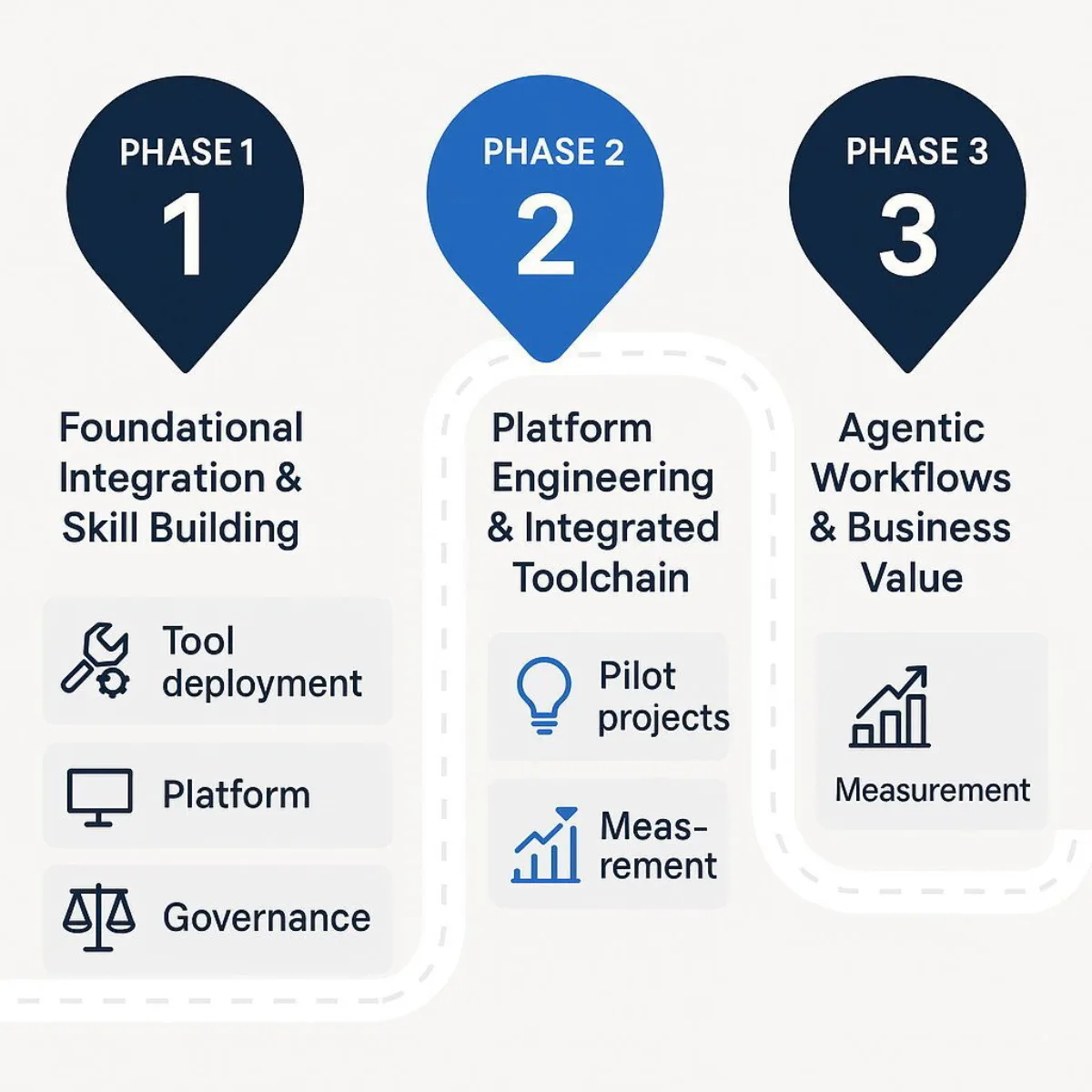
A well-structured plan typically breaks the initiative into a cycle of distinct, but interconnected, phases. A comprehensive article from OneReach.ai, "Best Practices for AI Agent Implementations," outlines a robust five-phase framework that serves as an excellent model.
Best Practices for AI Agent Implementations: Enterprise Guide 2026
This article presents a structured, cyclical process for deploying AI agents. This framework provides a strong foundation for your own implementation plan.
Please read the section titled AI Agent Implementation Framework. Pay close attention to the five phases it outlines, as we will use this structure as our guide: Strategic Assessment and Planning Technology Architecture and Design Development and Integration Deployment and Change Management Monitoring and Optimization
This five-phase cycle isn't just a linear project plan; it's a flywheel. The "Monitoring and Optimization" phase of one cycle directly feeds into the "Strategic Assessment" of the next, creating a loop of continuous improvement. This is fundamental to treating your AI capabilities as an evolving product, a concept we've touched on in our discussions of platform engineering.
Fleshing out the Phases: Milestones and Deliverables
A plan is only actionable if each phase has clear milestones and concrete deliverables. Let's detail what you, as the architect, would be responsible for producing or overseeing in each phase. A great resource for this is the "90-Day Roadmap" from Aisera, which provides a time-boxed, concrete example of such a plan.
Agentic AI Implementation: A 90-Day Roadmap for Enterprise Scale
This article provides a detailed, 90-day execution roadmap that maps directly onto the more general framework we are using. It gives concrete examples of goals and activities for each phase.
Read the section A Phased Approach. As you read, notice how their timeline (Discovery, Selection, Design, Integration, Deployment) aligns with the five phases from the previous resource and consider the specific deliverables mentioned.
By synthesizing these two resources and adding an architectural lens, we can define a clear set of deliverables for your plan.
Phase 1: Strategic Assessment & Planning (e.g., Weeks 1-2)
This phase is about ensuring you're solving the right problem. It translates your high-level strategic goal into a specific, high-impact opportunity.
- Key Activities: Stakeholder interviews, data analysis (e.g., analyzing support tickets, CI/CD metrics), market research.
- Milestones:
- Identify and prioritize 1-3 initial use cases.
- Secure executive sponsorship.
- Core Deliverables:
- Business Case: A document outlining the problem, proposed solution, and expected ROI. Define clear Key Performance Indicators (KPIs) like "Reduce developer onboarding time by 50%" or "Automate 80% of L1 incident response tasks."
- Initial Scope Document: A one-pager defining the boundaries of the first pilot project.
Phase 2: Technology Architecture & Design (e.g., Weeks 3-6)
Here, you translate the "what" into a technical "how." This is where your system design skills are paramount.
- Key Activities: Technical workshops, proof-of-concept spikes, vendor evaluations, security reviews.
- Milestones:
- Select core technologies (e.g., specific LLMs, vector databases, orchestration framework).
- Gain consensus on the high-level design.
- Core Deliverables:
- High-Level Architecture Diagram: A visual representation of the system, its components, and its integrations with the existing landscape.
- Architecture Decision Records (ADRs): Document key decisions, such as "Buy vs. Build" for the agent orchestration engine, or the choice of a specific pattern for integrating with legacy systems.
- Data Management & Governance Plan: Outline how data will be sourced, secured, and managed, and define the initial set of "guardrails" for the system.
Phase 3: Development & Integration (e.g., Weeks 7-8)
This is the build phase. Modern approaches leverage AI to accelerate this work, moving away from traditional, sequential development. The "AI-Driven Development Lifecycle" (AI-DLC) methodology is a powerful example of this shift. It advocates a tight loop of human-AI collaboration.
AWS re:Invent 2025 - Introducing AI driven development lifecycle (AI-DLC) (DVT214)
This presentation from AWS re:Invent introduces a methodology for structuring development work with AI. It provides practical lessons for making the build phase more efficient and predictable.
First, watch the core principle from the plan-execute-verify cycle. This human-validates-AI-executes loop is a key pattern. Next, watch the overview of the AI-DLC phases and stages to see how a project can be broken down adaptively. Finally, review the section on key learnings, which contains invaluable, hard-won advice on topics like managing context, the importance of testing, and having a well-oiled CI/CD pipeline.
- Key Activities: Mob elaboration sessions, coding, automated testing, CI/CD pipeline setup.
- Milestones:
- Minimum Viable Product (MVP) is feature-complete.
- MVP is deployed to a staging environment.
- Core Deliverables:
- Working MVP Software: The initial version of your agent or AI-powered feature.
- Test Suite: A comprehensive set of unit, integration, and end-to-end tests.
- "AgentOps" CI/CD Pipeline: An automated pipeline for testing, deploying, and monitoring the AI system.
Phases 4 & 5: Deployment, Monitoring & Optimization (e.g., Month 3+)
The final phases are about safely releasing the system to users, measuring its impact, and feeding those learnings back into the cycle.
- Key Activities: Pilot program with a small user group, user training, performance monitoring, feedback collection.
- Milestones:
- Pilot successfully completed.
- Go/No-Go decision made for wider rollout.
- Core Deliverables:
- Pilot Rollout Plan & Communication: A plan for who gets access, when, and how they will be supported.
- Observability Dashboard: A dashboard tracking the KPIs defined in Phase 1, as well as operational metrics (latency, error rates, costs).
- ROI & Learnings Report: A document summarizing the pilot's outcomes, validating (or refuting) the initial business case, and providing recommendations for the next cycle.
Architecting for Risk: A Mitigation Strategy
A plan that ignores risk is incomplete. As an architect, your job isn't just to design the happy path, but to anticipate and mitigate failures. With AI, these risks extend beyond typical software bugs.
The following diagram shows a workflow where human oversight is a key architectural component for risk mitigation.
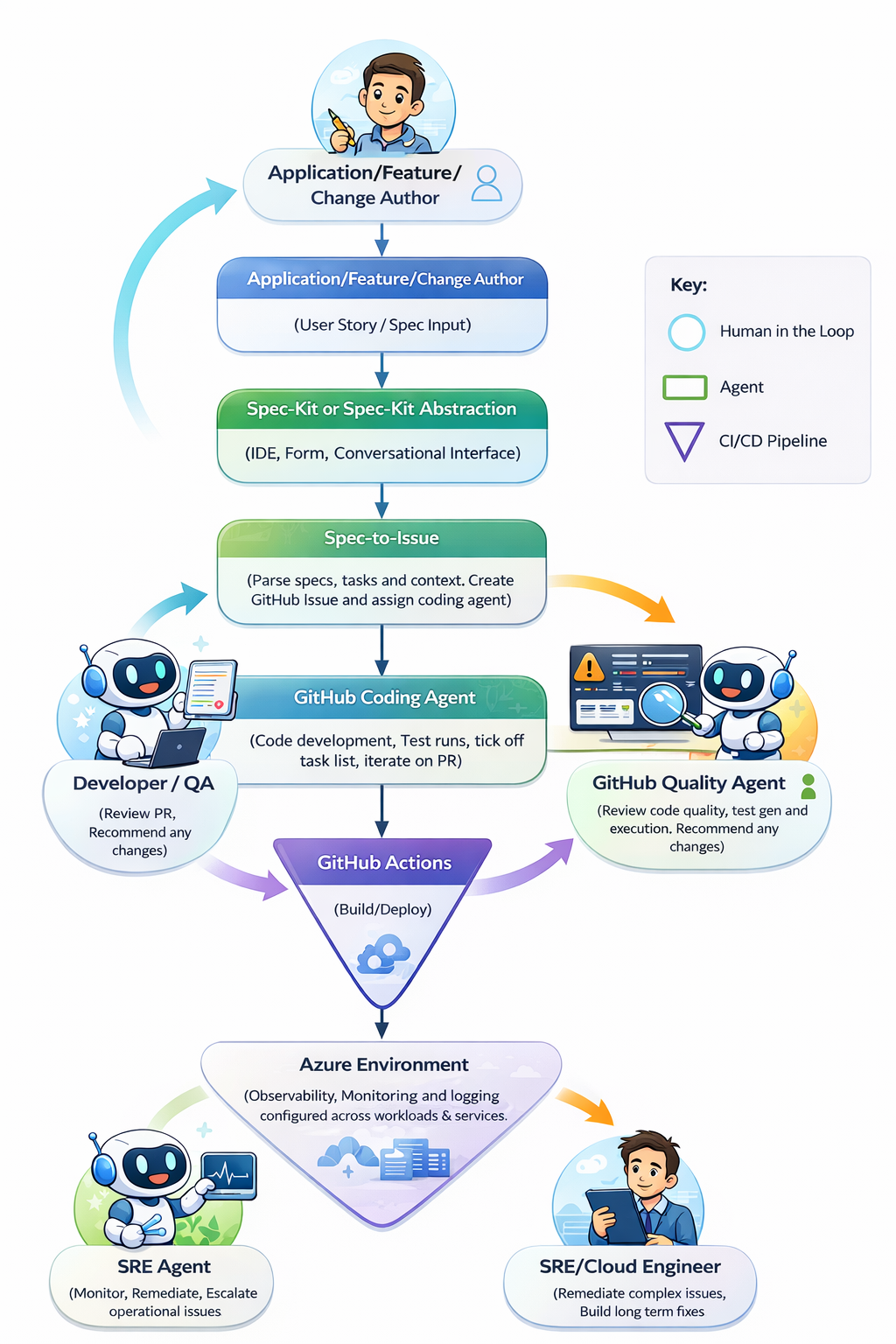
We can categorize risks into three main areas. The "Best Practices" article provides an excellent overview of these challenges and how to approach them.
Best Practices for AI Agent Implementations: Enterprise Guide 2026
This resource clearly lists the most common challenges and provides direct, actionable advice for mitigating them.
Please read the sections Implementation Challenges and How to Overcome Them. This will give you a structured way to think about risk.
Let's organize these risks and discuss architectural mitigation strategies.
1. Technical & Security Risks
- Risk: Integration with legacy systems is complex and brittle.
- Mitigation: Use an anti-corruption layer or facade pattern to isolate the new AI system from the legacy core. Document the interface in an ADR.
- Risk: Poor data quality leads to poor AI performance ("garbage in, garbage out").
- Mitigation: Make a "Data Readiness Assessment" a specific deliverable of Phase 1. Architect data pipelines with explicit validation and cleaning stages.
- Risk: Security vulnerabilities like prompt injection or data leakage.
- Mitigation: Implement an "AI Gateway" that centralizes prompt filtering, input sanitization, and applies Role-Based Access Control (RBAC) to AI agent actions.
- Risk: Uncontrolled costs from model API calls or infrastructure.
- Mitigation: Implement caching strategies at the gateway. Use cost monitoring and alerting tools. Make "Cost Analysis" a part of the Phase 5 report.
2. Organizational Risks
- Risk: Developer or end-user resistance to new tools and workflows.
- Mitigation: Make "Change Management" a formal part of your plan (Phase 4). Start with a pilot program with enthusiastic early adopters. Communicate early and often, emphasizing how the AI will augment, not replace, human expertise.
- Risk: Lack of clear governance leads to chaos.
- Mitigation: Establish an AI governance framework as part of Phase 2. This includes defining roles, decision hierarchies, and ethical guidelines.
- Risk: Misalignment between the engineering team and business stakeholders.
- Mitigation: The phased approach itself is a mitigation. By delivering a business case in Phase 1 and an ROI report in Phase 5, you create formal touchpoints to ensure continued alignment.
3. AI-Specific Risks
- Risk: AI "hallucinates" or generates incorrect, unsafe, or biased outputs.
- Mitigation: Use Retrieval-Augmented Generation (RAG) to ground the model in verified, internal data. Implement human-in-the-loop checkpoints for critical decisions, as shown in the diagram above.
- Risk: Model performance degrades over time (model drift).
- Mitigation: Architect a continuous evaluation pipeline as part of your AgentOps. Use a portion of production traffic to benchmark new model versions against the current one (A/B or canary testing).
- Risk: The non-deterministic nature of AI makes the system's behavior unpredictable.
- Mitigation: Design for graceful failure. Implement fallback mechanisms (e.g., if agent confidence is low, escalate to a human). Invest heavily in observability to track not just outputs, but also the agent's reasoning process (e.g., logging the chain-of-thought).
Conclusion
In this lesson, we have constructed a blueprint for turning a strategic AI vision into an executable plan. You now have a structured framework for leading an AI initiative from conception to value delivery and beyond.
Key Takeaways:
- Use a Phased Approach: Structure your implementation into logical phases like Strategy, Design, Development, Deployment, and Optimization. This manages risk and builds momentum.
- Define Concrete Deliverables: Each phase should have clear, architecturally relevant deliverables (e.g., business cases, ADRs, observability dashboards) that mark progress and ensure alignment.
- Integrate Risk Mitigation Architecturally: Your plan must proactively address technical, organizational, and AI-specific risks. This involves designing systems with patterns like AI gateways, human-in-the-loop checkpoints, and robust observability.
- The Plan is a Living Document: The phased, cyclical nature of this process means your plan is not static. It's a tool for learning and adapting as you gather more data.
Preview of the Next Lesson:
You now have all the core components for your capstone project: a strategic focus, defined goals, and a methodology for creating an implementation plan. In our final lesson, we will focus on the art of communication. You will learn how to synthesize your technical plan and strategic vision into a compelling executive summary—a document designed to build consensus, secure investment, and rally an organization behind your proposed future.