Welcome to the final module of our course. In the previous lessons, we took a deep dive into the technical intricacies of building AI systems, culminating in our analysis of emergent behaviors in multi-agent architectures. We learned how to use causal loop diagrams to diagnose and prevent unintentional, systemic failures. That was about ensuring our systems are robust and behave as designed.
Now, we will elevate our perspective. This module, "Strategic AI Integration," is about ensuring our systems behave responsibly and align with our organization's values and broader societal expectations. We will move from the "how" of technical implementation to the "why," "where," and "when" of strategic deployment.
Our focus for this lesson is to explain the principles of responsible AI usage in software organizations, specifically transparency, fairness, and accountability. We will explore why this is fundamentally an architect's concern and how these high-level principles can be translated into concrete engineering and governance practices.
Why Responsible AI is an Architect's Problem
Traditionally, governance and ethics are often seen as separate from the act of building software—a compliance hurdle to be cleared by a legal or risk department. However, with AI, where systems can learn, adapt, and make autonomous decisions, this separation is no longer tenable. The ethical implications of an AI system are deeply intertwined with its design.
This situation mirrors the "principal-agent problem" from economics, where a principal (e.g., the business) delegates work to an agent (e.g., the AI system) whose interests may not be perfectly aligned. An AI optimized solely for a narrow business metric might achieve it in ways that are harmful, biased, or opaque. As an architect, you are uniquely positioned to bridge this gap. You operate at the intersection of technical possibility and business requirements, embedding values and priorities directly into the system's blueprint.
Let's begin by reading an article from Architecture & Governance Magazine that frames this challenge and establishes the architect as a central figure in ensuring digital trust.
This article argues that architects are not just contributors but the foundation of establishing trust in AI systems. It outlines why your role is critical in navigating the complexities of AI governance.
Please read the first two main sections of the article: Start with The Architect’s Unique Position. Pay attention to how it frames the challenge using the principal-agent problem. Continue with the section Why Architects are well-placed to be the Stewards of AI Governance. Focus on the specific responsibilities it outlines for architects, such as embedding governance into blueprints and championing transparency.
This article positions you not merely as a technical designer, but as a "custodian of digital trust." To fulfill this role, we need a clear understanding of the principles we are meant to uphold.
The Core Principles: Fairness, Transparency, and Accountability
"Responsible AI" (RAI) is an umbrella term for practices that ensure AI systems are developed and used in ways that benefit society while minimizing harm. While there are many facets to RAI, a consensus has formed around a few core tenets. A talk from Credo AI provides an excellent overview of these principles from a product development perspective.
Building Responsible AI Best Practices Across the Product Development Lifecycle | Credo AI
This video, "Building Responsible AI Best Practices," breaks down the key tenets of RAI into understandable and measurable concepts.
Watch the following segments to get a clear definition of the core principles: First, get an overview of the six main tenets of a responsible AI system. Pay close attention to the discussion on Fairness (found here), especially the critical distinction between parity of outcomes (e.g., in a hiring system) and parity of performance (e.g., in a medical diagnosis system). Next, watch the segment on Transparency (in this part), which clarifies that it encompasses more than just model explainability, including documentation and disclosure. Finally, listen to the explanation of Accountability (covered here), which frames it as having an auditable record of decisions made throughout the development process.
As the video makes clear, these principles are not just abstract ideals.
- Fairness forces us to ask "fair to whom and in what way?" and requires us to make explicit, context-dependent choices.
- Transparency challenges the notion that intellectual property is an excuse for total opacity, demanding clear documentation and disclosure so users understand they are interacting with an AI.
- Accountability shifts the focus to the human decisions behind the AI, demanding clear ownership and audit trails. The IBM Technology video "What is Responsible AI?" drives this point home, arguing that when "everyone" is accountable, no one truly is. It stresses the need for clear roles and responsibilities.
From Principles to Practice: Governance as a System
Knowing these principles is necessary, but not sufficient. The architectural challenge lies in operationalizing them. This is achieved through AI Governance, which can be understood as the overall system of rules, practices, and processes an organization uses to manage its AI development and deployment.
A useful mental model for the components of a governance framework is provided by Gartner.
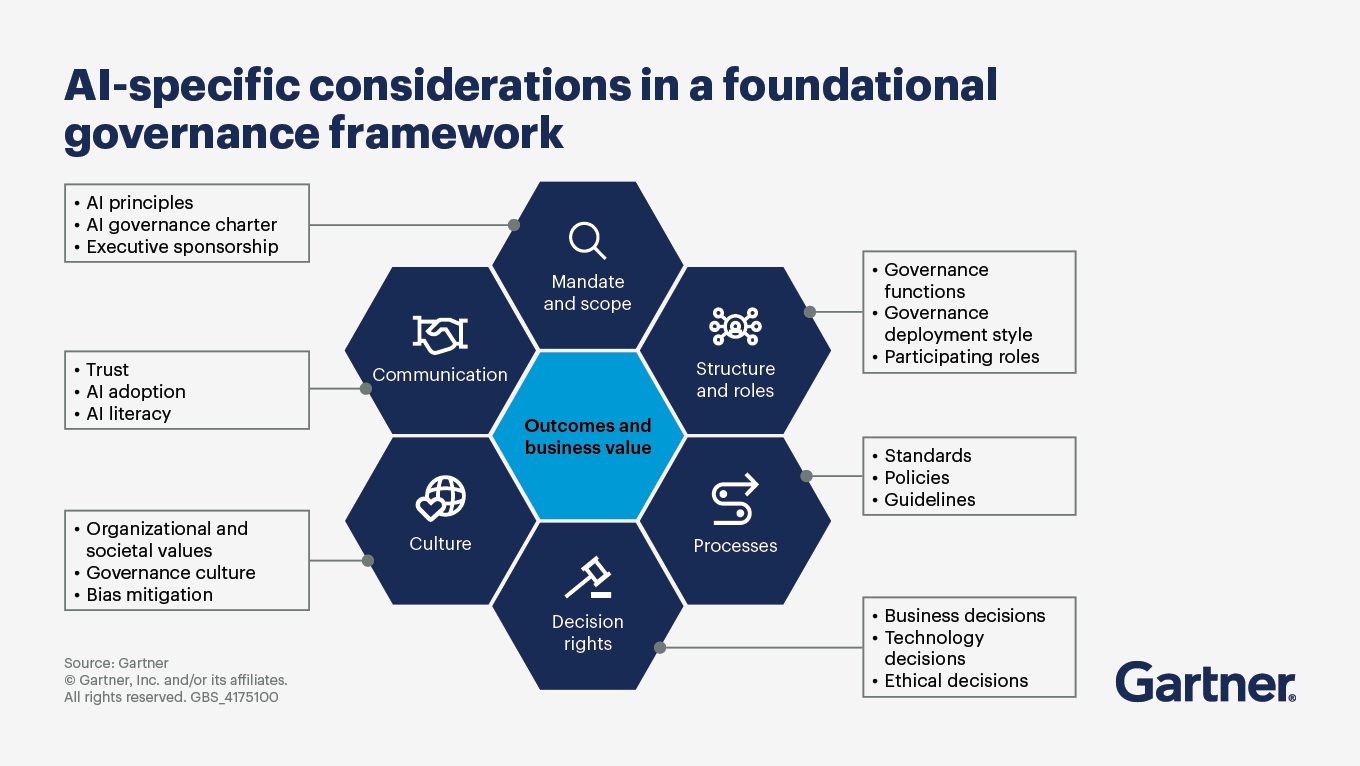
This framework shows that governance is not a single activity but a multi-faceted system. The most critical insight for a modern software organization, as highlighted in the Credo AI video, is that this governance system cannot be a final checkpoint.
The traditional Agent Development Lifecycle might depict governance as a phase that happens after development.
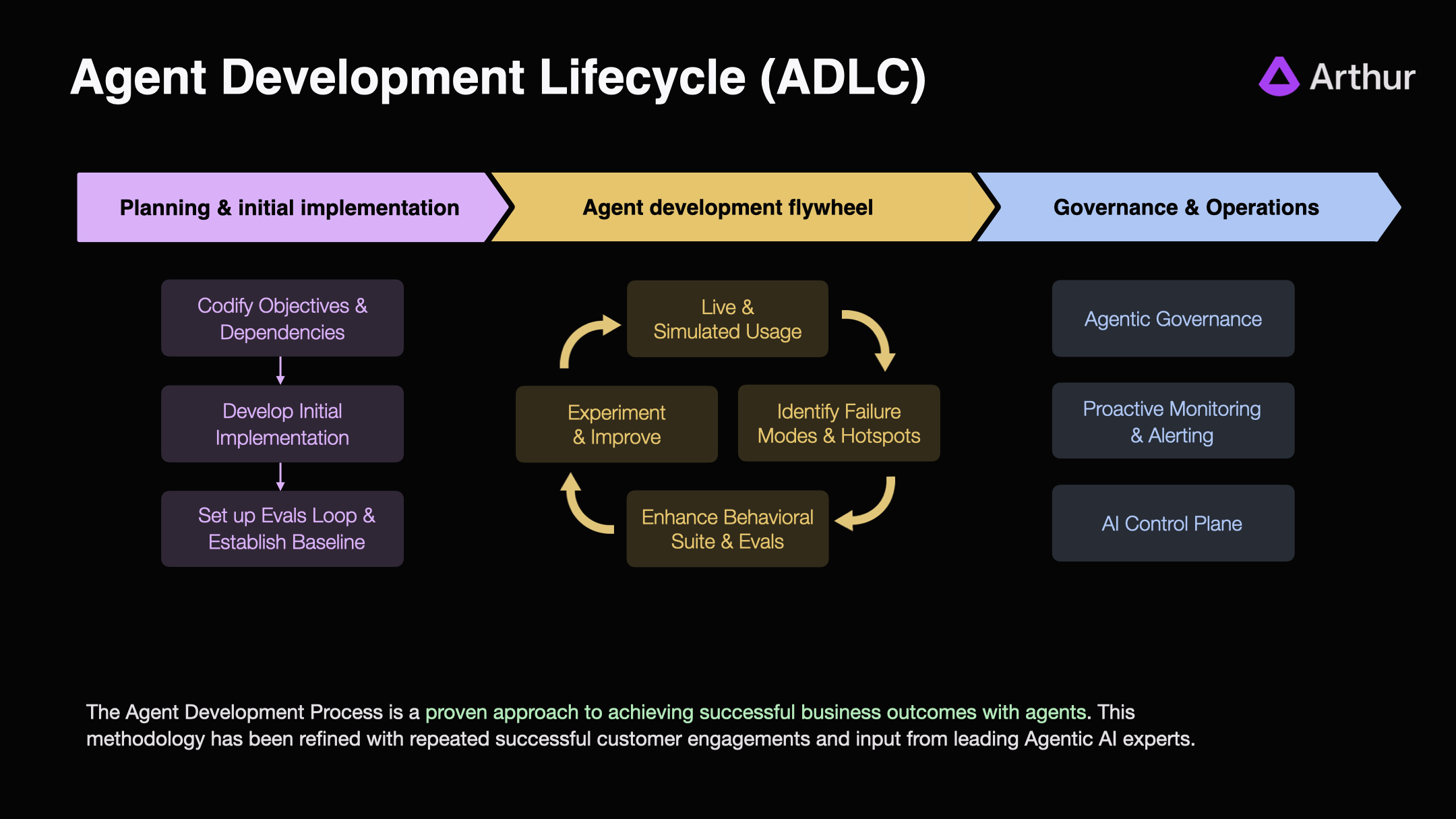
This "bolt-on" approach is inefficient and often ineffective. A far more powerful approach is to weave governance practices throughout the entire software development lifecycle (SDLC).
Building Responsible AI Best Practices Across the Product Development Lifecycle | Credo AI
Let's revisit the Credo AI talk to hear the argument for integrating responsible AI practices from day one.
Please watch the segment from integrating check-ins. The speaker makes a compelling case for shifting from a single, arduous review at the end of a project to a series of smaller, continuous assessments at every stage.
This idea of continuous, integrated assessment transforms RAI from a bureaucratic burden into a proactive cultural practice. It is a classic "shift left" strategy, applied to ethics and responsibility.
An Architect's Toolkit: RAI Patterns
So, how do you, as an architect, facilitate this shift? One of the most effective ways is by using a pattern-based approach, a concept you are very familiar with from software design. Patterns provide reusable, proven solutions to recurring problems.
Australia's national science agency, CSIRO, has developed an excellent "Responsible AI Pattern Catalogue" that does exactly this. It provides patterns at the governance, process, and product (architectural) levels.
Responsible AI Pattern Catalogue – Software Systems
This resource from CSIRO provides a practical, pattern-based toolkit for implementing RAI. It bridges the gap between high-level principles and concrete engineering practices.
Please review the following sections: First, read the Overview (this section) to understand the philosophy behind using patterns for RAI. Next, focus on the Process Patterns section (found here). Examine Figure 4, which maps ethical risks to the familiar stages of the SDLC. This provides a direct, actionable link between RAI concerns and your team's existing workflow. Finally, skim the Product Patterns section (this part). Look at Figure 8, the "Pattern-oriented responsible-AI-by-design reference architecture." You don't need to memorize it, but appreciate it as a conceptual target: an architecture where responsibility is a core, designed-in feature.
This catalogue gives you a concrete toolkit. When a team is in the requirements phase, you can introduce patterns for "Ethical Risk and Impact Assessment." During the design phase, you can guide them with patterns for "Fairness-aware Design." By codifying best practices into patterns, you make responsible development systematic and repeatable.
Conclusion
In this lesson, we transitioned from managing technical complexity to embracing ethical responsibility. We established that responsible AI is not a peripheral concern but a core tenet of modern system architecture.
Key Takeaways:
- Architects are Custodians of Trust: Due to your position at the nexus of technology, business, and design, you play a pivotal role in ensuring AI systems are developed responsibly.
- Core Principles: The pillars of Responsible AI are Fairness (context-dependent parity), Transparency (beyond explainability to include documentation and disclosure), and Accountability (clear ownership and auditable processes).
- Governance is a System: Effective AI governance is a holistic, socio-technical system involving people, processes, and tools, not just a final compliance check.
- Integrate, Don't Gate: Responsible AI practices must be woven into every stage of the development lifecycle, shifting from a reactive, end-stage review to a proactive, continuous process.
- Patterns for Practice: A pattern-based approach provides a powerful toolkit for architects to translate abstract principles into concrete process and design guidance for development teams.
Preview of the Next Lesson:
We have established the foundational principles of RAI. Now, we will focus on one of the most critical mechanisms for achieving transparency and accountability: human oversight. In our next lesson, we will learn how to design human oversight mechanisms appropriate for different levels of AI autonomy in software workflows, turning the principle of accountability into a tangible architectural component.