Introduction
In our last lesson, we delved into the essential balancing acts of platform design, weighing standardization against flexibility and simplicity against feature richness. These are the foundational design principles for building a platform developers will want to use. Now, we'll translate those principles into a long-term, strategic plan. This lesson addresses the learning outcome: Create a prioritized roadmap for an internal platform that balances developer needs, technical debt, and strategic objectives.
A roadmap is far more than a feature list or a release schedule. It is a strategic communication tool that articulates the why behind your work, aligning your team, your developer-customers, and your leadership on a shared vision for the platform's evolution. For someone with your interest in the intersection of business and technology, you'll see the roadmap as an investment strategy for your organization's engineering resources, deciding where to place your bets to achieve the highest return.
The Three Pillars of a Platform Roadmap
A robust platform roadmap doesn't emerge from a vacuum. It is a synthesis of three distinct, and often competing, streams of input. Your primary task as an architect or platform leader is to weave these threads into a coherent strategy.
- Developer Needs (The "Pull"): This is the voice of your customer. It encompasses the pain points, frustrations, and desires of the developers who will use your platform. These needs pull the platform in the direction of immediate, tangible value delivery.
- Strategic Objectives (The "Push"): This is the voice of the business and its long-term technical vision. These are top-down goals that push the platform in a direction that supports future business capabilities, architectural health, or market ambitions.
- Technical Debt (The "Drag"): This is the weight of past decisions. It's the accumulated entropy in your systems that creates a drag on both developer productivity and strategic progress.
To truly understand the "pull" from developers, you must go beyond surveys and tickets. The most powerful insights come from direct experience.
Some Principles From Real World Internal Developer Platform Engineering • Russ Miles • GOTO 2024
In this segment of his talk, Russ Miles advocates for an experiment-driven approach rooted in understanding user stories.
Watch the clip from where he discusses the power of stories over abstract measurements. His concept of "gemba" — going to the place where work is done to feel the pain firsthand — is a crucial practice for gathering roadmap inputs. Pairing with a developer for a day can reveal more about platform friction than a dozen surveys.
Prioritization Frameworks: From Wishlist to Strategy
With a backlog full of developer requests, strategic initiatives, and tech debt tickets, the central challenge is prioritization. You cannot do everything at once, so you must have a logical framework for making trade-offs.
The Impact/Effort Matrix
A simple yet powerful tool for an initial sort of your initiatives is the impact/effort matrix. Given your extensive engineering background, you can likely estimate effort with reasonable accuracy, and your user research will inform the potential impact.

- Quick Wins (High Impact, Low Effort): These are your best friends. They build momentum, generate goodwill, and deliver immediate value. An example might be scripting a common manual task or improving the documentation for a confusing API.
- Big Projects (High Impact, High Effort): These are your major strategic bets, like migrating to a new CI/CD system or building a new service scaffolding tool. They require careful planning and should be broken down into smaller phases.
- Fill-in Jobs (Low Impact, Low Effort): These can be useful to tackle during lulls but should never take priority over more impactful work.
- Thankless Tasks (Low Impact, High Effort): Actively avoid these. They consume resources with little to show for it. If something falls here, question if it needs to be done at all.
The Investment Portfolio Approach
A more strategic method, appealing to an economic mindset, is to treat your roadmap as an investment portfolio. Instead of prioritizing item by item, you allocate your team's capacity as percentages. This forces a deliberate conversation about balance.
6 CTOs share 18 tips for balancing innovation with technical debt - SaaSiest
This article gathers practical advice from several CTOs. Charles Beaumont of TheyDo provides a particularly clear model for this portfolio approach.
Read the section by Charles Beaumont. Focus on his first tip, "Build a product investment strategy." His key insight is to pre-commit a percentage of resources and put everything on a single, unified roadmap. This prevents tech debt from perpetually losing the prioritization battle.
A common allocation might be:
- 60% on Strategic Initiatives & New Features: Directly addressing developer needs and business objectives (e.g., your "Big Projects").
- 20% on Paying Down Technical Debt: Proactively improving the health and maintainability of the platform.
- 20% on "Keeping the Lights On": Bug fixes, minor enhancements, and operational overhead.
This allocation isn't fixed; it should be adapted based on the maturity of your platform and the current state of your technical debt.
A Deeper Dive into Technical Debt
As an experienced engineer, you know that "technical debt" is an overloaded term. To prioritize it effectively, you first need to classify it.
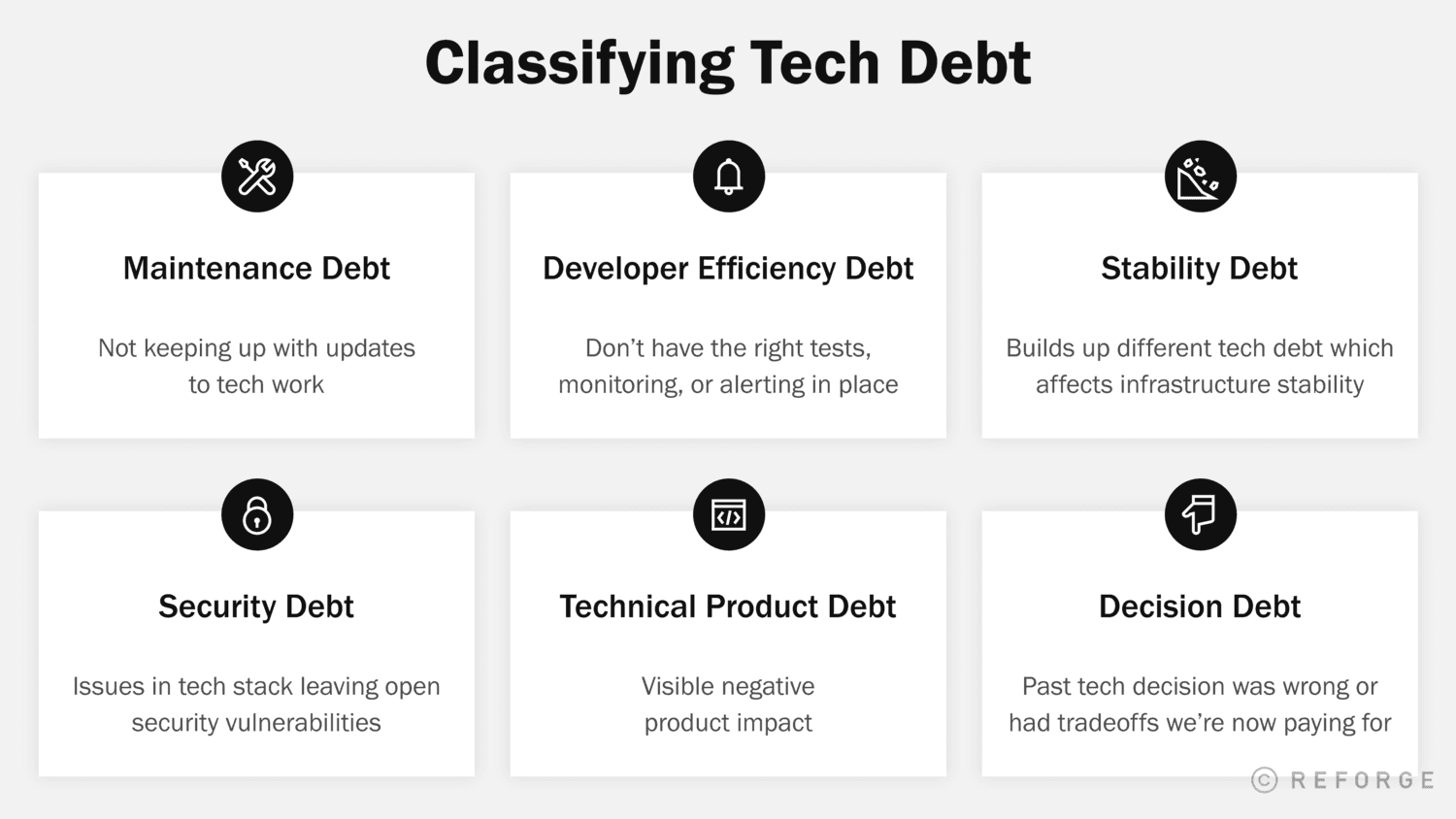
This classification helps you articulate the cost of the debt. Is it slowing developers down (Developer Efficiency Debt)? Is it creating production risk (Stability Debt)? Or is it a poor decision from the past that needs correction (Decision Debt)?
Once classified, you can prioritize debt based on its impact, not just its technical severity.
6 CTOs share 18 tips for balancing innovation with technical debt - SaaSiest
Continuing with the same article, Freddy Bang, CTO of Zensai, offers a pragmatic framework for prioritizing debt.
Read the section by Freddy Bang. His first point, "Make Technical Debt Visible and Prioritize by Impact," is crucial. He suggests categorizing debt by its effect on Customer Experience, Developer Experience, and Business Value. This reframes debt from a purely technical problem to a business problem.
Combining these ideas, you can create a clear prioritization hierarchy for debt:
- Security & Stability Debt: Anything that poses an active risk to the business or its customers is top priority.
- Developer Efficiency Debt: Debt that directly slows down development (e.g., slow build times, flaky tests) has a high ROI to fix, as it frees up time for innovation.
- Strategic Debt: Debt that prevents you from pursuing a key business or architectural objective. As Rikard Birath notes in the same article, you should "Prioritise technical debt to unlock Innovation."
- Maintenance & 'Nice-to-have' Debt: This can be addressed opportunistically, following Maria Hall's advice to "fix what you touch."
Structuring and Communicating Your Roadmap
A prioritized list is not a roadmap. To be an effective communication tool, it needs a narrative structure.
Structure: Now, Next, Later
Avoid committing to specific delivery dates months in the future. They are almost always wrong and create the wrong focus. Instead, use a rolling three-horizon structure:
- Now: What the team is actively working on in the current development cycle (e.g., the next 2-6 weeks). This section should have high detail and clear scope.
- Next: What's coming up in the medium term (e.g., the next quarter). These items are well-defined, and you have high confidence they are the right priorities, but the detailed implementation may still be flexible.
- Later: What's on the horizon for the long term (e.g., 6-12 months out). This section is about strategic direction. It contains ideas and larger initiatives that you intend to pursue, but they are subject to change as you learn more.
Theming: Telling a Story
Group individual work items under larger strategic themes. This elevates the conversation from features to outcomes.
| Bad (Feature List) | Good (Themed Roadmap) |
|---|---|
| * Implement new logging library | Theme: Improve System Observability |
| * Build a metrics dashboard | * Now: Standardize structured logging across services. |
| * Set up distributed tracing | * Next: Launch a self-service metrics dashboard. |
| * Later: Pilot distributed tracing for critical services. |
This thematic approach makes the why immediately obvious and connects the work directly to strategic objectives.
Linking to Value
Finally, every major initiative on your roadmap should explicitly state which pillar it supports. This reinforces the logic of your prioritization and helps justify the investment to stakeholders.
For example, when presenting your roadmap, you can frame it like this:
"In the 'Next' horizon, under the theme 'Accelerate Time-to-Market', we are prioritizing the creation of a new service template. This is a 'Big Project' that directly addresses our strategic objective of reducing concept-to-cash time, while also tackling significant Developer Efficiency Debt and fulfilling a top-requested need from our developer user research."
This connects the work to business value, technical health, and user satisfaction simultaneously.
How to set up an Internal Developer Platform: An implementation guide
This guide from PlatformEngineering.org provides a structured approach for an MVP, which can serve as the "Now" and "Next" portions of your initial roadmap.
Skim the description of Phase 4, which explicitly includes "roadmap planning." Then, read the section Scaling beyond your MVP. This reinforces the idea that the roadmap is a living document that evolves from the initial MVP to a plan for hardening capabilities and scaling the team.
Conclusion
You have now learned how to transform a collection of requests, goals, and problems into a coherent, prioritized, and defensible platform roadmap. This process is a cornerstone of effective platform leadership, blending technical insight with business strategy.
Key Takeaways:
- Balance the Three Pillars: Your roadmap must strike a balance between developer needs (pull), strategic objectives (push), and technical debt (drag).
- Prioritize with Frameworks: Use tools like the Impact/Effort matrix for quick sorting and an Investment Portfolio approach (e.g., 60/20/20 split) for strategic allocation.
- Treat Debt Strategically: Classify technical debt by its nature and prioritize it based on its impact on security, stability, developer efficiency, and strategic goals.
- Communicate with a Narrative: Structure your roadmap using themes and a Now/Next/Later horizon to tell a story about the value you are creating, rather than just listing features.
Preview of the Next Lesson
Creating a brilliant roadmap is only half the battle. Its value is only realized when developers adopt the platform and the business sees the return on investment. In our next lesson, we will begin Module 7, "Driving Platform Adoption," starting with how to define qualitative and quantitative metrics to measure platform adoption and developer satisfaction. You'll learn how to prove that your strategic roadmap is delivering on its promises.